Tabletop Storygames: Monsterhearts

title-postcard

Monsterhearts is a story game set in a high school, albeit a high school attended by vampires, werewolves, and other creatures of strange powers. And it’s less about their monstrosity per se than it is about interpersonal confusions. (At one point, my character, a wiccan able to conjure up visions, had to try to explain birth control and teenage dating customs to her boarding school roommate, a werewolf who had grown up feral.) The game comes with a set of “skins” — different preset monster types you can be for the duration — and each monster naturally has its own powers and abilities.

The mechanics of the game emphasize the fact that characters know themselves incompletely and control themselves even less. Everyone has a “darkest self”, a side to their personality that can be triggered if things go sufficiently wrong, in which they’ll be motivated to do antisocial or outright evil things. It’s possible for any character (on winning a roll) to turn on any other: sexual attraction is not entirely at the discretion of that character, though no one else controls how the character reacts to being attracted.

Continue reading “Tabletop Storygames: Monsterhearts”

Hide&Seek: Tiny Games Kickstarter

Screen Shot 2013-04-09 at 3.35.17 PM

Tiny Games is a Kickstarter-funded app offering rulesets for dozens and dozens of short, simple games, designed for a variety of social situations: games to play at the the pub, on the train, in your living room. Hide&Seek has years of experience doing installation-style games at museums and festivals, including the very cool Searchlight game demonstrated at the GDC Experimental Games Workshop this year. The Tiny Games collection includes work by a long list of well-known experimental game designers.

I’ve enjoyed all the Hide&Seek work I’ve encountered, and I especially like the playfulness of this concept, as a source of social lubrication and fun when no one happens to have a pack of cards or wants to commit to a playthrough of Arkham Horror. Or you just want to do something new.

There are only a couple of days left on this project and it’s still shy of its funding goal, so if it sounds like something you might be interested in, check it out.

Tabletop Storygames: Shooting the Moon

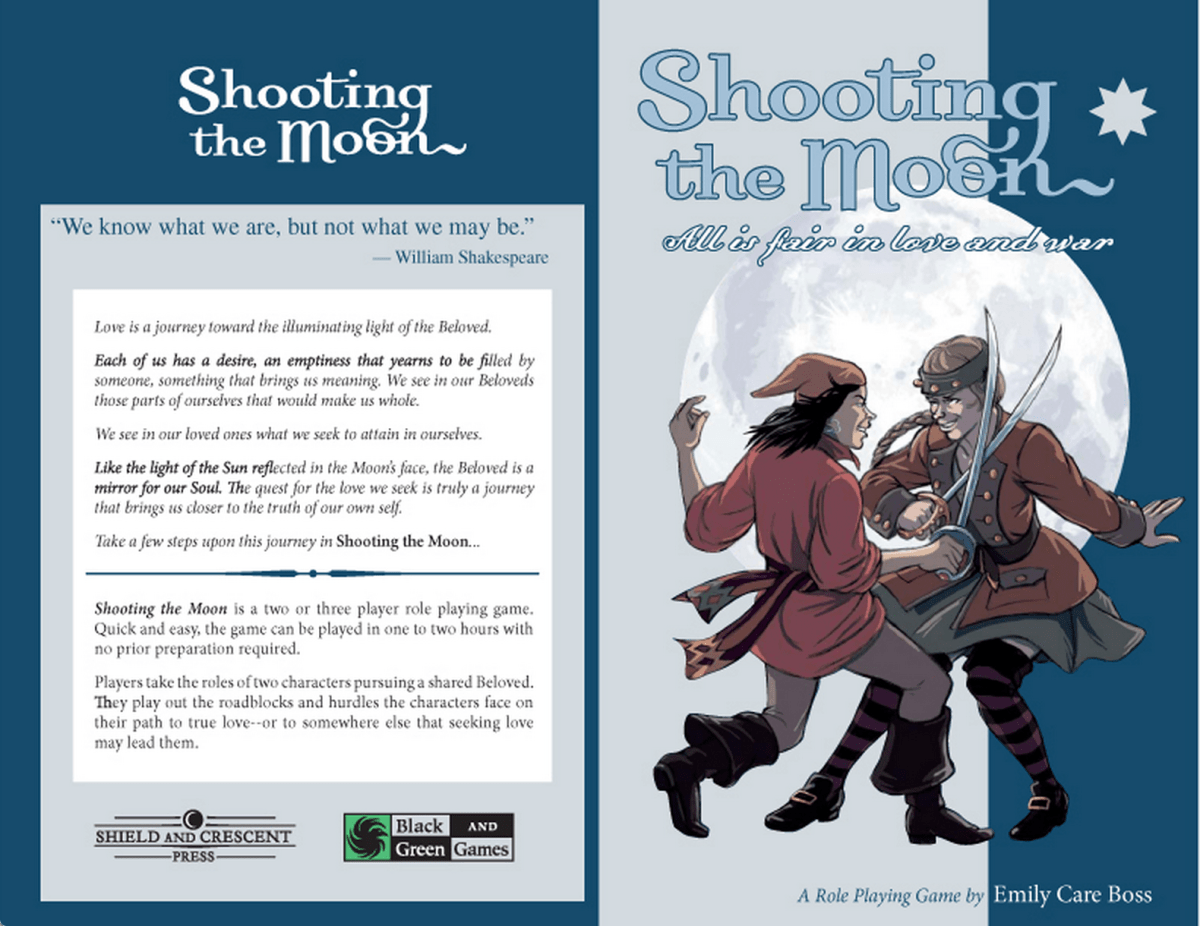
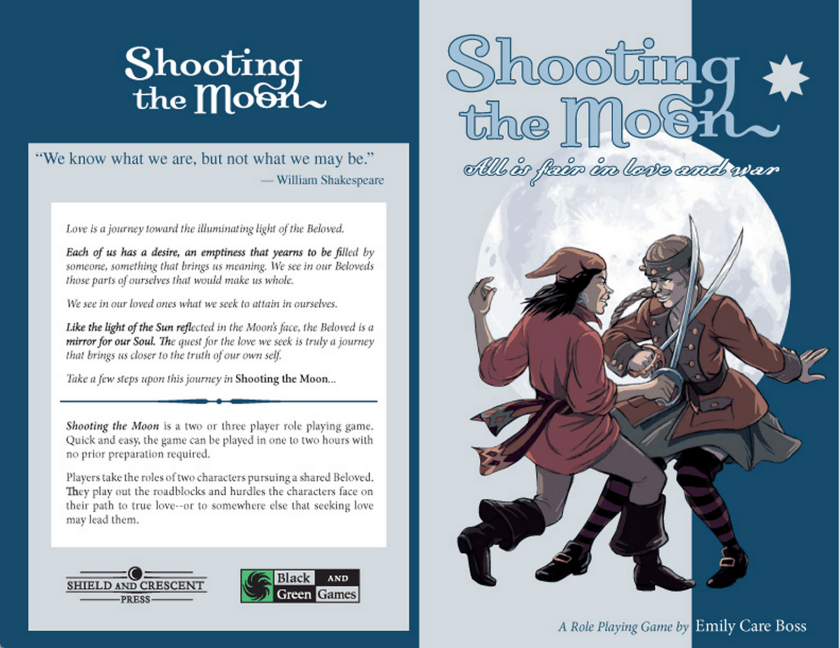
Shooting the Moon is a tabletop storygame about a romantic triangle, which I first heard of on Sam Kabo Ashwell’s recommendation (and indeed played with Sam). The two suitor characters compete to get something (probably love and affection, but conceivably something else) from the third, “beloved” character.

Continue reading “Tabletop Storygames: Shooting the Moon”

San Tilapian Studies (a casual narrative entertainment for 30-40 players)

Last week I had a party for about forty friends, many of whom didn’t already know each other but most of whom know me through some sort of game or story-related interest. A few others were people I thought didn’t know much about storygaming of any kind, but might enjoy an accessible, casual taster.

So I put together a small narrative game for the occasion. The design goals were to create something that would get people talking to strangers; that would take just a few minutes to participate in, but let people invest more time if they wanted to; that was playable even if you had a plate of food in one hand; that wouldn’t be ruined if some people arrived late or weren’t into playing; and that would produce a souvenir after the party.

The result of this project was San Tilapian Studies.

Continue reading “San Tilapian Studies (a casual narrative entertainment for 30-40 players)”

Tabletop Storygaming: A Penny For My Thoughts

A Penny For My Thoughts is a short storytelling game about trauma and lost memory. The premise is that the three players are all victims of some disastrous experience that caused them to lose their memories. Thanks to a special mind-enhancing drug, they are able to access fragments of those past events — both their own and one another’s.

To begin, each player writes down on a card three visceral experiences or sense impressions: in ours, these were things like “the smell of rotting lemons” or “vertigo.” Then the players take turns rebuilding past memories for their characters. Each draws a card from the shuffled stack and says, for instance, “I remember the smell of rotting lemons.” The other two players take turns asking establishing questions, such as “Were the lemons from a lemonade stand?” and the player who is doing the recollection must — in good improv style — reply, “yes, and…”, accepting the offer and providing an additional detail of his or her own.

Continue reading “Tabletop Storygaming: A Penny For My Thoughts”

Tabletop Storygaming: The Shab-al-hiri Roach

Thursday night’s storygame was The Shab-al-hiri Roach, which I’ve wanted to try for ages. The premise is that the player characters are all academics striving for power and status in a small but prestigious college somewhere in New England in 1919. Introduced into their midst is an uncanny archaeological discovery, the eponymous roach, which represents a Sumerian cockroach deity of deep and sinister powers.

At any point during the game, the players can choose (or be forced) to “swallow the roach,” thereby gaining power, but also making themselves subject to the roach’s commands. These commands come from a deck of cards: during each of six acts, the players draw to discover a task they have to complete this act, with different tasks depending on whether they currently have the roach. The deck of cards can also make players possessed, or give them the opportunity to be freed from possession. No one can win while roach-possessed, so there’s a trick of allowing yourself to be possessed and then get rid of the roach again — which may or may not work.

Our play session was pretty successful from moment to moment. Having the goal from the card provided some goals for players trying to frame scenes; and there’s nothing like speaking some guttural faux-Sumerian to unlock one’s hammier acting. I had a really good time playing.

But I didn’t feel that the mechanics produced a very coherent arc story. In particular, when a player’s attempt failed (the theft of some pygmy bones from a museum, for instance), the failure was pretty final and didn’t really allow for interesting ramifications afterward; so there were a fair few storylines that were developed and then dropped again immediately, forcing players to come up with new schemes instead. Another difficulty was that the setting and situation tended to encourage a lot of the same kind of action: Player character A saying nasty things about player character B to university authority C. (Or maybe it was just us?)

Also, it was definitely the most fiddly with dice of the storygames I’ve tried so far, with each resolution requiring a certain amount of discussion between players about which dice to roll (“is this a power/status roll or not? do we think my enthusiasm for gossip counts here?” etc.).

Still. I had fun with it and want to play more, as I really liked the setting and core concept.