End of August Links

Events

September 1. The yearly IF Comp is now accepting submissions for this fall. If you intend to enter, you should indicate that by September 1 (so tomorrow — though I imagine most people who are planning to enter will already have sent in their intent).

Sept 2, the San Francisco Bay Area IF Meetup gets together in person.

IntroComp, the very long running competition for just the beginnings of interactive fiction games, is currently running. Entries are available to play, and votes are due September 8.

Sept 17. The Seattle IF Meetup is getting together to play and discuss my multiplayer IF game Aspel. Because the game is hard to play without fellow players, this may be an unusual opportunity to check it out, if you’ve not been able to.

November 4-5, the convention AdventureX is running in London. It’s friendly to many types of narrative game.

Elite Status: Platinum Concierge

Long ago, I started a game for Choice of Games, then titled Platinum Package. When I started it, it was a lighthearted, slightly satirical piece about the world of luxury services and interactions with the wealthy.

Writing it during the period of 2015-2019, though, I found that my own attitudes about wealth shifted to be significantly more critical, and I found myself writing more and more about the challenges of human connection in a world where resources and opportunities are so unequally distributed.

It was always a part-time project, running alongside whatever other work I was doing, and my day jobs were becoming ever more demanding. At a certain point, I realised that I was not sure when (if ever) I would have enough time to work on it further, and that my thematic concerns were pulling it further from being the lighthearted game I originally pitched to CoG. I discussed the issue with them, and they kindly offered an option I hadn’t considered: to involve another, experienced CoG author to finish the game off and bring certain aspects of it back in line with the brand. To do that, they brought in Hannah Powell-Smith, who has written a number of well-received CoG games of their own. They did a lovely job of revising the project, and I’m grateful to Hannah and to CoG for rescuing it.

Elite Status is now available to play. Players have noted that it’s a bit different from the typical Choice of Games piece: it’s not a power fantasy, and while there are romance elements, that is a relatively light aspect of the story. Also, several NPCs have their own preferences and will not be open to dating all possible player characters.

Elite Status also does something a bit experimental, structurally: after chapter 6, the game branches widely and doesn’t come back together until the epilogue sequences; and it chooses its final crisis on the basis of the player’s engagement with particular characters and themes. (When I was first planning the game eons ago, Choice of Robots was one of CoG’s best-regarded pieces, and it branches very widely at that stage too — but not for the same reasons.)

I believe the most difficult of these later game sequences to reach — but also perhaps my favourite from a writing perspective — involves having a strong relationship with your colleague Felix/Felicity, and finding out more of what has happened in their life. If you happen to be hunting for that outcome yourself, try cultivating their friendship; skewing populist and practical but not strong on brand awareness or reputation; choosing a character motivation focused on your own family or financial insecurity; and not being too close to MJ or Ax.

Other Recent or Semi-Recent Releases

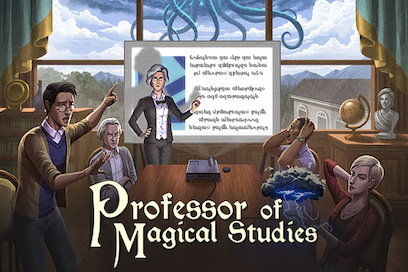
Long-time IF author Stephen Granade also recently(ish) released a Choice of Games project, Professor of Magical Studies:

You are a practitioner of pattern magic: an arcane art that allows you to reshape the very nature of reality, with an extra advantage thanks to your synesthesia, which enables you to see patterns more clearly. With a few strokes of a pen on paper, you can draw magical energy from the space between universes to do everything from levitating objects to preserving memories that you can walk through later to creating pocket dimensions.

You’ve just been hired for your first faculty position at Winfield Phillips, the seemingly normal New England college that happens to have a secret magic department. It’s a great first job, or would be except for Darcy Bozeman. Your former school friend used magic to cheat you out of a coveted fellowship, almost derailing your academic career before it began. Now Darcy’s a fellow professor at Winfield Phillips, and is still working to undermine you.

I’ve not yet had a chance to try it out, but player responses rave about the cool magic system and fun romance developments.

*

Fans of the Marino Family’s Mrs Wobbles series may like to know that there’s a new story available and a new format for reading it as well: called UnBoxing, it’s available as an ePub.

If you’re not familiar with them, this guest review by Lucian Smith offers a better thematic introduction than I could: they are interactive stories of fostering and adoption, told by a family who knows that experience from the inside.

*

Already available on mobile devices and coming soon to Steam, Escape from Norwood is a text game with active NPCs who will carry on acting when you’re not doing anything, as well as supporting maps and illustrations. The game’s tagline bills it as “the depth of a classic text adventure with a modern UI”, and the Steam release also supports screen-readers.

*

ParserComp is a competition for parser text adventure games specifically. It ran through the beginning of August this year: it’s too late to vote if you missed that, but if you’d like to check out the results and try some parser-based games, they can be found on itch.io.

Meanwhile, the Single Choice Jam collected games where there was only one meaningful choice presented to the player — an intriguing formal exercise.

And not a new work but an old one: Consider the Consequences, thought to be the first choose-your-own-adventure-style book ever published, is now archived online.

Articles and Reviews

The Rosebush is a web-based magazine for interviews and articles about interactive fiction. It is fairly new, but already features an interview with author Autumn Chen; an article on gender in the 1990s text adventure Christminster; and a piece by Mike Russo on games that use a limited verb set, whether that’s implemented as a limited-verb parser game or as a choice-based game with unusually systemic underpinnings. (Back in 2016 I wrote an article for IF Only about limited-verb parser games; it’s fun to see what’s become of that genre since.)

Tools

Dendry is one of the cooler tools out there for people interested in storylet interactive fiction. It draws heavily on the design of Varytale, but is open source and available to install locally. It’s Dendry that allowed several of us (with thanks to Ian Millington and Autumn Chen) to get my older game Bee working again.

It has, however, been somewhat challenging for people to get up and running on their own, because instead of being a tool available on a webpage, it expects a command-line user comfortable with installing code from Github. The good news: there is now a new tutorial that walks a new user through the process and teaches a first few beats of design with the tool.

Meanwhile, if you’d rather try some storylet work with a more familiar and widely supported language, Ian Thomas has also released an Ink/Unity framework for storylets.

Fundraising

The Colossal Fund raises money every year, partly to fund prizes for IF Competition winners and partly to pay for the activities of the IF Technology Foundation. If you’d like to contribute, you can do so here.

Status

I’ve been unusually quiet lately and not even following my usual link assortment schedule – apologies for that, especially to people who’ve sent me interesting links lately. I do mean to resume in time, but have needed to set even this aside for a little while. The end of last year was rough; I lost a couple of people close to me, one of them very unexpectedly and much too young. And work-wise, I’ve been deep in finishing Mask of the Rose.

However! I will be speaking at GDC, in person this time, and I expect to be more present here again once Mask launches.

End of October Link Assortment

Events

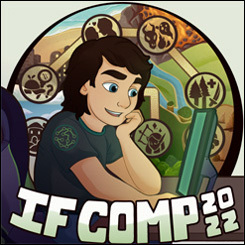
Promotional art for the IF Comp. It shows a person in a green t-shirt apparently playing a text-based game, with a background of images suggesting an adventure. The bottom of the image reads IF Comp 2022.

IF Comp is still running, now through November 15. There are lots of games to play; you need only vote on five to participate as a judge in the competition. (Though you’re very welcome to vote on more than five, of course!)

And as if the bounty of IF Comp were not enough, October also always sees EctoComp, for spooky Halloween games. It’s run as a jam on itch.io; games are available from Oct 31. EctoComp invites games in English, French, and Spanish.

Tomorrow, November 1, the Oxford/London IF Meetup is playing through some of those Comp games together online.

November 12 is the next meeting of the SF Bay Area IF Group.

December 1 is the opening of the Winter TADS jam for games written in the TADS language.

And a note: I do my best to pull together events people announce publicly in certain spaces, or things that they email me about – but I don’t always get everything, and my time for blog maintenance also varies a bit from month to month. However! There is now a calendar section on ifwiki, which you can check out or add to.

I’m not planning to stop mentioning events on my blog, but the ifwiki calendar is a useful place to go if you’d like to make something known to the IF-playing public. You can also post about things in the Events section on the intfiction forum.

Other Releases

The Marino family has a long-running series of Undum stories about Mrs Wobbles and the Tangerine House, which takes a fantasy perspective on the experiences of children with foster homes and adoption. Lucian Smith wrote a lovely review of one of the previous episodes that spoke to this theme in some depth.

The eighth(!) entry in that series, “Action Figures”, is live today.

Work

UC Santa Cruz is hiring an Assistant or Associate Professor of Computational Media:

While this is not a position focused on teaching frameworks/engines or programming (which are covered elsewhere in the curriculum) an understanding of processes and tools used to create computational media work is desired.

The successful candidate will develop and teach courses within the graduate and undergraduate curriculum; continue their work in creative, technical, and/or scholarly practices of computational media; and participate in shaping our diverse, interdisciplinary department. 


Mid-October Link Assortment

Promotional art for IF Comp. It portrays a person in a green shirt looking at a computer screen, with imagery suggesting different types of adventure. The words IF COMP 2022 appear at the bottom.

IF Comp is currently in full swing. This annual competition has been running now for nearly three decades, and continues to showcase interesting new work in the field.

The IF Comp website has gotten some sweet upgrades to help judges find the games they’ll like the most: you can have the website serve you a personally randomised list (to help distribute judges and avoid situations where games by well-known authors or those at the top of the alphabetical list get way more attention). Alternatively, you can set filters and look only for, say, parser-based games with an expected play time of half an hour.

If you’d like to judge, you need to submit scores on at least five games (out of the total of 71).

If you’d like to get a sense of what’s in the mix before diving in, you might check out reviews by other players – one of the cool things about the IF Comp is that it has a very long tradition of in-depth reviews, shared on the intfiction.org forums, on IFDB, or on private blogs.

The Short Game podcast also provides coverage of the comp games, often over the course of several episodes.

This year the comp is looking to draw in more judges, more discussion, and more attention from the wider world – so please do join in if this sounds appealing, and let your friends know as well.

Other Events

October 21October 28 is the AI and Games Jam, which is for games built using AI techniques, and organised by Tommy Thompson of the AI and Games Youtube channel (which I also recommend). Text-based and PCG games are welcome:

What do you mean AI? If you’re implementing artificial intelligence of any kind, be it for decision making, pathfinding, character behaviour, player modelling, level generation, animation, you name it.  It can be as simple or as complicated as you like.  You can use classic/symbolic AI or machine learning as well.   Submissions are not judged on the complexity of the AI implemented.

So PCG as well? Yup, procedural generation for levels, art, characters etc. is relevant.

Roguelike Celebration is coming up October 22-23, and will be running online: this is often a great place for talks about procedurally generated content. Not all of it is necessarily narrative-heavy, but typically at least some is interesting to interactive story folks.

The next People’s Republic of IF meeting will be online, October 25.

October 26, the Unnamed IF Bookclub will meet to discuss IF Comp games.

And as if the bounty of IF Comp were not enough, October also always sees EctoComp, for spooky Halloween games. It’s run as a jam on itch.io, and is open to new submissions through October 31; then the games will be available to play. EctoComp invites games in English, French, and Spanish.

November 12 is the next meeting of the SF Bay Area IF Group.

And a note: I do my best to pull together events people announce publicly in certain spaces, or things that they email me about – but I don’t always get everything, and my time for blog maintenance also varies a bit from month to month. However! There is now a calendar section on ifwiki, which you can check out or add to.

I’m not planning to stop mentioning events on my blog, but the ifwiki calendar is a useful place to go if you’d like to make something known to the IF-playing public. You can also post about things in the Events section on the intfiction forum.

Articles and Talks

From my Failbetter colleague Chris Gardiner, here’s a narrative postmortem on Sunless Skies, offering a deep dive on what was required to make that project work.

End of September Link Assortment

Events

The SF Bay IF Meetup will convene again on October 1. This will be a hybrid event, so you can attend in person if you’re in the area, or online if you aren’t.

IF Comp games are also scheduled to become available tomorrow, October 1. This annual competition has been running now for nearly three decades, and continues to showcase interesting new work in the field. Judging is open to anyone able to submit scores on at least five games.

In a change of rules, authors may participate in rating other games, as long as they refrain from rating their own submissions.

October 9 is the next Seattle IF Meetup, which will again be held via Discord.

October 11, Dan Hett is running a free introduction to writing interactive fiction in Stockport (outside Manchester). Hett’s IF Closed Hands was nominated in 2022 for an IGF narrative award.

Roguelike Celebration is coming up October 22-23, and will be running online: this is often a great place for talks about procedurally generated content. Not all of it is necessarily narrative-heavy, but typically at least some is interesting to interactive story folks.

Articles and Talks

Here’s a Guardian article that does a deep dive on the Discworld MUD.

Meanwhile, GDC has published Jon Ingold’s talk on the detective mechanics on Overboard! – if you missed Jon’s presentation to the London IF Meetup, you might like to watch this instead.

Joey Jones has an academic article forthcoming on how IF authors manage the complexity of their work, and a preprint verison is available free online.

Mid-September Link Assortment

Events

Interactive Fiction Club Jam opened August 26 and is running through tomorrow, September 16. It’s open to IF of any genre, as long as it’s safe for work.

September 18 is the next meeting of the Seattle IF group.

September 27 is the next meeting of the Boston/Cambridge PR-IF group; this meeting will be remote, so people are welcome to join from a distance.

IFComp games are due September 28 – though authors should already be registered to participate. It’s also a good time for contributing to the prize pool, if you’re so inclined.

If the Interactive Fiction Club Jam’s deadline is (very reasonably) too soon for you, Interactive Fiction Jam #2 is currently running through the end of September. This jam welcomes several genres of story-focused game; a Halloween theme is recommended but not required. Authors may use a tool of their choice, as long as the resulting game is playable on Windows.

The SF Bay IF Meetup will convene again on October 1. This will be a hybrid event, so you can attend in person if you’re in the area, or online if you aren’t.

Roguelike Celebration is coming up October 22-23, and will be running online: this is often a great place for talks about procedurally generated content. Not all of it is necessarily narrative-heavy, but typically at least some is interesting to interactive story folks.

Talks and Articles

Cardboard Computer’s Patreon is offering a series of workshops, with past episodes visible to watch on YouTube. The first workshops in the series dig into questions of what it means to write or program, approaches to existing tools, and processes in developing new design systems.

Meanwhile, Jacob Garbe offers an article, condensed from his dissertation (and based on quite a bit of real-world experience), on how to manage scope on dynamic narrative projects. I suspect many readers of this blog will be interested in projects like these:

games driven by deeply reactive character dialogue, system-driven games whose narrative is closely tied to game mechanics, open world games whose narrative deeply responds to player actions / game state, and much more!

…and sympathise with issues like this:

Creating content for dynamic narratives, compared to static ones, comes with some design challenges that often make shipping games with them difficult or infeasible. Many times the task of solving these problems falls on narrative designers and writers. And when they can’t move mountains, things get cut…

Games

Since last roundup, I released an updated version of my 2012 game Bee, and also did a post about the process of revising it for this release.

That process was only possible because of help from Autumn Chen. Autumn has extended the Dendry toolset, an open source tool for writing games like Bee that rely on storylets; and the Dendry source for Bee is available through her Github as well.

Autumn has also written a couple of games of her own with Dendry. Pageant tells the story of a Chinese-American girl who is struggling with the final years of high school, college applications, and her parents’ insistence that she enter a beauty pageant in order to make herself stand out to the MIT admissions board. I found it fascinating to play because it shares some structural features with Bee – and a similar interest in balancing academic success with other goals – but portrays a different family, culture, and texture of life.


Screenshot of Curious Fishing, showing a level with pixel art seaweed and squid.
A screenshot from Curious Fishing

Speaking of memoir narratives: fans of freeware puzzle games may enjoy Curious Fishing by Connor Halford, and perhaps also like his detailed dev diaries.

…and a screenshot from WIP, a playable short memoir about developing Curious Fishing

I heard of this game because Connor is a coworker; it really pulled me in when I tried, as a lovely, elegant piece of puzzle design. All of the puzzles are written with specific playability and accessibility constraints in mind.

If you’re only here for narrative games, though, check this Bitsy piece about the making of Curious Fishing. I liked the way it uses space to narrative effect, and the way it blends real world spaces with explorable re-renderings of the gameplay space.