I have a problem with my iPhone game playing. There are the games I think I ought to want to play on the iPhone, like the special edition of Secret of Monkey Island, or Beneath a Steel Sky — games I want to play in general, that I’m pretty sure I would enjoy, and that happen to be pleasantly cheap and portable in this format.
But that’s not what I actually play. The time I spend gaming with my iPhone is usually unpredictable snippets on buses and trains. In which case I don’t want something with a continuous plot; I want something I can pick up and put down again after any stretch of play I choose. I’ve had them around for months, but the games I most consistently go back and play more of are Jigami and 7 Cities.
 So my recent downloads have been more in the same line. I got a free review copy of Blackout!, which has the misfortune of looking something like a Bejeweled clone in screenshots. It isn’t — you’re eliminating elements as in a match-3 game, but in a more sophisticated way that involves selecting a detonator and then drawing a (possibly crooked) line through the matching gems you want to get rid of. This is all in aid of affecting the underlying board: when you detonate a series of gems, that explodes a channel in the board beneath, which allows light to flow from sources to sinks.
The graphics are very polished and the gameplay is more subtle than I expected it to be. At the same time, I find it slightly frustrating in ways that make it less addictive. For one thing, in the interests of complexity, they’ve made the game board large — larger than you can see on your screen at once. That means a lot of scrolling around to find the light sources and the sinks you want to connect them to; it also means it can be hard to wrap your mind around a strategy for the board as a whole, especially in later levels where there are an increasing number of barriers and special objects to deal with.
For another, each level is on a timer, and as you get close to running out of time, the area you can see is vignetted by darkness, giving you a smaller and smaller effective area of vision — which means more and more desperate scrolling.
Still, I’m having some fun with it, and it looks really pretty, so I do return to it from time to time.
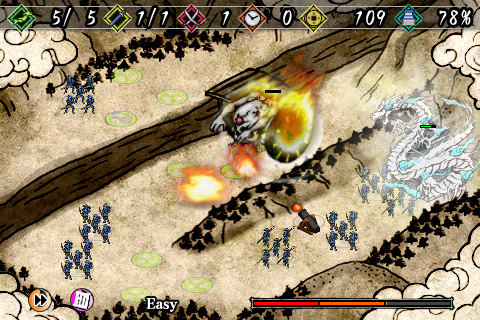 I also bought a copy of Mikado Defenders. It’s a tower defense game, a genre I generally enjoy, and it comes with a tasty wrapper of Japanese art style and setting. Thing is, unfortunately, the gameplay isn’t really working for me so far: the waves of enemies come on slowly, so it’s easy to get bored, and the board is small enough that if the enemies are doing really well, there’s not much opportunity to add last-ditch defenders near the goal. Maybe I haven’t found the ideal settings for it yet. This is sad to me, because I have killed a lot of otherwise boring time with 7 Cities but have reached a point with it where I can survive for more or less indefinite periods in survival mode, so I was looking for a new iPhone TD game.
My experience with what I play (and therefore what I’m willing to buy more of) does make me doubt whether targeting IF to phones is really a useful way to go. It might be; it might be that we haven’t done a good enough job of putting the games out there, but they’d be well-received if we did.
On the other hand, I just can’t imagine getting all the way through even a moderate-length game in this format. And the form factor (in my opinion) sabotages a lot of the strengths of IF.
 Emily Short's Interactive Storytelling
Regarding your concerns about form factor, picture this: The interpreter is full-screen, in landscape mode. In “prompt” mode, it acts like a normal interpreter, and responses are provided interleaved with your actions, in the line after your prompt. Perhaps we have 5 or so lines of text here at a nice readable font size.
If a response to your action is more than a line or two long (as many may be) then we switch to “long-form” mode, where we break the response into paragraphs, and we display one paragraph on-screen at a time. Tap the screen when you’re ready to see the next paragraph. (If paragraphs are too long, perhaps we scroll.) When you’re done reading the response, it clears the screen and puts you back into prompt mode.
This sounds like it would be reasonable to me. Do you think so? The Achilles’ heel of this approach would be if you found yourself frequently scrolling up to examine prior responses and narrative, but I don’t do so often. Other than that, it sounds like it would be tolerable.
Of course, it’s a good point that phones lend themselves to quicker games where you can bite off a chunk at a time. And the right answer is just to put IF on e-readers and iPads instead.
The form factor you suggest would work perfectly well on a G1 or a Droid, both of which have physical keyboards. I like my G1’s physical keyboard, but then, before it I had a Treo and a Palm Tungsten C, on which I played IF quite happily. The keyboard/live display ratio for on-screen keyboards (iPhone, Nexus One, etc.) seems the major hitch, not the phone / short-term play aspect….
Surely now that Plants vs Zombies is on iPhone, all other tower defense games are rendered meaningless? ;)
I’ve had several point and click adventure games sitting unplayed on my iPhone too. But since I got my iPad, I’ve hardly played anything else.
I played Photopia via Twisty over the weekend on my HTC Desire (Android). It was a wonderful way to pass a train journey. I loved the different pace from playing a more action-oriented game, so I could relax and take in the scenery while playing.
It’s also a game I’d meant to play for ages now, but I never got around to on the desktop due to other distractions. Once I was alone with my phone, it was so easy to pop onto the marketplace and grab Twisty, download a copy of the .z5 and fire it up.
I guess what I’m saying is it’s horses for courses. I wouldn’t play IF in a 5 minute bus journey, but then I tend to spend those shorter intervals checking email, news feeds or Twitter anyway.
The dual-screen Nintendo DS would probably be a better experience for IF: put a keyboard on the lower screen, and the text on the upper.
But the cost of putting an interpreter on the DS would probably be prohibitive.
” The interpreter is full-screen, in landscape mode. In “prompt” mode, it acts like a normal interpreter, and responses are provided interleaved with your actions, in the line after your prompt. Perhaps we have 5 or so lines of text here at a nice readable font size.”
On the iPhone, at least, the problem is that the screen keyboard takes up too much space.
Agreed that the keyboard taking up valuable screen real-estate is a problem. It would be less so if the interpreter provided a font-size setting, since recent devices with higher DPI can fit much more on screen (only useful if you’ve got great eyesight though I suppose)
Most useful of all, however, would be a simple button or swipe gesture to toggle display of the keyboard when you’re at the prompt.
I’m not sure about the DS interpreter. The dual-screen is indeed ideal, but I find text input with the DS stylus a painfully slow process. Besides, it’s the “always available” aspect of phone apps that I enjoy. I don’t always plan far enough in advance to think of bringing a separate device along with me, but my phone is always in my pocket.
I’m pretty sure there is a DS interpreter, DS-Frotz.
gugusse.central.free.fr/papafuji/DSFrotz.html
I can relate: I installed Frotz on my iPhone along with several interesting-sounding IF stories and a few old Infocom classics I never finished as a kid, but have hardly touched (ha!) them. Like you, I find a much more consistent attraction to quick and “stateless” games like puzzlers and tower defense. The closest I’ve come to playing anything long-term on the phone has been with Handmark’s “Westward”, which I became quite addicted to (and am surprised hasn’t gotten a sequel, yet).
I don’t think the “problem” is technical, however, as some of the comments here suggest. The kinds of situations that lend themselves towards playing a game on your phone are simply different (usually) than those that would encourage playing long-form games. I don’t find the iPhone’s screen or keyboard particularly limiting for what would be required of IF, for example.
Basically, the world is giving us all shorter times-of-attention more than it’s giving us shorter attention spans.