 Coverage for Bender, from Introcomp 2011. Bender is a piece about a protagonist with some unusual (superheroic? magical?) abilities, forced to navigate a hostile environment. No real story spoilers to follow, just some discussion of the mechanics.
Like Chunky Blues, Bender draws immediate attention by introducing a new and transformative gameplay mechanic. In this case, it’s the protagonist’s ability to move walls around in order to help navigate a difficult environment and prevent an antagonist from traversing that space first. The result is a bit like a cross between the Royal Puzzle in Zork III, where the player has to push giant sandstone blocks around in order to reconfigure the area he’s in, and a Theseus and the Minotaur maze puzzle.
That’s an idea with some potential. I’m less convinced it’s an idea for a text game. There are syntax challenges. It turns out that BEND NORTH means “bend a random markered wall nearby so that that wall is to my north”, not “bend the wall that is currently already to my north so that it is elsewhere”; it’s not clear how the game would cope if the player were adjacent to multiple bendable walls. BEND NORTH WALL TO THE SOUTH (or similar) might work, but it’s a bit fiddly — a lot of typing to express a highly spatial idea that could more easily be handled with clicking or dragging something in a top-down graphical interface. There are also display challenges. The map of your surroundings is rendered with blocky colored sigils that are neither attractive nor easy to read. All in all, it doesn’t look or feel smooth to play, and I’m pretty sure there are additional interesting puzzles you could do with this mechanic if you were allowed more spatial specificity.
Meanwhile what text we are given is kept extremely utilitarian, save for the opening cut-scene. None of the room descriptions convinced me that I was benefiting from the power of prose.
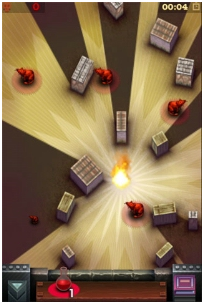
Unfortunately, Bender repeatedly crashed on me before I had gotten through the main puzzle, so I didn’t finish it out.
All told, this might be an interesting multi-level puzzle game with a framing narrative, perhaps with the story advancing in different ways depending on how the player solved the puzzles. I don’t think it should be IF, though. Flash, perhaps?
 Emily Short's Interactive Storytelling
*** Spoilers *** – I didn’t have any crashes (in Mac Gargoyle). What weirded me at first was that I didn’t know what the game was talking about. ‘Bend what?’ I said to meself. It took me, well, somewhere up to 5 minutes to realise it was magic powers ala Last Airbender. I felt the opening was simultaneously exciting but without enough context. But re: the mechanics of typing ‘bend such and such’, I only had to move one object once to clear the first screen, so I’ve already forgotten if those mechanics were convenient or not.
Once you clear the maze screen, it disappears and you enter a driving in the desert section of conventional IF delivery. I got stuck here in a vortexy fashion, so I don’t know if there’s more after that.