My Secret Hideout

A secret treehouse
Treehouse with observatory
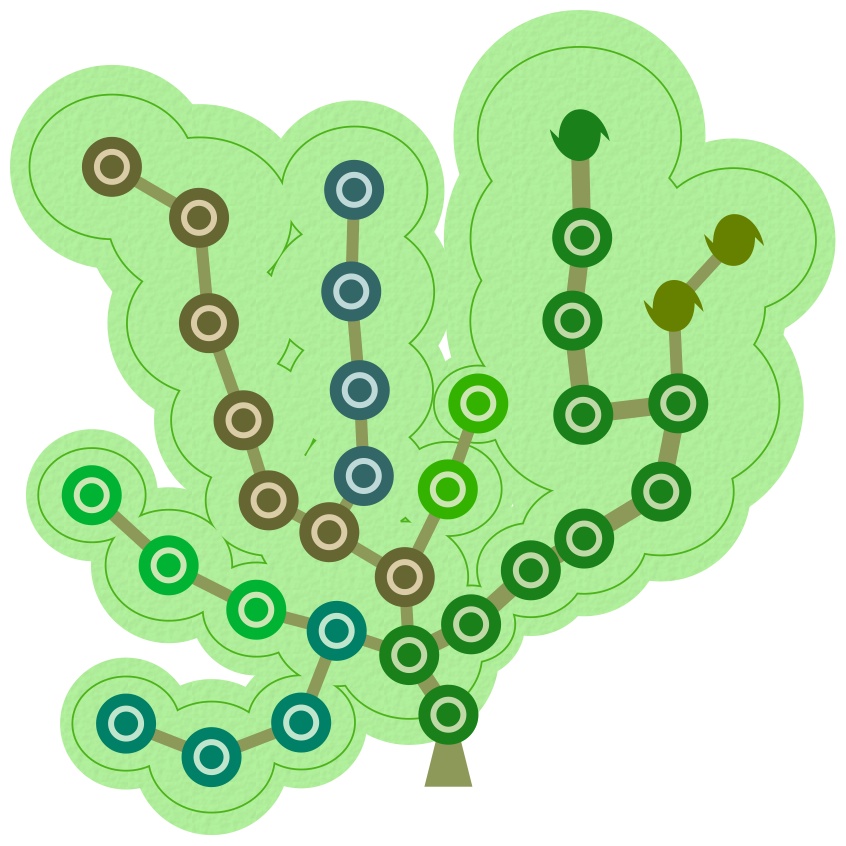
“My Secret Hideout” is a new iPad application from Andrew Plotkin, which bills itself as interactive art or poetry or a toy. Technically it’s a bit easier to describe: it’s a text generator manipulated by an intentional cryptic and evocative graphical UI. You drag and drop new nodes onto a tree, and the text on the lefthand side changes in response to what you’ve just done. The structure you build maps to a random seed that determines the textual output. Move nodes, and content changes. What it creates is a description of a location or a string of linked locations: IF-like room descriptions, only without the ability to manipulate the objects directly. Consequently it shares some of IF’s appeal — the visionary access to a place of someone else’s imagination. There are a lot of zarfian ideas here. The secret hideout you produce will likely feel like a Myst-like place, a dwelling for mystical inventors, combining machines and instrumentation with natural materials.

For instance, the tree image here produced the following description:

My secret hideout is a ring of beautifully-ornamented cubbies hanging in a pine stand. A doorway, engraved with territorial diagrams, opens out to a core room, overgrown with ivy.

The hideout is powered by a miniature steam boiler, rattling cheerily on a side platform, in a small cabinet.

An observatory is on the left side. A high-powered telescope is set up by a smoky grey beanbag chair. An antique mechanical clock stands on a pile of blocks. A bookshelf of astronomy reference books stands to the side.

This isn’t in any meaningful sense a game: there aren’t any goals, scores, win/loss states, etc., and it’s hard even to see how one might project such things onto the structure.

It’s also not a story. I’ve often argued for the power of setting as a story-telling mechanism, and the significance of objects as conveyors of narrative, My Secret Hideout doesn’t entirely respond to that kind of treatment. The descriptions are too flexible, the whole output too mutable and dreamlike. While it’s possible to make up theories about why the narrator built this particular hideout and what it all means, there’s too little control over content — or opportunity to select and label favorite content yourself — to encourage that mode of thinking for very long (I found, anyway).

To the extent it is a toy, the toy-nature is about figuring out how it does what it does and how much agency you can reasonably exercise over the output. As you may want to work that out for yourself, the rest of the discussion might be considered moderately spoilery, hence the cut.

And then I’ll talk about what I think it is, and to what extent it’s good at being that thing.

Continue reading “My Secret Hideout”

The Night Circus

The Night Circus is a new game by Failbetter, the creators of Echo Bazaar, set in the fictional world of the forthcoming book of the same name by Erin Morgenstern. (I should say as a disclaimer, before I go any further, that I’m not a completely disinterested party — I’ve worked with Failbetter several times in the past, and hope to do so again in the future, and I also did some beta work on the game of The Night Circus.)

A few of my mementoes
Structurally, The Night Circus is quite a bit like Echo Bazaar, but tighter and easier to get into. If you’ve ever looked at EBZ and thought that it was more confusing or more of a commitment than you were ready for, Night Circus is doing some similar narrative experiments in a more streamlined fashion, with a shorter lead time and fewer optional extras. (There’s no store to buy objects from, for instance, and no map to move around — just a set of storylets to choose from at any given moment.) Brief text passages let you explore the environment of the circus and make choices about what you’re interested in pursuing. As you go, you accumulate mementoes — an inventory of physical and non-physical rewards from your exploration, some of which are required to open up new possibilities. Because it’s about exploring the mysteries of a setting and making serendipitous connections, it’s light on plot and strong on imagery, but there are some gradually accumulating ideas nonetheless.

The art is disciplined and evocative. Night Circus’ commitment to a black-and-white-with-red-touches scheme means the iconic art fits together well, even when the images are of quite different things.

There is a diary, to which you can save the text of events that are most important to you, and there’s the option of adding your own brief comment to something you’re recording. (Here’s mine, containing some of my favorite snippets from play so far, and here’s another from someone who comments more extensively than I do.) The diary is something EBZ does also, but (IMO) less effectively: Night Circus lets you add things to your diary even if you don’t simultaneously choose to tweet them to your friends, which means that you can make decisions about what you want to include in your personal narrative record without agonizing whether you’ve annoyed your twitter list enough for one day. I’m keenly interested in this technique: it encourages players to think about which events are important and memorable to them, and cooperate in constructing a narrative for themselves. I’d like even more to be able to go back and change the tagging on past events, I think, but that might be a bit heavy-handed for this particular piece.