…is written up here. It’s a very odd balance of puzzler and dating sim, which I didn’t find entirely satisfying in either dimension, and which raises some issues about gender stereotypes but veers off before dealing with the implications.
Month: September 2011
L. A. Noire Article
Here I talk about what I liked and didn’t like in L.A. Noire. (Quite a lot, actually, in both cases.) My main contention is that the story and gameplay aren’t clear enough about what the player’s role is meant to be — and various game systems pull in different directions.
The Night Circus in book form
I’m partway through the actual book The Night Circus
Which I guess is a roundabout way of saying that I feel like the game has actively added to my enjoyment of the book, and not just in the marketing sense of making me aware of the book in the first place (which is true also).
Balance of Powers on Kickstarter
Balance of Powers is a dark new alternate-history world from the team that wrote Perplex City. Follow the free-to-read story online, with eight chapters unfolding over eight weeks.
…Or better, sign up and receive bonus content in email, artifacts in your mailbox, or be invited to take part in live online events.
Balance of Powers is being launched on Kickstarter by Adrian Hon, Naomi Alderman, Andrea Phillips, and David Varela, a group that includes veterans of game and ARG design, live interactive events, and conventional fiction writing. The four of them were kind enough to answer a few of my questions about their new project — talking about pacing, storytelling as performance, and the narrative value of feelies.
Balance of Powers is set to unfold over eight weeks, one chapter a week. Can you talk a little about the function of time in your storytelling? How do you want the experience to differ from just sitting down and reading the story in one compressed session?
The action of the story itself takes place over much less than eight weeks – really more like eight days – so we’re absolutely not aiming to produce real-time storytelling. But there’s something deliciously Dickensian about enjoying a serialised story every week. It creates suspense. It allows time for the words to sink in and be analysed, either by the individual reader or between readers online. (We love a bit of speculation.)
The time between installments doesn’t just allow for reader speculation, either – it lets us peek at, and perhaps be influenced by, that speculation. The great thing about writing something online is that, unlike print materials, you can tweak at the last moment if you have a really fantastic idea. And it’ll allow us to drop in the other cool items – like our newspaper – between episodes, at a point in the story where they’ll have most impact.
The long timeline also gives people a chance to read at their own leisure without feeling that they’re being left behind. Having said that, we hope that the readers will be really looking forward to each week’s installment. TV execs talk about ‘appointment television.’ We want this to be ‘appointment reading’ because they’ll want to discuss and speculate about the story with their friends as soon as they’ve finished.
Charlotte: Prowling For Enchantment
“I’m a vampire. It’s very boring.”
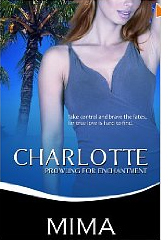 Thus Ryder, one of the love interests in the CYOA Charlotte, Prowling for Enchantment (Take Control)
The bubbling sexuality eating at her flashed into steam.
This is one of those metaphors that’s not so much mixed as fatally mangled at the blender factory. How can a liquid both bubble and eat? Are we talking about a flash-boiled acid here? Or, speaking of hot things you don’t want to be dipped into:
Lava tickled the tender skin between her thighs.
Such a tease, lava. Or
She needed a drink. Of skin.
You just don’t really want to think about that too hard.
The prose is not good — not keenly observed, not stylish or lyrical, not surprising — but it has a glossy professional assurance. And, indeed, the author, who works under the name Mima, has apparently published a whole series of non-interactive paranormal erotic romances.
The premise is that the protagonist has gone on a cruise, not realizing that (a) the cruise is a singles cruise for fantastical beings and (b) she has paranormal powers herself. At once she is being fought over by a vampire and a werewolf (where have I heard this before?). The first choice, therefore, is about which of the two she’s going to spend the night with. From there, many of the additional choices are about whether she is going to use her power, as it turns out she can command people to do her bidding. You would think she would have noticed this before the age of 29, but apparently the power is activated by proximity to bodies of water, and she was raised to avoid them all her life.
Some of the paths have a fair amount of plot; others are almost entirely porn, the kind of porn consisting largely of boggling euphemisms. (“The pleasure roared past like the blue line metro had missed its stop.”)
As CYOA, it’s structurally unusual. The passages between choices are long — the app calls these chapters, and it’s not wrong to do so — and there can be only three or four choices in a complete play-through. This makes the choices seem more surprising when they appear, because there’s so much that Charlotte decides to do of her own accord that getting agency back is a little startling. It is also a bit of a drag on replay (at least, I thought so), because there’s necessarily such a lot of previously-seen text to reread before one gets to any new branches.
It does offer a fairly polished interface, though, and the credit text on the iOs version is interesting: it invites published authors or professional writers to contact Branching Path Books to get their adventures out there.
The tactic of approaching static-fiction authors with an established fan base and getting them to write various types of interactive fiction has been discussed before, but I don’t know of a lot of cases (post-80s, anyway) where it’s happened. Mima isn’t exactly Stephen King, but there are those 19 published erotic romances; and the result is a CYOA that feels fairly different from the average example of the genre, both because of its subject matter (mostly the “silken bar” the vampire has in his pants) and its structure (choice points are rare and feel arbitrarily placed, with the emphasis of the experience still mostly being on the author’s story vision).
The King of Shreds and Patches for Kindle
 Jimmy Maher’s The King of Shreds and Patches


What’s more, Jimmy’s blog post on the topic seems to suggest that the underlying engine may be able to present other Glulx games on the Kindle in the future. This is a relief to me. I’m constantly being asked why there isn’t IF for sale on the Kindle. Now there is! Look! See!
I haven’t had a chance to play the Kindle version myself — I can read Kindle books on my iPad but not play the interactive Kindle games. But I have played the original, and can say that it’s a massive, meaty, plot-rich piece of work. (Review here.) Recommended.
 Emily Short's Interactive Storytelling