Shufflecomp: More, Cryptophasia

More is a Shufflecomp game, based on a whole big batch of different songs. Structurally it reminded me quite a bit of Tea and Toast: both pieces give the player a task to perform in the foreground while simultaneously providing a slow drip of memories about a lover. It’s a way to get memory and emotion and interpersonal relationships into a parser game where all the main verbs are about picking up and moving objects. Not a trick that would work across the duration of a long game, but for both of these it works fine, I think.

There are differences. More is more overtly puzzly than Tea and Toast; there’s actually something to solve, not just something to do (though I didn’t find it especially difficult). The content is more implausible, and more melancholy. The lovers in Tea and Toast are lesbians who met on a bus and have a backstory that could easily belong to someone I know; the lovers in More are Bonnie-and-Clyde-style robbers who have finally been brought down by the need to keep acquiring, long after they had plenty.

I particularly liked this paragraph:

You try to remember when you and Tommy first met. You can’t. Isn’t that weird. That’s the sort of thing everyone remembers. It’s just like how you don’t remember when you first read a book or watched a movie. Everything fades into the past. His love haunts your entire life; the rest is gone.

*

Cryptophasia is about a baker in a voiceless future space-faring society which dedicates a lot of its time to ASMR (short for Autonomous Sensory Meridian Response) videos — a whole genre of videos in which people tap things, rustle things, and whisper or speak softly to the viewer in order to trigger a physiological response. Even for people who don’t get the tingling head ASMR response (not everyone does), they’re often very relaxing — which is why it’s possible for a 20-minute video of someone folding towels or tapping fake nails on a wooden box to have hundreds of thousands of views. A few ASMR videos have a plot, but that’s not really the point.

In the context of the story, the ASMR videos become doses of intimacy secretly delivered in a society that discourages such connections — which may not be so far off from their appeal in the current world, come to that.

I enjoyed the strangeness of this piece. It probably needs to be played a couple of times; at least, I found that it made most sense when I’d seen more than one of the endings.
Shufflecomp’s Outcast: Barbetween

Barbetween is a Seltani age written for Shufflecomp but excluded from the final competition because it was impossible to archive. Seltani is an online multiplayer text space that combines Twine-like room and object descriptions with the capacity for live chat and exchanges with other players in the same area.

I’d like to talk about Barbetween, but it’s the kind of piece that benefits a lot from being played in more or less complete ignorance of what’s going to happen, so I really suggest you do that. (It doesn’t take long.)

I played with the song that inspired it on in the background, and that proved to be a good choice.

Continue reading “Shufflecomp’s Outcast: Barbetween”

Shufflecomp: Mirrorwife

Shufflecomp is responsible for introducing me to Nightwish, specifically “Over the Hills and Far Away”, which is the inspiration for a piece called Mirrorwife.

I can totally see why someone might have picked this song. It’s got a simple, tropey premise that turns up everywhere from medieval ballads to current-run lawyer shows: dude is falsely accused of a crime, but he chooses to pay the penalty rather than present his alibi, which is that he was sexing up his best friend’s wife at the time the crime occurred. It takes an instant to understand and there are a gazillion ways you could hook off of it. No subtleties about the music either: big singing! Big guitars! It’s all about the emotion and the color. Even if you’re not particularly a fan of its genre, you can at least get it.

Which is why Mirrorwife is such a surprising evolution of the song. It takes the simple barebones premise and turns it into something strange and fantastical, which takes most of the game even to understand. (Sure, it’s a short game. But still.) It takes a song about separation and makes a game about homecoming, of sorts. And it does this in a way that is intentionally spare and dry. Though it’s in Twine, and though the story concerns people, most of Mirrorwife is told through settings and object descriptions, terse and evocative and cold.

I liked the story. It’s still about infidelity, and bad marriages, and being silent, and being punished for something that wasn’t your fault, but it’s about those things differently. In the original song, the protagonist could save himself with a word, but chooses not to speak it; in Mirrorwife, speech is impossible and would not in any case be believed. It is a story about living on the margins, without power, without autonomy.

Shufflecomp: An Earth Turning Slowly

An Earth Turning Slowly is a submission in Shufflecomp. Shufflecomp is a comp with an impressive 33 entries (and one more written for the comp but technically outside the rules), in which IF authors created games based on music suggested by other entrants. It’s like a giant mix-tape IF compilation, and the games include Inform and TADS parser games as well as choice-based Undum, inklewriter, and Twine pieces. (The excluded game is a Seltani age, excluded because it breaks the comp’s rules about archivability.)

An Earth Turning Slowly is… an Undum parser game? A choice-based game with partially hidden choices that you access by typing? The parallel-universe anti-twin of Jon Ingold’s The Colder Light?

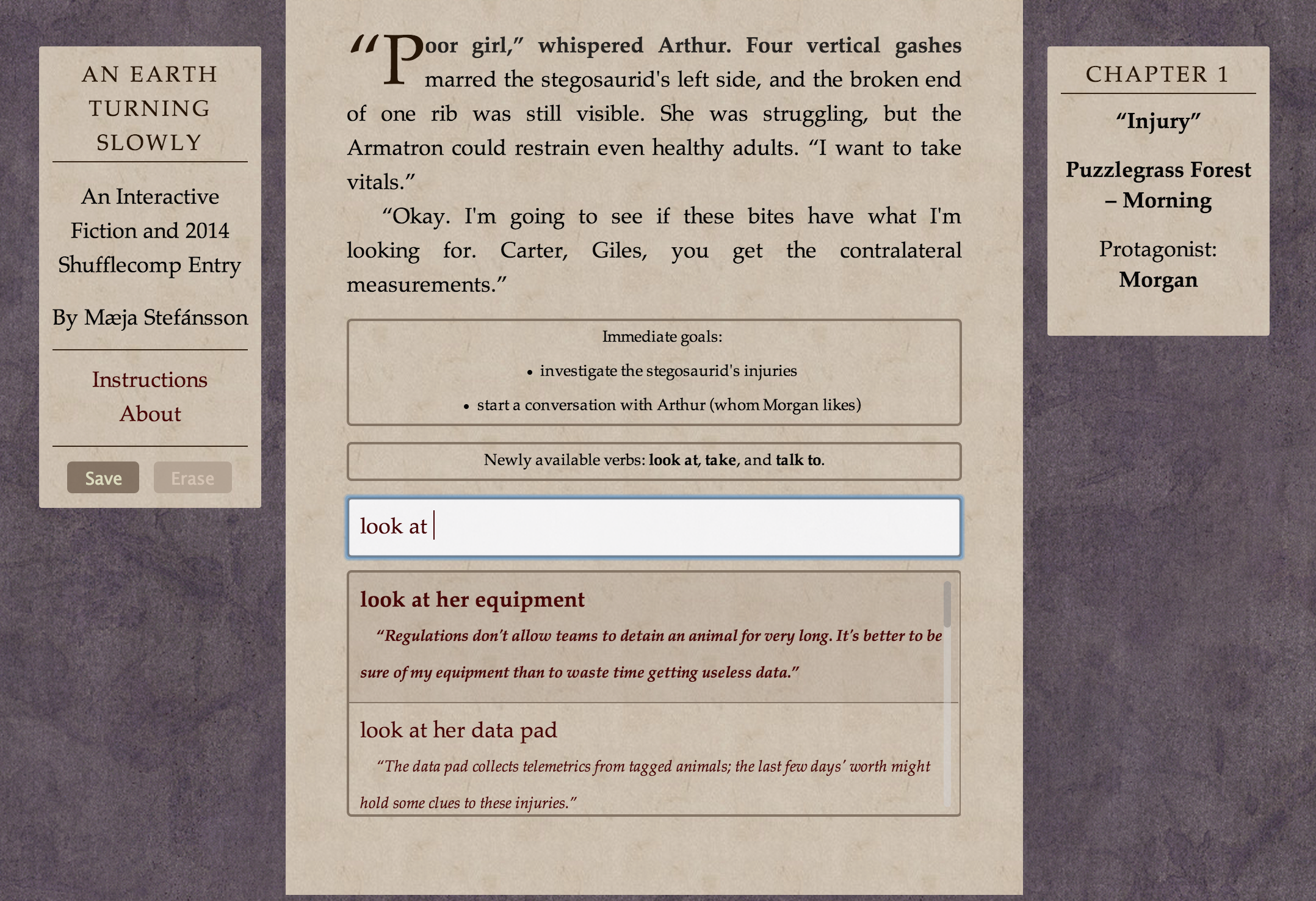
Typing the beginning of a command brings up completion suggestions

Here’s how it works: you type the beginning of a command. AETS supplies a menu of possible completions for the command that are currently valid. If you type something that’s not on that menu, you can’t submit it, so there’s no need for actual parser error messages: you never get as far as submitting a malformed command.

I’m fairly sure this isn’t doing most of the work your classic parser has to do, as far as breaking up sentences and looking for objects in scope and matching against them; I don’t get the impression that there’s that much of a world model under the surface. The menu is making up for that work, because it pattern-matches the beginning of a valid command and then helps you complete that command in the one way that the game is actually designed to understand.

So for the author, there’s less error-message-writing and bad-entry-handling to do; for the player, there’s less opportunity to get caught in guess the verb/noun situations. The effect of the system isn’t just to eliminate problems, though: the menu also comes with a sentence or two describing why your protagonist might be considering that particular action, which gives it some extra context.

This is all quite nifty. I really liked having Undum’s attractive presentation associated with a parser game. It feels so elegant. I think there’s possibly a bit more infrastructure around the command line than is strictly ideal — a lot of the page is taken up telling you what you’re trying to do and what you could possibly type — but I think this could be tweaked. (And I don’t dislike it as it stands; I’m just tempted to streamline a little.) Those who are at all interested in the ongoing discussions and debates about parser/choice game UI really really should give it a look, and I hope that the author will choose to share the code or make a tool available after the competition.

All that and I’ve said nothing about the story! It’s a short SF story; short enough that I don’t want to say very much and spoil it. I did feel a bit frustrated halfway through that one of the viewpoint characters seemed not to realize an obvious action when I had already figured it out, but that can be a tricky point to get right. Nonetheless, I enjoyed the read. I might have enjoyed it even more if I hadn’t been distracted by trying to analyze how I felt about this fancy new UI. (Note: it is not the author’s fault that they have created multiple intriguing elements in the same game.)

CYOA Structures transcript up

The transcript is now available from yesterday’s theoryclub chat on structures in choice-based stories.

Our next meeting is scheduled for June 14, on the topic of interactive nonfiction. That can include everything from educational simulations to persuasive pieces to personal memoir. As before, there are some suggested reading pieces for those who are interested in preparing a bit for the discussion.