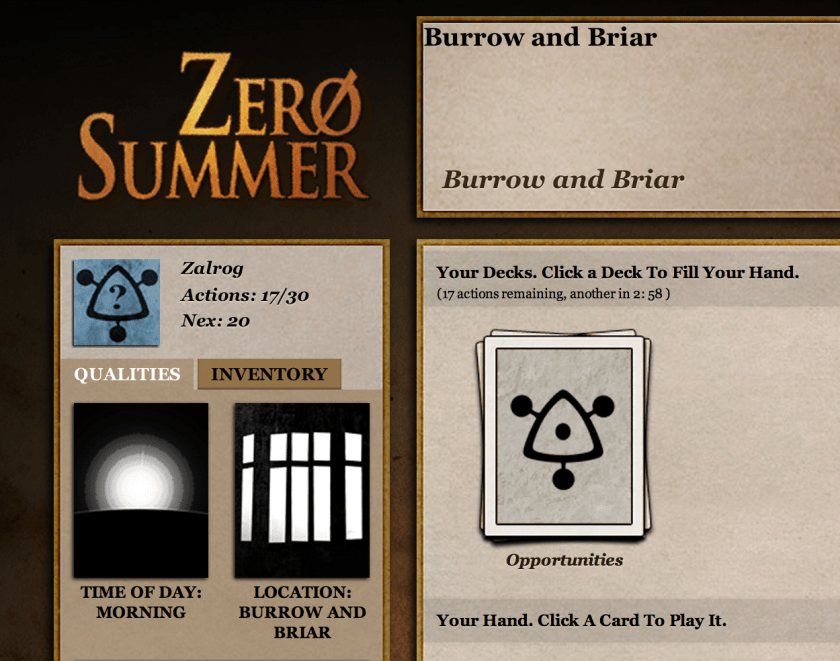
Zero Summer is the second place finisher in the seasonal StoryNexus competition, after Samsara. The setting is an apocalyptic western dated to 2026: Corpus Christi has become ground zero for an outbreak of monsters, and much of Texas has become essentially frontier territory again. And you’ve been clubbed on the head in a train robbery and forgotten everything, so that you are now the Man With No Name. Soon you fall in with people who offer to help you, and you begin to be embroiled in local plots.
There are several ways to go with this sort of setting. Happily (at least in my view), Zero Summer seems more interested in the society that might result from such a disaster, the sorts of people who would find themselves living in it, and how everyone gets on, than in dwelling on the monstrosities first thing. There’s a good establishing scene of creepiness, but it’s played with a lot of restraint, and then the player is sent out to get to meet people and be part of the life of the town.
The setting and the writing alike set Zero Summer apart from what I might call the StoryNexus house style — aspects that are not at all inherent in the system of StoryNexus, but that show up a lot, because a number of the existing works are written by Failbetter and then many of the others were written by people who liked Failbetter’s content and to some degree were inclined to emulate it. Fallen London, Samsara, Night Circus, Winterstrike, Cabinet Noir, The Silver Tree share a tendency towards artisanal virtuosity; towards luxury and violence, slashed silk and blossoming wounds; towards perfumed encounters with NPCs forgotten in the morning. If a story were a meal, the archetypical StoryNexus work would be a box of tiny, exquisitely intense bonbons — not chocolates, but Turkish delight, crystalized violets, spun-sugar caskets of anise liqueur.
This is by no means a complaint. StoryNexus is hardly the only language or system with a house style. Twine’s house style tends towards stream-of-consciousness and highly personal narrative, perhaps thanks to Anna Anthropy’s championing of it as a tool for self-expressive game design, while ChoiceScript’s tends towards highly customizable protagonists with a lot of stats and minimal pre-defined characterization. There’s no reason that has to be the case. Twine and ChoiceScript have most of their feature set in common — just different ways to visualize those features, and different supporting cultures.
So I tend to think the use of a system is driven as much by the community of people who are already using it as by the technical affordances. If a new author doesn’t like what’s been written already, or is not on the same wavelength with the existing experts who could help her, she’s much much less likely to be drawn to using that system. Eventually, if you’re lucky, you get a sufficiently complex ecosystem that the house style starts to break down, and people are trying lots of new things, and tool becomes separate from genre. But it takes time, and examples, and variation.
Zero Summer takes StoryNexus a step in this direction. Zero Summer is not a box of sweets.
 Emily Short's Interactive Storytelling