Further works from Fear of Twine. This time we have The Scientific Method, Drosophilia, Duck Ted Bundy, Abstract State-Warp Machines, The Work, Coyotaje, TWEEZER.
Category: narrative of objects
18 Cadence

18 Cadence is a new interactive text experience by Aaron Reed: he calls it a “story kit” rather than a story or storyworld or interactive fiction. This is fair enough. Scraps of text describe the rooms in the house at 18 Cadence during each year from 1901 to 2000, as well as the objects and the inhabitants. To manipulate the story, one moves back and forth through the years, or through the rooms by clicking on a floor plan. Different inhabitants have different understandings of what is going on. The story of the house includes both personal histories — deaths, betrayals, love affairs, weddings and births, addiction and depression — and hints of the history of the 20th century, social change and prejudice. During the house’s turbulent years in the 90s, inhabitants come and go quickly, and there are lots of roommates, so it is hard to care as much about any one of them as they flicker past: a hint of social disintegration. But there are also props that last through the years, features that persist and change.
If the piece were only that much, it would be interesting, an exploratory text heavily tied to the history of the house. But each scrap of text can be moved and manipulated by the player. Descriptions of objects can be juxtaposed, glued together into new sentences or simply left on top of one another. Characters, ages, room names and dates, actions and motivations can be laid out in new arrangements, and the arrangements shared with other readers. If you want to read things that others have written with/about 18 Cadence, you can browse through, looking at alternate arrangements.
Aaron draws an analogy with fridge magnet poetry, and there’s a bit of that feeling of play and sometimes randomness. But it’s also an experience that invites the interactor to discover her own themes in the work. Because the scraps can overlap, obscuring one another, it’s possible to replace intended meanings with others. Sometimes the effect is intentionally comical:

Sometimes it’s not, as in this tale about the deaths of three sons of the household:
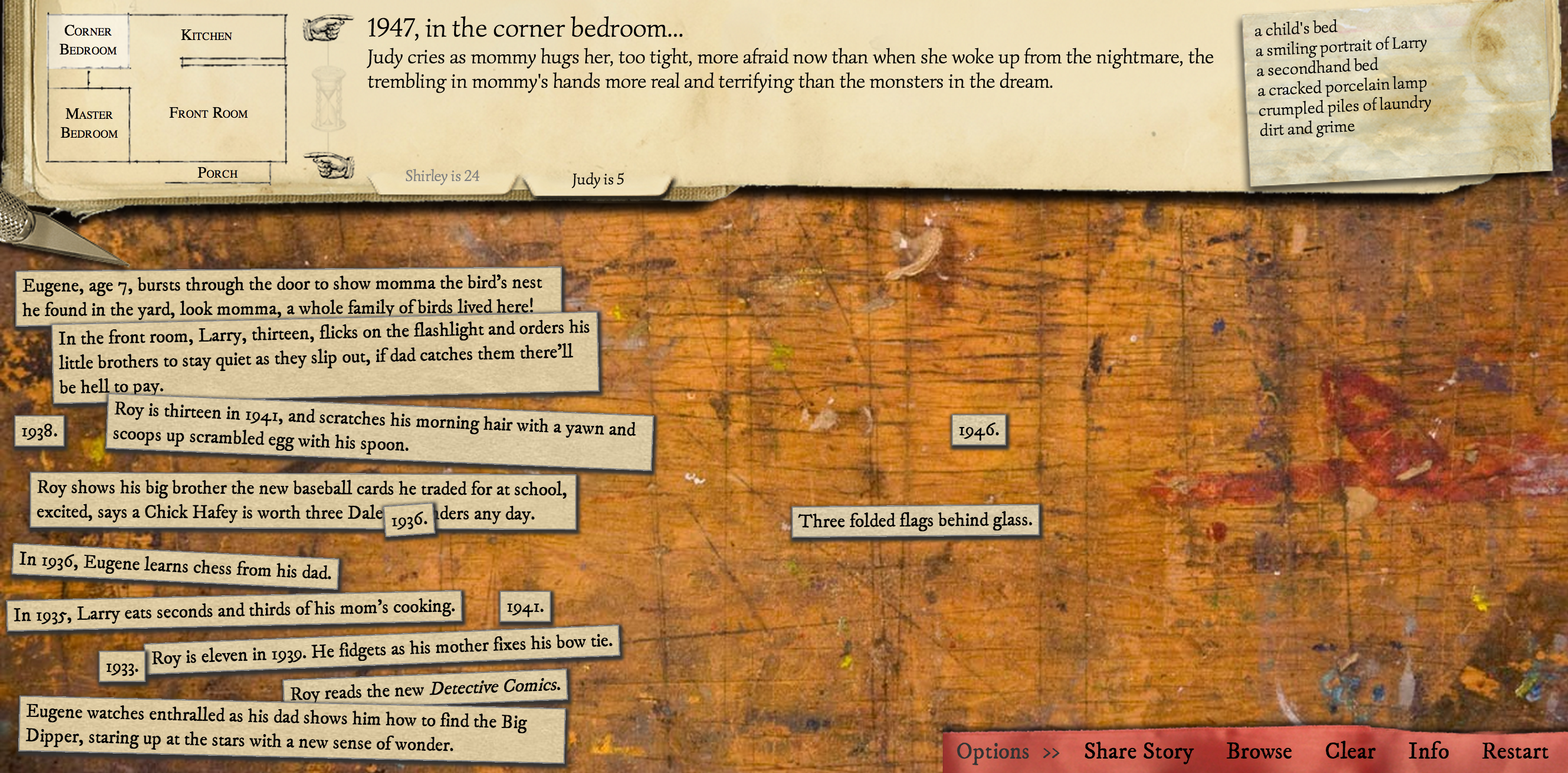
And sometimes the juxtapositions call out themes or possibilities that are less explicit in the work. I encountered one disturbing cluster of text that seemed to hint at incest, though that story wasn’t obvious on the surface of the text. Working out what is supposed to have happened to all of the characters is one sort of semi-puzzle; working out new or different perspectives on their experiences is another.
As the screenshots should make obvious, this is a really lovingly textured piece of work. When you lay out scraps of words, they drift into attractive positions, perhaps skew a little bit as though you were arranging them on a table. Dragging together two scraps that refer to the same scene will glue those scraps into a continuous sentence, but the X-Acto knife tool will separate them again. It’s all a pleasingly tactile, precise and elegant interface, and reminded me of some of the attractive work inkle has done with text; also of Andrew Plotkin’s My Secret Hideout. I recommend giving 18 Cadence a look.
San Tilapian Studies (a casual narrative entertainment for 30-40 players)
Last week I had a party for about forty friends, many of whom didn’t already know each other but most of whom know me through some sort of game or story-related interest. A few others were people I thought didn’t know much about storygaming of any kind, but might enjoy an accessible, casual taster.
So I put together a small narrative game for the occasion. The design goals were to create something that would get people talking to strangers; that would take just a few minutes to participate in, but let people invest more time if they wanted to; that was playable even if you had a plate of food in one hand; that wouldn’t be ruined if some people arrived late or weren’t into playing; and that would produce a souvenir after the party.
The result of this project was San Tilapian Studies.
Continue reading “San Tilapian Studies (a casual narrative entertainment for 30-40 players)”
Angal Tentara; inkle’s Frankenstein
Periodically I check out interactive narrative projects on Kickstarter, whether they’re by people I’ve heard of before or not. Angal Tentara and The Root of All Evil is an “interactive animation” for iOS. It looks like it’s working with a fairly standard fantasy premise about a young person who has a destiny tying her back to an ancient civilization. Two things struck me about it, though. First, it comes with a backer reward consisting of a “storybook kit” with what look like some pretty nice-quality feelies:

Second, check out the video on the Kickstarter page — no, not the main video, the one a little lower down that’s titled “Story Telling 2.0”. The “you become the editor” model, with a conscious attention to the reader’s ability to expand or advance the narrative, is reminiscent of stuff the IF community sometimes talks about. Though the video is brief and doesn’t go into a lot of detail, this strikes me as a more mature/considered description of how the story is going to be interactive than I’ve found in a lot of interactive project proposals. Remains to be seen whether the project will actually deliver on that model, but hey.

Meanwhile inkle studios — the company formed by Jon Ingold and Joseph Humfrey — has just announced that it’s working on an interactive version of Frankenstein for iOS, published with Profile Books. Their press release is not so specific about the theory underlying the project (perhaps intentionally). Nonetheless, I’m keen to see what Jon and company come up with here.
Tabletop Storygames: Shock, Fiasco
 Last night, per Dan Fabulich’s recommendation, I checked out the Seattle story games meetup and played through a game each of Shock and Fiasco. Shock is about exploring social issues (whichever ones the participants choose) in the context of a science fictional future; Fiasco is about emulating the wacky, everything-goes-wrong misadventure plots typical of Coen Brothers movies. I’d heard about Fiasco before from Stephen Granade (here’s a play report of his as well as an academia-themed playset he wrote). Both were a lot of fun and went in rather goofy, unexpected directions.
Our particular play group went back and forth between actually role-playing scenes out and doing quick narration, and was really cooperative in terms of trying to get interesting, narratively satisfying outcomes for the story. Quite a few times, one player had the opportunity to help or oppose another player’s character and made the decision based on what would generate the most aesthetically effective scene. That was a lot of fun — the spirit of collaborating towards a common (if not always clearly perceived) outcome is a standout feature of this kind of play. Our group seemed to tend towards the tragic or bittersweet, preferring outcomes that were mixed success and failure for our characters.
Balance of Powers on Kickstarter
Balance of Powers is a dark new alternate-history world from the team that wrote Perplex City. Follow the free-to-read story online, with eight chapters unfolding over eight weeks.
…Or better, sign up and receive bonus content in email, artifacts in your mailbox, or be invited to take part in live online events.
Balance of Powers is being launched on Kickstarter by Adrian Hon, Naomi Alderman, Andrea Phillips, and David Varela, a group that includes veterans of game and ARG design, live interactive events, and conventional fiction writing. The four of them were kind enough to answer a few of my questions about their new project — talking about pacing, storytelling as performance, and the narrative value of feelies.
Balance of Powers is set to unfold over eight weeks, one chapter a week. Can you talk a little about the function of time in your storytelling? How do you want the experience to differ from just sitting down and reading the story in one compressed session?
The action of the story itself takes place over much less than eight weeks – really more like eight days – so we’re absolutely not aiming to produce real-time storytelling. But there’s something deliciously Dickensian about enjoying a serialised story every week. It creates suspense. It allows time for the words to sink in and be analysed, either by the individual reader or between readers online. (We love a bit of speculation.)
The time between installments doesn’t just allow for reader speculation, either – it lets us peek at, and perhaps be influenced by, that speculation. The great thing about writing something online is that, unlike print materials, you can tweak at the last moment if you have a really fantastic idea. And it’ll allow us to drop in the other cool items – like our newspaper – between episodes, at a point in the story where they’ll have most impact.
The long timeline also gives people a chance to read at their own leisure without feeling that they’re being left behind. Having said that, we hope that the readers will be really looking forward to each week’s installment. TV execs talk about ‘appointment television.’ We want this to be ‘appointment reading’ because they’ll want to discuss and speculate about the story with their friends as soon as they’ve finished.
 Emily Short's Interactive Storytelling