Spring Thing 2013: Witch’s Girl

Screen Shot 2013-04-03 at 3.35.02 PM

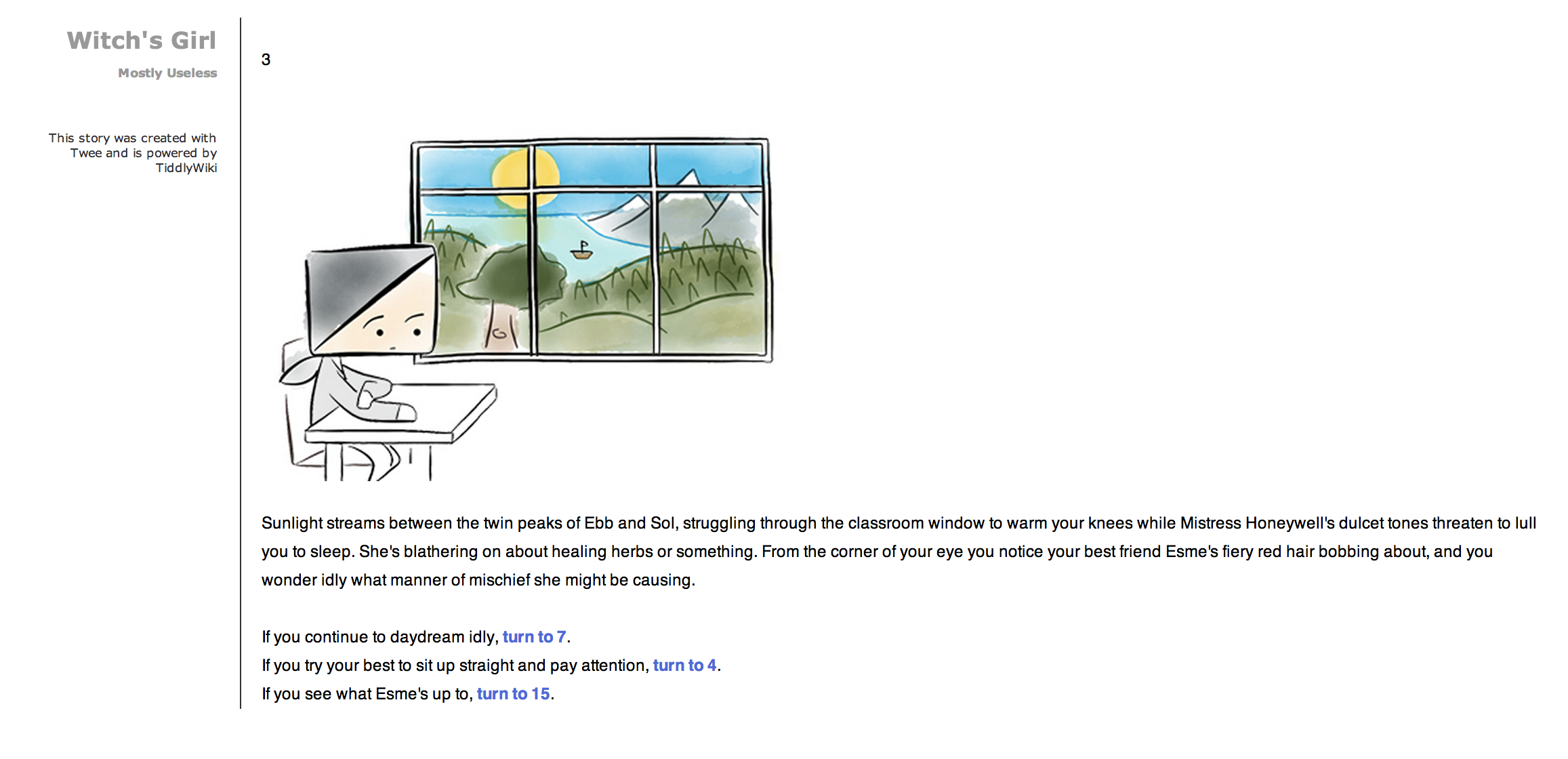
Witch’s Girl is a Twine game entered in the Spring Thing 2013 competition. It’s a light-hearted fantasy puzzle game with tropes from fairy tales and children’s fiction. Structurally a bit reminiscent of Andrew Plotkin’s puzzly multiple-choice fanfic Bigger Than You Think, Witch’s Girl rewards playing back through previously visited branches of a CYOA tree with new knowledge; it leverages Twine’s variable-tracking abilities to open up new avenues from certain pages. Illustrated with childlike drawings, it looks and feels different both from parser IF and from many of the blue-and-black Twine games recently released.

More thoughts, evaluative but not too spoilery, follow the jump.

Continue reading “Spring Thing 2013: Witch’s Girl”

Future Voices (inkle)

Future Voices logoFuture Voices is an iOS-based anthology of eleven CYOA stories from inkle, culled from an open competition. As one might expect from inkle’s work, it’s an aesthetically pleasing object: it uses Frankenstein’s imagery of pieces of paper being attached to the end of an ongoing, developing story. Proofreading is not flawless — I ran into a handful of typos here and there — but this is a fairly rare problem, and overall the app is an elegant-looking piece of work, tactile and classy.

I’m also delighted to see someone running with the concept of anthologized interactive narrative: curating and promoting the best material from the wide variety of freeware is still a really useful role for publishers or publisher-equivalents. And I gather that the competition leading to this anthology drew work from a wide range of authors, some of whom had no previous experience with interactive writing.

Continue reading “Future Voices (inkle)”

Zero Summer: Fifty Miles South of Lexington

Zero Summer IconIn November I wrote about the StoryNexus game Zero Summer. At the time I didn’t play their for-pay content, Fifty Miles South of Lexington, but I’ve done so now, and it deserves its own discussion. Fifty Miles is its own short story, which you can buy from within the main game of Zero Summer using Nex, once you’ve progressed far enough to move around town a bit.

From the StoryNexus perspective, Fifty Miles South of Lexington is pushing the envelope of what the engine can do. Which is a good thing! Every new storytelling engine needs some content that pushes it to or beyond its capacity; that’s how the formal capacities of the machine are discovered. Experimental stuff typically feels just a little bit odd, though, just because it is doing something that may be hacky and weird for the affordances of the toolset. Consequently, the following is a review both of the content of Fifty Miles and a discussion of StoryNexus’ ability to cope with this kind of content.

Continue reading “Zero Summer: Fifty Miles South of Lexington”

CIA: Operation Ajax

CIA: Operation Ajax is an enhanced graphic novel about the 1953 coup d’Ă©tat in Iran, engineered by the CIA and British intervention.

The story is compellingly told, with the clear intent of both teaching the reader something and establishing a particular attitude towards what happened. CIA: Operation Ajax works to establish its credibility. It is thorough — it runs about a dozen chapters and took me multiple hours to read; this is not a brief pamphlet, and to lay out a story about 1953 it starts with originating events in 1908 and works its way forward. There are also a number of supporting documents that are embedded in the story or accessible through supporting menus. In some panels, a star appears — a kind of visual footnote marker, which will bring up citations or background articles for claims that the story is making. And yet this is also not a documentary. The choice of dialogue, the manner of drawing, the narrator’s plainly expressed horror and regret about what happened, all convey an unmistakable attitude towards events, and the final chapter drives home the point that the effect of American intervention was to destroy a democratic government and create significant future problems in the region.

The production values are extremely impressive, and it makes the most of the idea of a computer-aided comic format: panels slide in and out of frame, speech bubbles pop up and disappear, characters shift positions; but the comic book metaphor never drops away entirely, and the screens never cross the line into the territory of animated movie. The only exception is that old newsreels are embedded at intervals, documenting events such as the arrival of Mossadegh in New York to speak to the UN. There are no voiceovers, but background sound effects and music do a great job of establishing mood. I would suggest being sure to read with headphones or somewhere where you can afford to leave the sound up.

By the standard of most things I review on this blog, CIA: Operation Ajax is only very barely interactive at all. You can tap to advance the story; you can tap stars or look through the character roster to bring up supporting evidence. The affordances are roughly equivalent to turning pages or flipping to a set of end-notes in a conventional book — and if accessing notes is less annoying in this format than it would be on paper, conversely you’ll be tapping to advance many more times than you would turn pages under ordinary circumstances, just because of how many different frames there are. There’s too little connection between reader actions and story events to establish a sense of complicity in what’s happening, much less to leverage some of the more difficult and complex player/story relationships we see in interactive narrative. So I’m not convinced by some of the more breathless blurb-writing about how it represents a revolution in interactive storytelling. What it does do is present a fairly uninteractive story in a very memorable and compelling form.
Evolve (Caitlin Lill)

Evolve placed third in the StoryNexus World of the Season competition, after Samsara and Zero Summer. Unlike the other two pieces, it’s a work of educational non-fiction: you begin as a single-celled organism and make choices that allow your organism to evolve. The author has written about her inspiration: she works in a science museum, and saw the StoryNexus platform as a possible way to convey the educational content she’s interested in.

Continue reading “Evolve (Caitlin Lill)”

Tabletop Storygames: Shooting the Moon

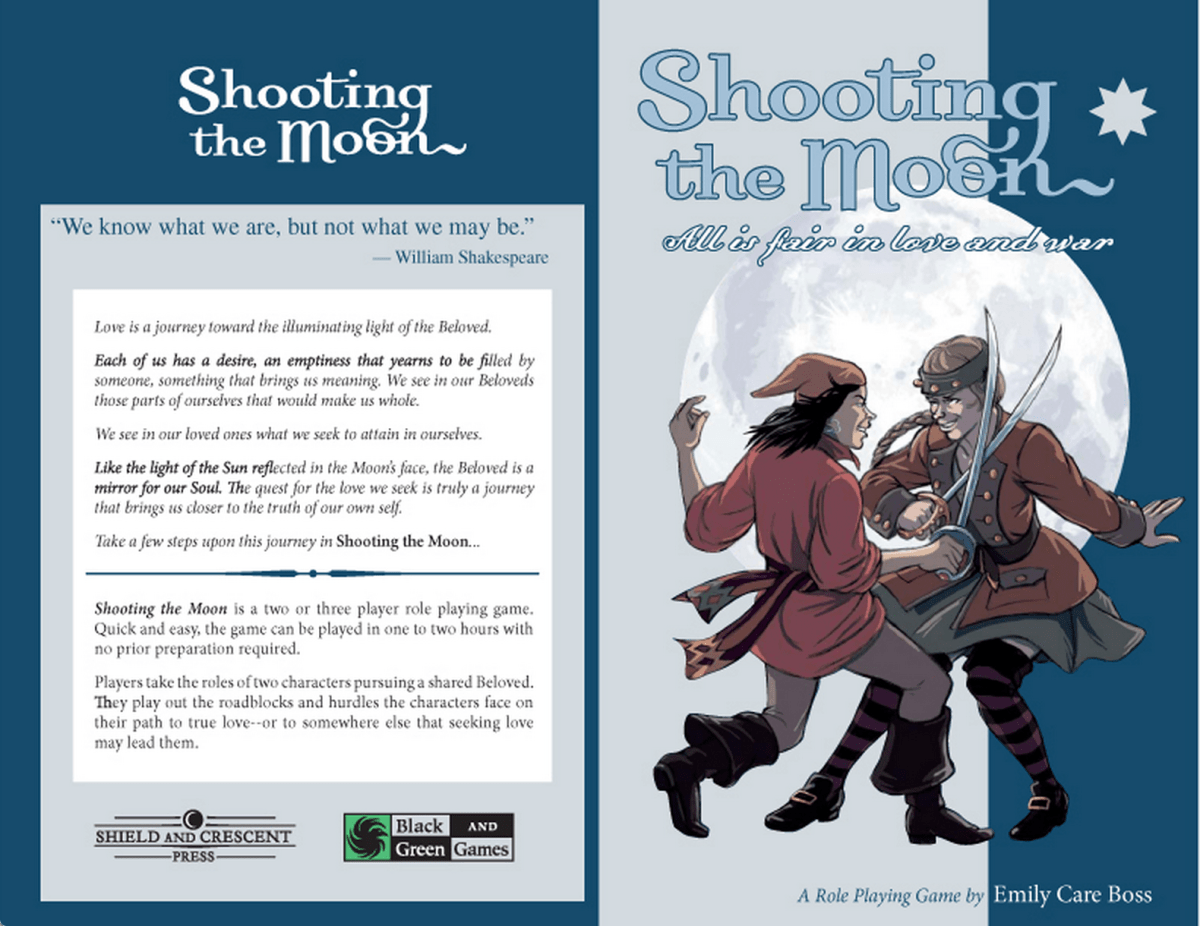
Shooting the Moon is a tabletop storygame about a romantic triangle, which I first heard of on Sam Kabo Ashwell’s recommendation (and indeed played with Sam). The two suitor characters compete to get something (probably love and affection, but conceivably something else) from the third, “beloved” character.

Continue reading “Tabletop Storygames: Shooting the Moon”