
Sigmund’s Quest is a game based on classic Norse stories, with retro-styled art and a hybrid choice engine. I played through what was there, but the game is not finished as it stands.
Continue reading “IF Comp 2014: Sigmund’s Quest (Gregor Holtz)”
Sigmund’s Quest is a game based on classic Norse stories, with retro-styled art and a hybrid choice engine. I played through what was there, but the game is not finished as it stands.
Continue reading “IF Comp 2014: Sigmund’s Quest (Gregor Holtz)”
An Earth Turning Slowly is a submission in Shufflecomp. Shufflecomp is a comp with an impressive 33 entries (and one more written for the comp but technically outside the rules), in which IF authors created games based on music suggested by other entrants. It’s like a giant mix-tape IF compilation, and the games include Inform and TADS parser games as well as choice-based Undum, inklewriter, and Twine pieces. (The excluded game is a Seltani age, excluded because it breaks the comp’s rules about archivability.)
An Earth Turning Slowly is… an Undum parser game? A choice-based game with partially hidden choices that you access by typing? The parallel-universe anti-twin of Jon Ingold’s The Colder Light?
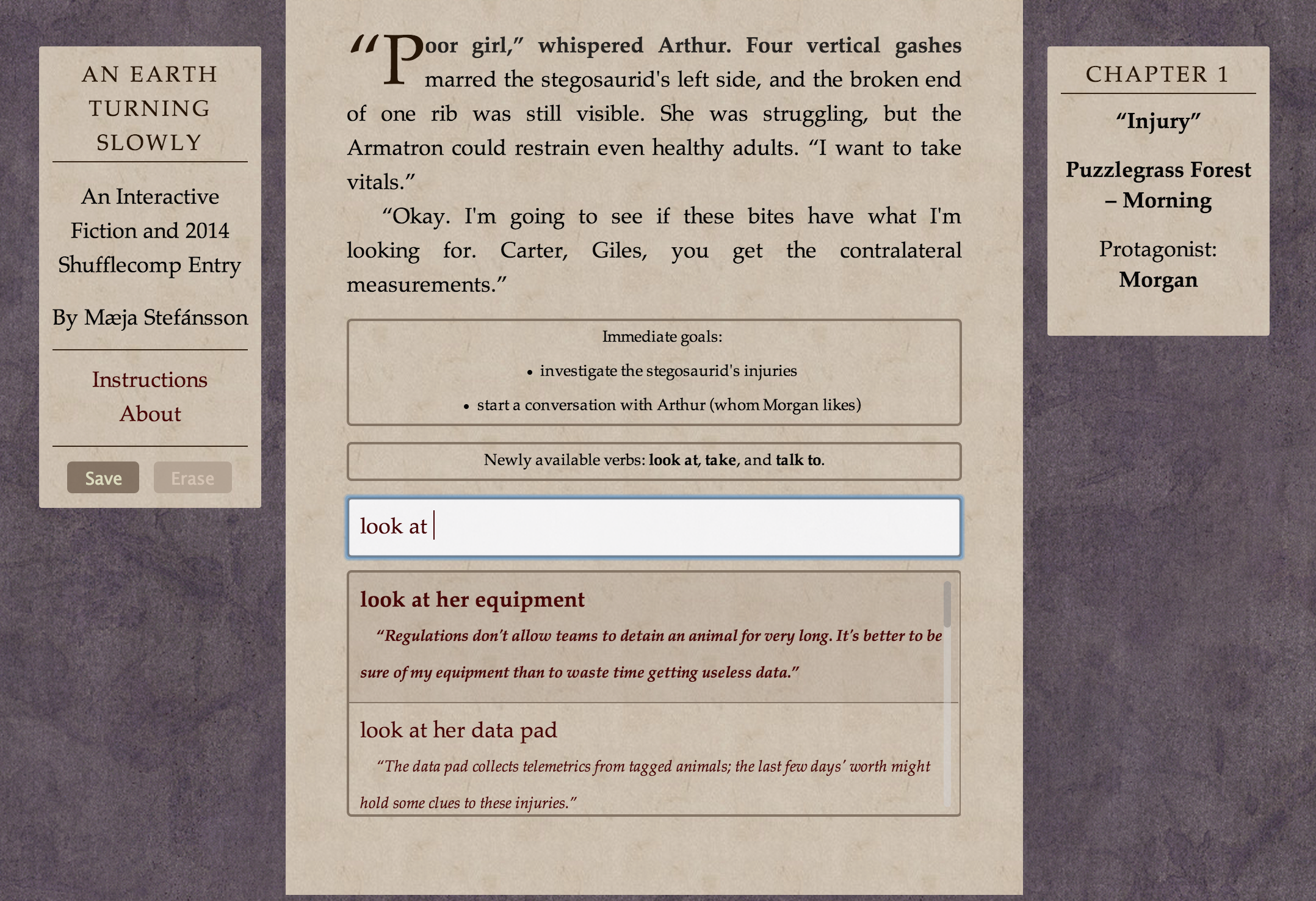
Here’s how it works: you type the beginning of a command. AETS supplies a menu of possible completions for the command that are currently valid. If you type something that’s not on that menu, you can’t submit it, so there’s no need for actual parser error messages: you never get as far as submitting a malformed command.
I’m fairly sure this isn’t doing most of the work your classic parser has to do, as far as breaking up sentences and looking for objects in scope and matching against them; I don’t get the impression that there’s that much of a world model under the surface. The menu is making up for that work, because it pattern-matches the beginning of a valid command and then helps you complete that command in the one way that the game is actually designed to understand.
So for the author, there’s less error-message-writing and bad-entry-handling to do; for the player, there’s less opportunity to get caught in guess the verb/noun situations. The effect of the system isn’t just to eliminate problems, though: the menu also comes with a sentence or two describing why your protagonist might be considering that particular action, which gives it some extra context.
This is all quite nifty. I really liked having Undum’s attractive presentation associated with a parser game. It feels so elegant. I think there’s possibly a bit more infrastructure around the command line than is strictly ideal — a lot of the page is taken up telling you what you’re trying to do and what you could possibly type — but I think this could be tweaked. (And I don’t dislike it as it stands; I’m just tempted to streamline a little.) Those who are at all interested in the ongoing discussions and debates about parser/choice game UI really really should give it a look, and I hope that the author will choose to share the code or make a tool available after the competition.
All that and I’ve said nothing about the story! It’s a short SF story; short enough that I don’t want to say very much and spoil it. I did feel a bit frustrated halfway through that one of the viewpoint characters seemed not to realize an obvious action when I had already figured it out, but that can be a tricky point to get right. Nonetheless, I enjoyed the read. I might have enjoyed it even more if I hadn’t been distracted by trying to analyze how I felt about this fancy new UI. (Note: it is not the author’s fault that they have created multiple intriguing elements in the same game.)
 At GDC this year, I unfortunately wasn’t able to go to Mordechai Buckman’s poster session on interactive fiction because of schedule conflicts. (At any given time at GDC there are usually at least three things I urgently want to be doing…). The good news is that he was good enough to put up a video of that talk, which can be viewed here. I’m going to talk about what he says, but the talk itself is well worth viewing.
His first point is that CYOA and text adventures, and the point-and-click graphical adventures that came after them, are strongly hampered in the types of story they can tell and the variety of pacing they can provide because the interface elements remain fairly uniform throughout and because there are strong conventions about what they can be used for. He describes parser-based games as primarily evoking disorientation in the player; he argues that CYOA games always have to be high-stakes in order to make choices matter.
Throughout this portion of the presentation I found myself raising mental objections. The possibility space with existing tools is not nearly so narrow as he argues. There are a lot of IF games that incorporate some element of menu choice at key moments, or massively constrict the verb or object space in order to focus the player, or keep things moving so that actions keep playing out. There are a lot of CYOA games that present an IF-like world model under the surface, or that allow the player to explore multiple ideas in a leisurely fashion, or that reach for a lyrical experience. Mark Marino has just recently written about how the promise of hypertext, which had seemed long dead, has revised in new forms and formats of interactive literature. In the realm of visual novels and graphical adventures, too, there is a surprising diversity these days.
Nonetheless, though I thought his generalizations were way too general, Buckman’s not all wrong about CYOA and traditional parser IF. There’s a ton of fascinating work at the cutting edge, but a lot of that is coming about precisely because people are thinking about presenting options differently, dressing stories in different skins, and so on. I’d position Buckman’s pitch here not in contrast to what the IF and related communities are already doing, but as another natural contribution to this exploration of what all we can do.
Buckman’s second point is that it would be possible to explore a wide number of other emotional and play experiences by changing up how we display player choice, not just from one story to the next, but from one scene to another in the same story. He offers examples, and laudably they’re not just Photoshop mockups, but short playable sequences you can access on his site. Dialogue buttons change size and shape to communicate how the protagonist feels about saying those things. Boring options appear on just a to-do list to be checked off. In a time-pressured context, options pop up rapidly, obscuring old text. If some of this sounds familiar, you may have run into Buckman’s Gamer Mom at some point in the past. That work moves, expands, contracts buttons to reflect mood. Most of the concepts here have to do with implicitly and intuitively communicating the protagonist’s interior experience to the player without having to spell out how the protagonist feels about things, though there’s a curious minigame example about playing a difficult decision-making problem like a game of solitaire.
Some of Buckman’s mockups work better than others.
Continue reading “GDC 2013: Mordechai Buckman on Interactive Fiction Interfaces”
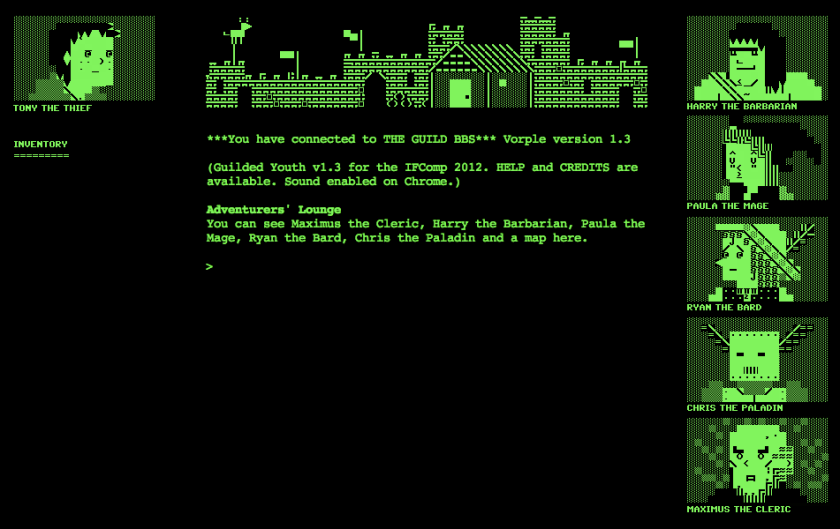
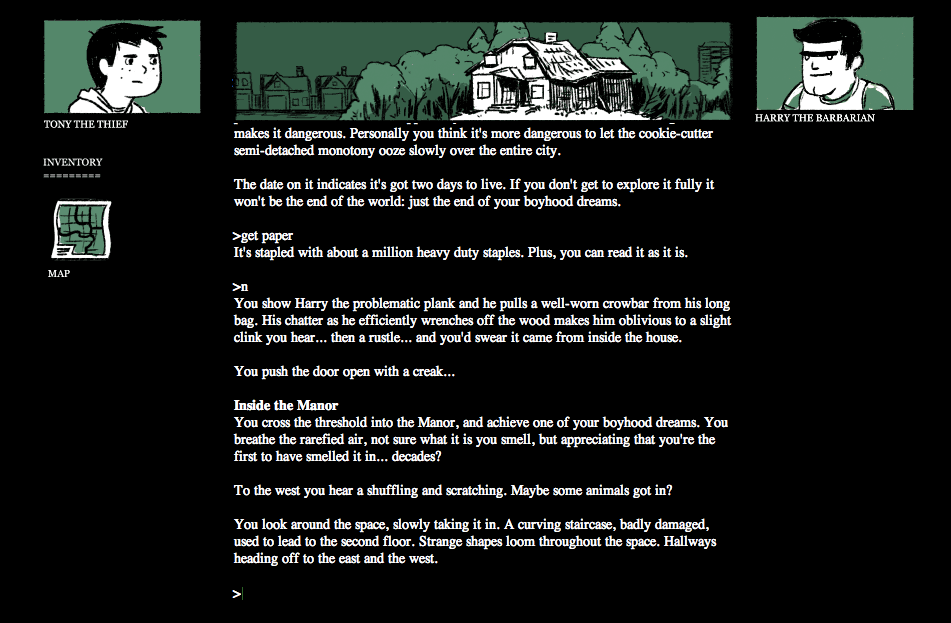
Guilded Youth is an Inform 7 game with a Vorple front end, concerning a teenager interacting with his MUD guild-mates both online and off. Per tradition, I will have some non-spoilery content after the jump; then if there’s anything spoilery I wish to discuss, it will be separated from the rest of the review with spoiler space. The fact that I am covering Guilded Youth at all means that it does feature listed beta-testers.

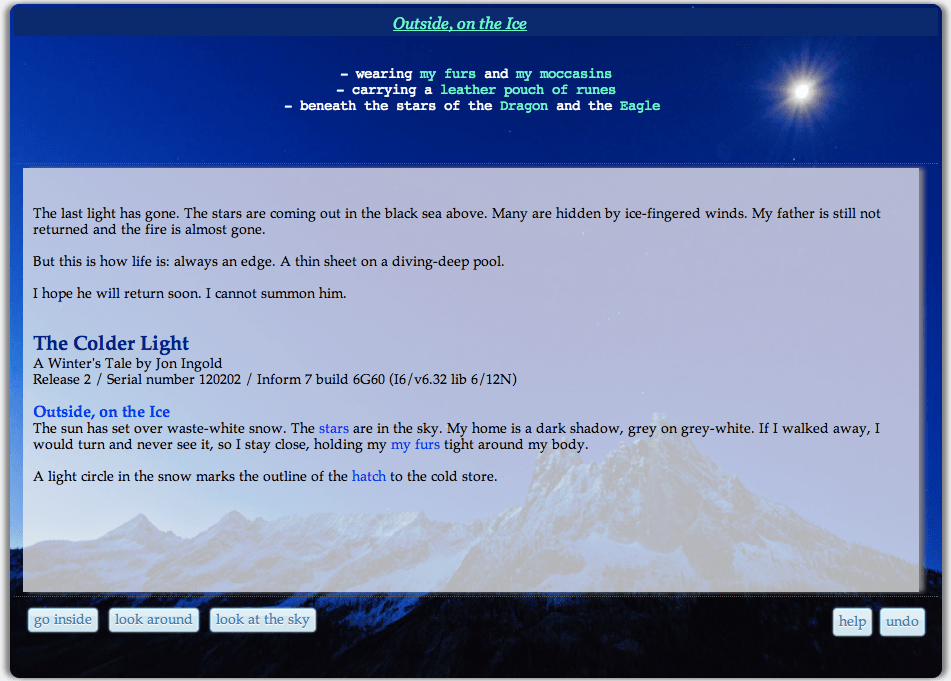
The Colder Light (online play, IFDB page) is the latest game from Jon Ingold: in this case, a spare, melancholy tale about life on the ice. It also uses an interface evolved from some work by Erik Temple (see for example Erik’s alternate interface to Sand Dancer).
This interface attempts to address some of the community’s long-standing concerns about the parser by presenting affordances explicitly. The player can click on hyperlinked objects in room descriptions and inventory and receive a list of plausible ways to interact with these. The result is a play experience with the noun-and-verb variety of classic parsed IF, a more consistent world model than the average CYOA, and enough diversity to make for genuine puzzles; but without any guess-the-verb issues. It also, I imagine, eased the authoring burden that Jon didn’t have to write the vast range of error messages that typically come with parsed interactive fiction.
There are some other possible novice-friendly features it doesn’t have: HELP only produces credits information, there are no hints to speak of, and mapping is also up to the player. But it’s still pretty accessible and I would be interested to see what new-to-IF players might make of it.
So that’s worth noting, and has already received some discussion. There have been a lot of user interface experiments over the past year and a half or so, but to my mind A Colder Light is one of the most successful in capturing the sense of possibility and setting immediacy that I like from parsed IF, while offering a significantly more accessible experience to the user and avoiding unnecessary screen clutter.
But the work also bears analysis on a couple of other levels.
First of all, it centralizes all its puzzles around a consistent mechanic — achieving this is a bit of an obsession of mine, I admit. To discuss that, I’ll need to be slightly spoilery, though I’ll try to avoid giving away specific puzzles.

The Binary is a time-travel science fiction thriller from the same universe as Vicious Cycles, a story implemented first in Inform (2001) and then in a customized web engine as demonstrated at the IF Demo Fair (2011). The Binary appears in an improved version (as I understand it) of that same customized web engine. Consequently, this review talks both about the game itself and about the engine for which it is an early representative.
 Emily Short's Interactive Storytelling