Changes is a parser-based science fiction puzzle game, fairly challenging and longer (at least for me) than the average comp game. As usual, the jump will be followed by non-spoilery comments; then if I have anything spoilery to say, there will be spoiler space. The fact that I am reviewing it at all indicates that there are beta-testers.
British Intelligence Officer Exam (Hide and Seek)

British Intelligence Officer Exam is an advergame written by the London transmedia studio Hide and Seek for Sony and the new Bond movie. The premise is that you’re working your way through a series of five simulator scenarios to figure out whether you have the chops to be an intelligence officer. In the scenarios, you’re giving directions to an agent in trouble whose supply of gadgets consists entirely of… tech made by Sony.
Generally speaking I am highly skeptical of advergames, but this one bears a lot of resemblance to standard IF: text-based input and output, occasionally enlivened with pictures or diagrams, and a sequence of object-manipulation puzzles to work through.
One significant difference from typical Inform/TADS fare is that this takes place in real time and is disguised as a chat scenario rather than a standard IF parser: supposedly you’re participating in a series of scenarios where you have to direct an intelligence agent in the field. In that respect, it’s a bit like Fail-Safe or LASH: the protagonist isn’t you, but instead there’s a fiction of communication. That fact also gives the parser/text detection a bit of cover, since the agent you’re directing in the field can reasonably demand that you repeat and rephrase things, and it fits into the fiction.
Even with that fiction, things occasionally get a bit exasperating and veer into guess the verb/noun territory, with the added frustration that it’s a realtime game and if you fail to communicate quickly enough, the agent at the other end might get captured or killed. (In practice, this didn’t actually happen to me, because the timings are fairly generous; but it felt like a concern and ratcheted up the anxiety I felt when the agent was inexplicably failing to listen to my instructions about how to defuse a bomb.) Example: LOOK doesn’t work, if you’re reverting to IF instincts; TELL ME WHAT YOU SEE doesn’t work either; WHAT CAN YOU SEE? does. There’s a learnable set of approaches, but it’s not exactly the same as the vocabulary for standard parser IF, and the looseness of the input structure encourages typing freeform phrasings that might or might not be understood.
Another issue, occasionally, is that the operative will not always automatically describe the current scene, but will start talking to you about things in it as though you should know what they are. If you get confused, it’s always worth requesting a description of the room and possibly using the MAP command, which downloads a little diagram of the space the agent is occupying. (It’s a little alarming that MI6 is supposed to have on hand a floor plan marking the location of every desk and wastepaper basket in every office in the world. Google Maps x 10, I suppose. But it’s helpful in the game.)
I mostly liked the puzzles themselves. While they are very much centered around teaching the player about the various functions of Sony devices — USB ports, GPS beacons, bluetooth connectors, etc. — they work in a way that still does feel a bit like you’re rifling through your selection of Q-supplied technology. I liked this; not least because it was a valid reminder that the contents of my purse right now would have looked like impossibly futuristic spy gear to me ten years ago.
They do steer clear of doing any really clever hacking; possibly Sony didn’t want to imply either that their products were themselves very insecure or that they are terrific tools for acts of data crime. And by and large the puzzles are not terribly hard, so there may be moments where you’re wondering how stupid your field operative could possibly be. On the other hand, from a gameplay perspective, the scenes play fast enough that really difficult puzzles would have been overwhelming.
Each of the puzzles has several objectives, meaning that it’s possible to be partially successful, and you can either choose to replay a scenario until you get an outcome you like better or lock in the score you got and move on — a design that is player-friendly both to hardcore puzzle enthusiasts and to people who just want to see all the content quickly.
In spots the story winds up in ethical territory, where there’s a choice to make about which of several targets you’re going to pursue and what you’re willing to sacrifice. Sometimes it’s possible to be clever and get around that. Sometimes it isn’t. I’m not sure I’d say that these were deeply profound, but they were sometimes nerve-wracking or emotionally affecting, and I found myself typing things in the moment because I felt them rather than because they were part of the solution. It’s a far better piece than “advergame” would tend to imply, and it manages to avoid the DRINK YOUR OVALTINE ending.
One warning. After the first scenario, the game will ask you for an email address to continue; it will then use that email address to send you “reports” of your success and failure in each scenario, which also just coincidentally happen to contain pictures of Sony products you might like to buy. This didn’t annoy me enough to make the game not worth playing; your mileage may obviously vary.
(See also Wired coverage.)
IF Comp 2012: A Killer Headache (Mike Ciul)
A Killer Headache is a highly difficult parser-based zombie-horror puzzle game. As usual, the jump will be followed by non-spoilery comments; then if I have anything spoilery to say, there will be spoiler space. The fact that I am reviewing it at all indicates that there are beta-testers.
Continue reading “IF Comp 2012: A Killer Headache (Mike Ciul)”
Samsara (Meg Jayanth)
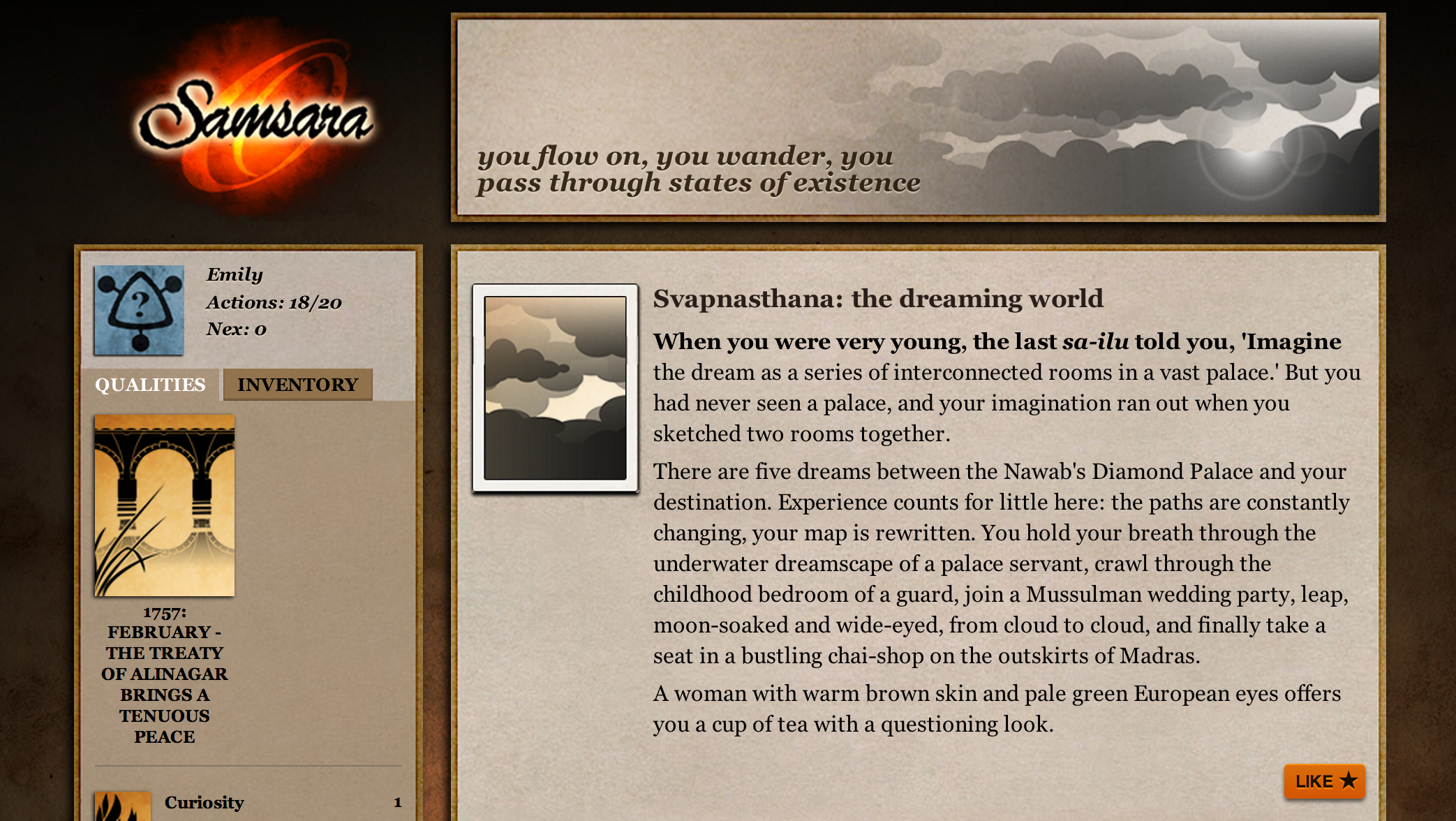
Samsara is a game written for StoryNexus, and the first place winner of Failbetter’s recurring “World of the Season” competition. (The second and third place were taken by Zero Summer, which appears to be an apocalyptic western of sorts [I have yet to play it]; and Evolve, a Spore-like story game that starts you off as a one-celled creature.)
For those not familiar with StoryNexus, it has set of mechanics that are more streamlined than Fallen London (fka Echo Bazaar) but with more persistent elements than Night Circus: there’s no map or travel paradigm built in, but the player has an inventory and stats, a deck of randomized cards to draw from (like FL’s Opportunity deck, or the sole deck in Night Circus), and a sequence of “pinned cards”, which represent quests currently in-progress. Cards look like this:

To play, you select a card — either one of those dealt from the randomized deck, or one of the pinned ones — and read a storylet setting up a situation; you can then try to do something about that situation (and often you have several options for how) or decide to put the card back and look at another instead. For instance:

(The imagery from these cards appears to belong to a common stock of StoryNexus images, though I’ve seen them rendered in other colors as well for other games.)
Success or failure in these various storylets depends on your stats and inventory, but even failure at a particular challenge will raise your stats in that area, so that you’re more likely to succeed if you try again. This is a system that can lend itself to fairly grinding content, and certainly Fallen London in its early days featured a sometimes-oppressive amount of grind. But that’s by no means a required feature, and some pieces (including Samsara) offer enough opportunities all the way along that it’s not necessary to redo and redo the same actions in an attempt to bulk stats out.
Another consequence of the mechanic is that it tends to be very much up to the player what narrative line she wants to pursue, and often playing a StoryNexus game feels like it’s more about texture than about plot. Moreover, because the stories are told so incrementally and the words themselves are the main reward for playing, each individual bit of text has to work very well on its own. The premium on well-turned sentences is higher in this medium than in almost any other kind of interactive narrative I know. Even parser IF is more forgiving.
Samsara deals gracefully with these challenges. Set in 1757 Bengal, Samsara casts you as a court magician with the ability to wander through the dreams of others, gathering information and planting ideas, choosing sides and reporting back as appropriate. The player can move back and forth between the waking and the dream states, depending on what she needs to accomplish.
This is a scheme that suits the StoryNexus platform well: the scraps of dreams are visionary and evocative enough to be effective in short prose snippets, while the political context naturally provides multiple quest lines to pursue and allegiances to explore. It’s also exactly the flavor of thing I love: historical fantasy with elements of romance, mysticism and intrigue, embedded in an unusual and beautifully envisioned setting.
Perhaps my growing familiarity with the system is at play here, but I was also impressed by how quickly Samsara gets its story off the ground. The opening phases of StoryNexus/quality-based narrative pieces are typically, in my experience, the rockiest aspect of the whole experience, because there is so much to teach about how the system will work, and because establishing character, setting, and motive within such brief snippets of prose can be challenging. Several pieces open with a long, linear introduction that doesn’t convey what the rest of the experience is going to be like, or else offer the player a bewildering array of options too soon. By contrast, Samsara establishes its core issues exceptionally quickly, introducing the idea of dream travel as well as the conflicts between local rulers, French and British army and trading interests, and competing religions and castes, all within a few short moves.
Like most pieces in this system, Samsara has an action meter and only allows playing so many turns at a time. On this scheme the current content lasts a day to a day and a half, ending on a cliffhanger; but there’s a promise of more to come, and I look forward to it.
IF Comp 2012: Murphy’s Law (Scott Hammack)
Murphy’s Law is a relatively brief parser-based slice of life puzzle game. As usual, the jump will be followed by non-spoilery comments; then if I have anything spoilery to say, there will be spoiler space. The fact that I am reviewing it at all indicates that there are beta-testers.
Continue reading “IF Comp 2012: Murphy’s Law (Scott Hammack)”
IF Comp 2012: The Test is Now READY (Jim Warrenfeltz)
The Test is Now READY is a puzzleless, parser-based sequence of moral choice scenarios. As usual, the jump will be followed by non-spoilery comments; then if I have anything spoilery to say, there will be spoiler space. The fact that I am reviewing it at all indicates that there are beta-testers.
Continue reading “IF Comp 2012: The Test is Now READY (Jim Warrenfeltz)”
 Emily Short's Interactive Storytelling