Where [do] you look for or find good inspirations, lessons and ideas for IF that come from as far from IF as possible absolutely no IF, no games, better if no pop culture, no media, no art).
Or, if I may put it better: how to enrich interactive fiction with inspirations, ideas and techniques originating in other fields, particularly in the most unrelated.
I asked for some clarification, which led to:
For me, perhaps the best would be: “this is how other people have found some unexpected new things to bring into IF, in case it might spark your imagination”.
This restatement makes the question much easier. There are lots of IF pieces inspired by events, places, crafts and activities, emotional experiences, or academic fields outside of interactive fiction — and many author essays about those processes.
The rest of this post collects links and excerpts on what authors found inspiring — and what aspects of their games were affected by the inspiration. A search for post-mortems on the intfiction forum will yield a very rich supply of other author essays, for anyone who’d like to explore beyond this collection.
September 1 is the deadline to register as an author for IF Comp, and the games themselves will be due September 28. This year, unusually, there is a move so that authors participating in the competition may also act as judges: this rules change may not be permanent, but it’s an experiment this year to help accommodate the growing number of authors and make sure games are getting enough voters.
And if you’ve got a fun prize that you’d like to contribute to authors, you can do that at the prize page. Good prize contributions can be all kinds of things: food, games, books, donations of art or other creative services, and modern or retro gaming souvenirs have all been popular prizes in the past.
September 18-19, Emperatriz Ung is running a session for the Asian-American Writers’ Workshop called Prototyping Memory, A Game Design Approach To Nonfiction, about using Inform and IF techniques to reimagine setting, perspective, and structure.
If you’d like to contribute a game, you only need to build it on the Seltani system and then leave a comment on the Meetup page to indicate that it’s been submitted for play. And if we don’t get a lot of entries (people are busy and it’s hard to tell in advance!) we’ll still meet and play through some of the existing games on the Seltani system. You’re more than welcome to come and play with us even if you don’t have time or inclination to write anything.
Roguelike Celebration runs online October 16-17, and is often a great place to pick up some talks on procedural generation of various kinds.
Releases
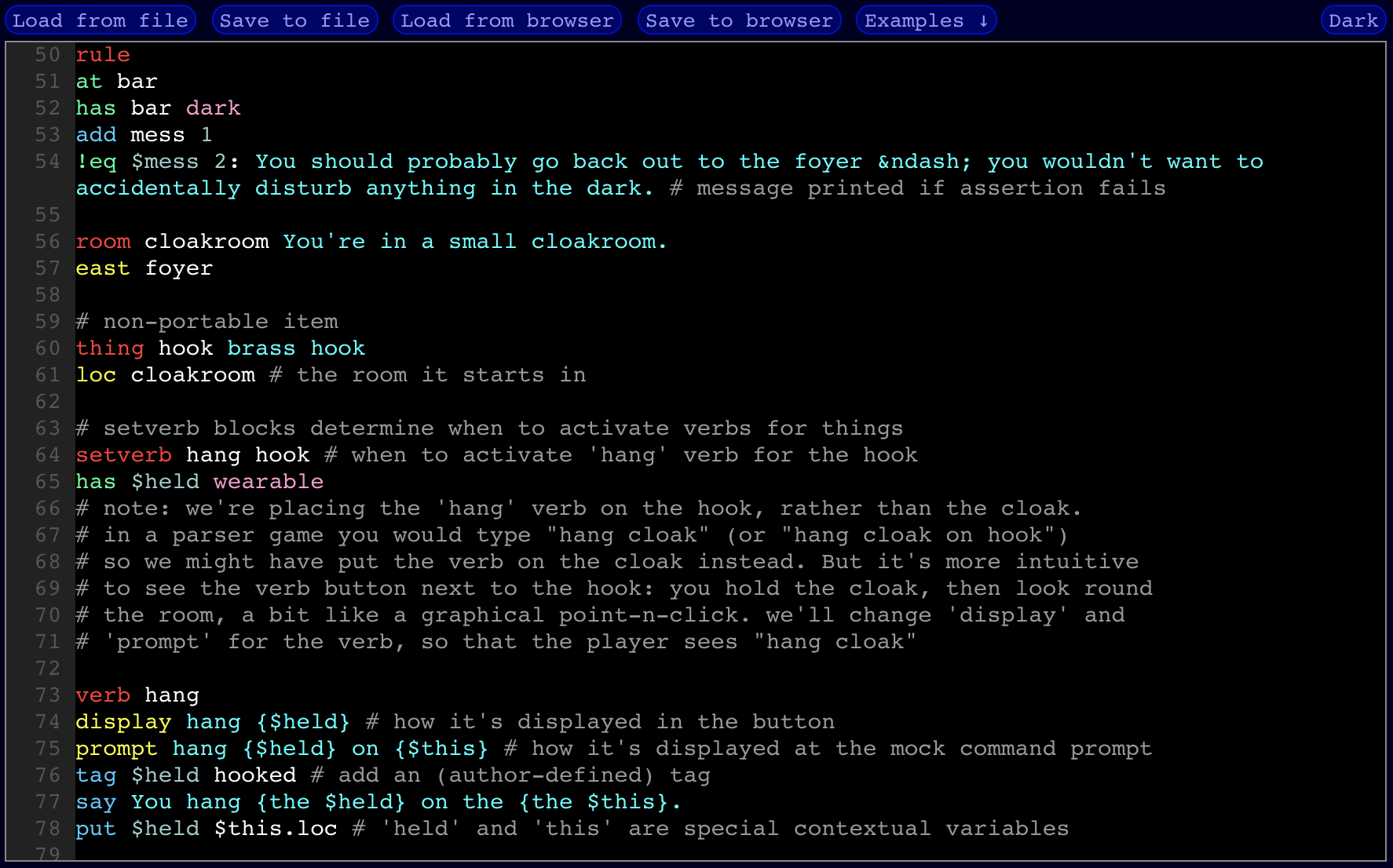
Sample Gruescript code for writing the classic Cloak of Darkness scenario
Robin Johnson has released Gruescript, a tool for making point-and-click text adventure games. The concept is familiar from a bunch of Robin’s past work, including IF Comp-winning Detectiveland: the player is offered a model world with items they can manipulate, much as in a standard parser text adventure, but the system explicitly presents all the verbs the player can use at any given moment:
Gruescript playing Cloak of Darkness
The included conversation system also supports topic-based conversation:
Gruescript’s conversation example
The system also comes with a full-sized sample game, The Party Line, whose source code can be loaded up for inspection when you start a new Gruescript project. The Party Line has a lot of familiar text adventure features: wandering NPCs with different associated actions, treasures and a place to deposit them to change the score, and randomised atmospheric messages.
At a recentish Oxford/London IF Meetup, some participants expressed an interest in writing for, and playing with, Seltani.
If you’re not familiar with it, Seltani is Andrew Plotkin’s multiplayer choice-based narrative platform. It lets players explore a shared environment, view each others’ actions, and change the world in ways that will affect others — in some respects like a MUD — but unlike a MUD, it’s navigated through clickable links.
Seltani is themed around the worldbuilding of Myst — hence the names and a lot of the imagery of Seltani’s hub space. But there’s nothing to force you to write your individual contribution to be Myst-related at all, and various experimenters have done Seltani projects with a different focus and feel entirely. Jason McIntosh’s Barbetween, for instance, is an evocative art installation piece about making contact with the emotions of strangers.
So the Meetup is hosting a jam. On September 19, we’ll get together and play some Seltani games together — starting with any new games that have been submitted for our consideration.
If we don’t get a lot of contributions, that’s fine, and we’ll play some of Seltani’s existing content together. But if you’re interested in building a Seltani game and then seeing it actually experienced by a multiplayer crew, this is one way of doing that. (The meetup page will let you sign up for the Zoom call and the other interaction here.)
Below the fold, a little guidance on getting started with a new Seltani writing account, and a few other links.
September 1 is the deadline to register as an author for IF Comp, and the games themselves will be due September 28. This year, unusually, there is a move so that authors participating in the competition may also act as judges: this rules change may not be permanent, but it’s an experiment this year to help accommodate the growing number of authors and make sure games are getting enough voters.
Aaron Reed’s 50 Years of Text Games has now covered King of Dragon Pass, which I strongly recommend reading: the game used techniques that we’re still very much exploring and discussing now, including elements we might now refer to as storylets with casting (that is, storylets that assign characters to particular roles). Well worth a look if you’re interested in the structure, code, or writing process of that game, or storylet games in general.
He has also done a lovely article on Galatea, getting into the context of its original creation and much Marnie Parker’s IF Art Show influenced the game in both form and content.
Hugo Labrande is offering a free monthly newsletter on retro text games called >REMEMBER. It offers histories and post-mortems; discussions of stripped down tools like tiny libraries for Inform 6 that will allow modern authors to write games that will still play on older systems and emulators; and discussions of text adventures in languages other than English, which often don’t get enough coverage.
In a completely different space: via @doougle , I ran into this article on The Missing Producer, discussing the problems that arise when indie game companies try to make do without a producer’s involvement, and a look at the types of sometimes-unacknowledged work that nonetheless must be done by someone.
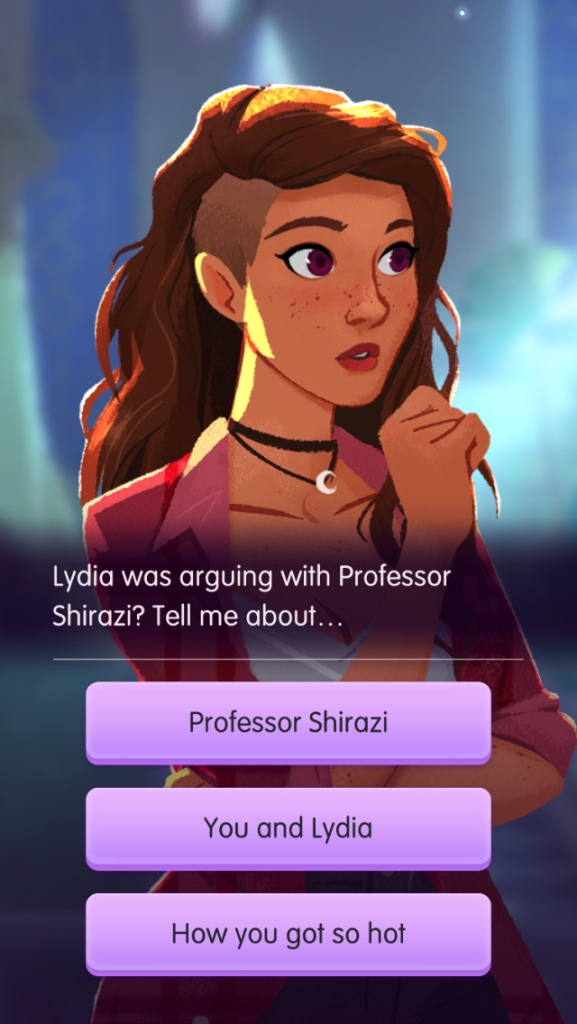
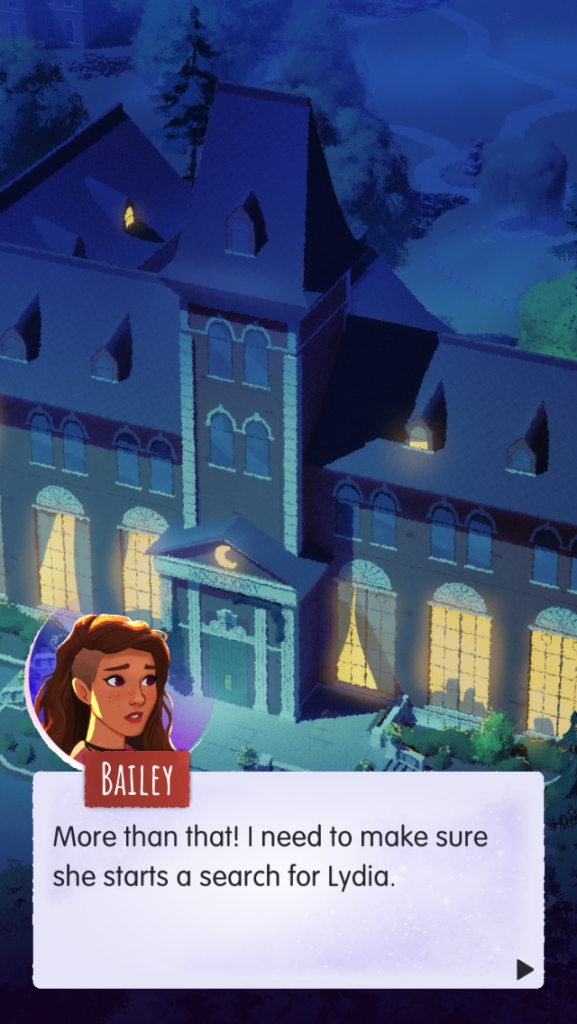
Screenshot from Wooga’s Switchcraft game, + choices
Screenshot from Wooga’s Switchcraft game, with lots of lovely art
If you like casual mobile games with a narrative element, roughly in the territory of Lily’s Garden — and if you live in the Canada/UK — you might also like Switchcraft — a match-3 game about girls at a magical school.
The story is a bigger component than usual for this kind of game, with a bunch of actual branching choices to make. I believe the title is not yet out in the US, but is expected to launch there later.
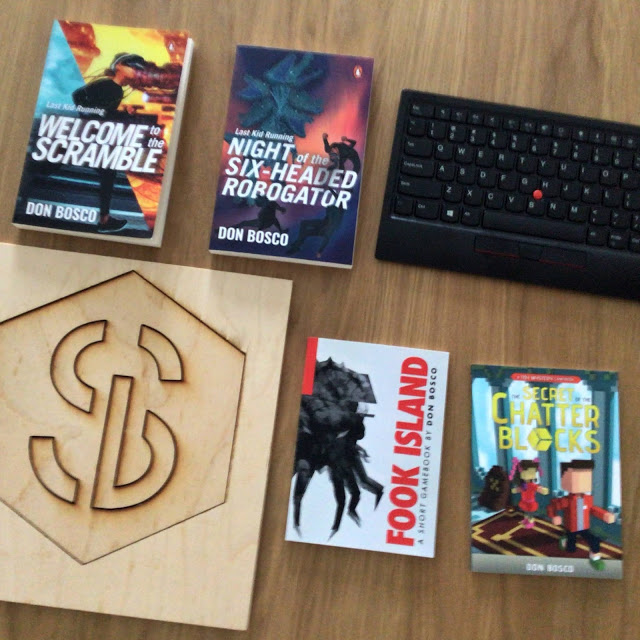
Last Kid Running is a gamebook series written for middle-grade readers by Singaporean author Don Bosco. The second book in the series is now out. Despite the physical gamebook format, Bosco is developing and testing his stories in Twine.
One of the requests was an article on how to provide NPCs with enough agency that they’re not place holders for plot points.
Despite the terms here – NPCs, agency – this is not necessarily a question about AI, character modeling, or even game design generally.
This is fundamentally a plot question. If you want active, agency-holding characters, that means knowing which character wants what – or which character fears what; how they’re trying to get it; and what incidents happen as a consequence. Only sometimes do game mechanics or tech come into it at all.
Plotting is one of the most invisible kinds of work you can do on a story. Beautiful sentences, funny dialogue, worlds with striking and memorable setting ideas: readers can often identify what they’re looking at when they see those things, and aspiring writers have lots of comprehensible examples to work from.
But plot’s harder to see in that way. It’s structure, not surface. It’s everywhere and nowhere.
The competition for games with a classic text parser, ParserComp, is just winding up now, so the results should be visible either now or in the very near future. And if you haven’t had a chance to play yet, you may enjoy checking out the range of games here.
August 22, the Seattle/Tacoma IF group meets from 2 PM to 4 PM PDT via Discord. It features Astrid Dalmady as the special guest, presenting some of her past work including Tangeroa Deep.
Paper submissions are due by August 12, and the event itself will be October 11-12. This workshop also has a “conversation starters” track, where people are encouraged to submit materials to spur discussion groups. Demos of languages are also welcome. If you’re working on a domain-specific language for interactive fiction development, this might be a place to share what you’re working on.
September 1 is the deadline to register as an author for IF Comp, and the games themselves will be due September 28. This year, unusually, there is a move so that authors participating in the competition may also act as judges: this rules change may not be permanent, but it’s an experiment this year to help accommodate the growing number of authors and make sure games are getting enough voters.
Kickstarter
A Compendium of Lesser Known Cryptidsis a non-interactive anthology but with some gamelike aspects, bringing together work by several game and interactive fiction writers:
A 50-75 page illustrated anthology of unique or “off-brand” cryptids compiled by the Seldom Valley Cryptid Society (SVCS). The SVCS documents its sightings with a variety of articles, diagrams, interviews, and photographs courtesy of more than ten independent researchers and consultants as well as a variety of field artists. Compiled like a research file, the compendium is a valuable source for any cryptozoologist looking for something new.
Aaron Reed’s ongoing series 50 Years of Text Games has now reached 1998, and covers Photopia.
Those who liked my GDC talk “Sigmoids for Storytellers” — or those who didn’t see it but just thought it sounded interesting — might also be interested in Bruno Dias’ article A Bestiary of Functions for Systems Designers.
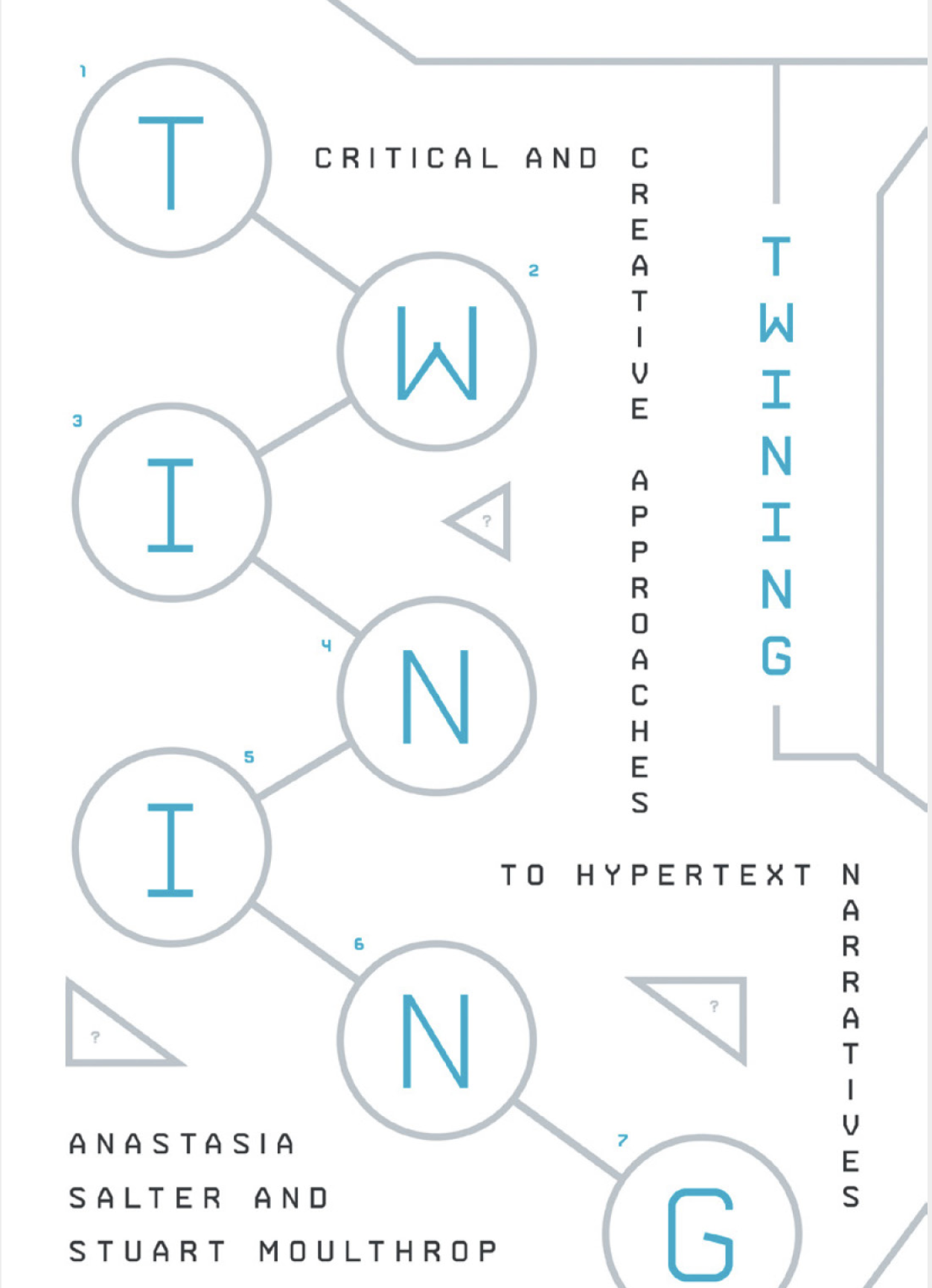
Twining: Critical and Creative Approaches to Hypertext Narratives by Anastasia Salter and Stuart Moulthrop is an approach to Twine as a tool and various Twine games in particular. Its introduction speaks of teaching Twine as part of an undergraduate course in interactive narrative, and documents, in a quite accessible form, the experience of teaching that class specifically during the beginning of the pandemic in 2020, and the ways that student projects reacted to the moment.
The chapters alternate between theoretical and practical discussions (with chapter headings marked T and P for clarity): the book is designed to help people interested in writing their first Twine story/game, but also to provide some historical background on the development of the tool and the surrounding communities, and to offer readings of both text and code from well-known Twine works.


 Emily Short's Interactive Storytelling