An Earth Turning Slowly is a submission in Shufflecomp. Shufflecomp is a comp with an impressive 33 entries (and one more written for the comp but technically outside the rules), in which IF authors created games based on music suggested by other entrants. It’s like a giant mix-tape IF compilation, and the games include Inform and TADS parser games as well as choice-based Undum, inklewriter, and Twine pieces. (The excluded game is a Seltani age, excluded because it breaks the comp’s rules about archivability.)
An Earth Turning Slowly is… an Undum parser game? A choice-based game with partially hidden choices that you access by typing? The parallel-universe anti-twin of Jon Ingold’s The Colder Light?
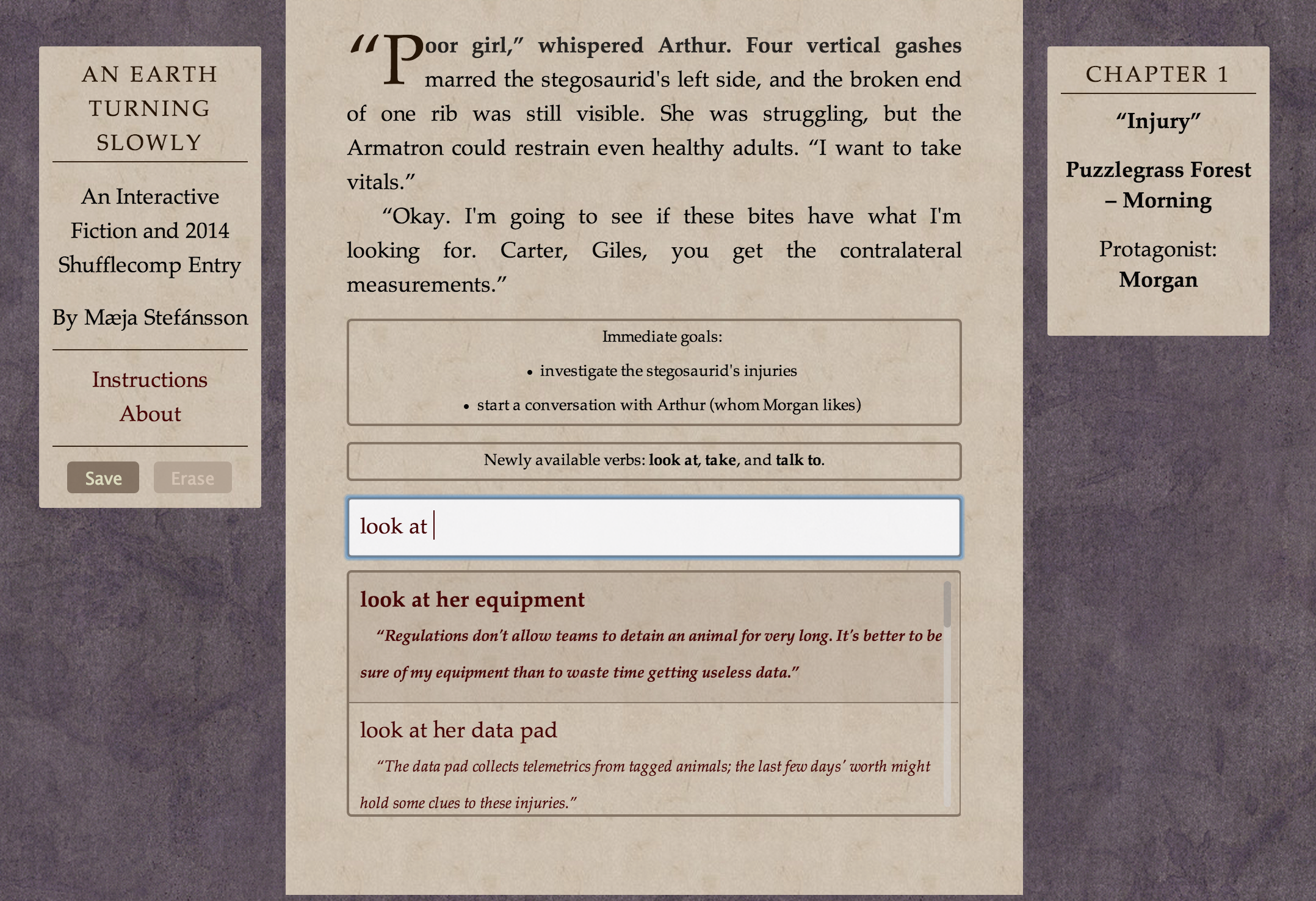
Here’s how it works: you type the beginning of a command. AETS supplies a menu of possible completions for the command that are currently valid. If you type something that’s not on that menu, you can’t submit it, so there’s no need for actual parser error messages: you never get as far as submitting a malformed command.
I’m fairly sure this isn’t doing most of the work your classic parser has to do, as far as breaking up sentences and looking for objects in scope and matching against them; I don’t get the impression that there’s that much of a world model under the surface. The menu is making up for that work, because it pattern-matches the beginning of a valid command and then helps you complete that command in the one way that the game is actually designed to understand.
So for the author, there’s less error-message-writing and bad-entry-handling to do; for the player, there’s less opportunity to get caught in guess the verb/noun situations. The effect of the system isn’t just to eliminate problems, though: the menu also comes with a sentence or two describing why your protagonist might be considering that particular action, which gives it some extra context.
This is all quite nifty. I really liked having Undum’s attractive presentation associated with a parser game. It feels so elegant. I think there’s possibly a bit more infrastructure around the command line than is strictly ideal — a lot of the page is taken up telling you what you’re trying to do and what you could possibly type — but I think this could be tweaked. (And I don’t dislike it as it stands; I’m just tempted to streamline a little.) Those who are at all interested in the ongoing discussions and debates about parser/choice game UI really really should give it a look, and I hope that the author will choose to share the code or make a tool available after the competition.
All that and I’ve said nothing about the story! It’s a short SF story; short enough that I don’t want to say very much and spoil it. I did feel a bit frustrated halfway through that one of the viewpoint characters seemed not to realize an obvious action when I had already figured it out, but that can be a tricky point to get right. Nonetheless, I enjoyed the read. I might have enjoyed it even more if I hadn’t been distracted by trying to analyze how I felt about this fancy new UI. (Note: it is not the author’s fault that they have created multiple intriguing elements in the same game.)
 Emily Short's Interactive Storytelling