Events
December 3 is the Bay Area IF Meetup.
December 14, the People’s Republic of IF meets at MIT to look at some of the remaining IF Comp winners and discuss future project plans.
December 30 is the Scouring of Scotia, a live-via-Twitter shared gamebook/IF experience.
The Oxford/London IF Meetup takes a holiday in December.
 New Releases
Quite a lot of good stuff has come out this month, even not counting the end of IF Comp and the ECTOCOMP games I reviewed previously.
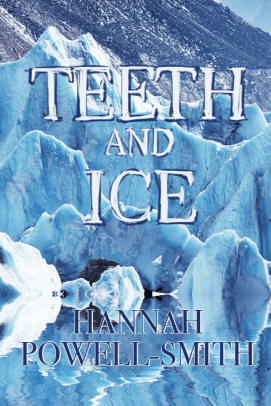
Sub-Q brings us a new story from Hannah Powell-Smith, a Raconteur piece called Teeth and Ice. It’s the story of a selkie trying to retrieve her skin; I lost several times, but it is possible to succeed, if you manage your resources right.
Xalavier Nelson Jr. (author of the comp game SCREW YOU, BEAR DAD) has a new piece out called Mazurka – A Ghost in Italy, now available on itchi.io for $0.49. It is a short, reflective story about prejudice, race, mental health, and fitting in vs. not; like some of Nelson’s other work, it uses link clicks very extensively to pace reading, and I found that more than usually effective in this particular work.
Ibis, Fly is a poetic new piece from Mary Hamilton, about being a bird who befriends other birds. Clicking the text often cycles between human and bird perspectives, turning familiar words into less recognizable descriptions of the way a bird might perceive these items. (See also Hamilton’s previous work, Detritus.)
Laura Michet’s Brigand Story is a horror piece about a tale told and retold and retold around the campfire, and what goes wrong with the telling and the tale. The words break down, repeat, stumble on themselves and change. It’s definitely its own thing, but might appeal also to people who enjoy Michael Lutz‘s horror.
Burnt Matches from Pippin Barr is concrete poetry…

…in which each screen is a textual space to be traversed. Many of the interactions are subtly witty: long walks that head off the edge of the screen, words that ripple as your cursor passes over them. The whole doesn’t really yield to simple literal explanation (or it doesn’t for me), but it describes a journey that feels at least tonally consistent. There are echoes out of The Waste Land, lilacs and tarot cards and full fathom deep. But then also flickering screens of chess moves and alphabets I don’t read, which often must be manipulated (without understanding) in order to open the transition to the next screen: a content-free form of hacking that reminds me of 90s cyberpunk novels. And then just cold, frost and chill rooms and water, everything guttering until the world-text disintegrates into a field of simulated Twine errors. (Like, but also completely unlike, B Minus Seven’s use of Twine errors in Inward Narrow Crooked Lanes.)
Then also, new from Porpentine, Miss Clemory and the Wall of Fire:

Its sole IFDB review at the moment describes it as good writing draped over not much story, but I disagree with that assessment. Yes, there’s a lot of metaphorical language in this piece, but the choice of metaphorical content is itself extremely revealing: the protagonist is very self-conscious about being a narrator, and the narration tells you quite a bit about who she is as a person. Meanwhile, the core of the story is about the distance between siblings, and the relationship between creative people, and the way we use language to manage and control and keep someone away. It has a short-story-shaped plot rather than a big bold adventure plot, but that suits this particular work.

 EctoComp
 Or you might like Bruno Dias’


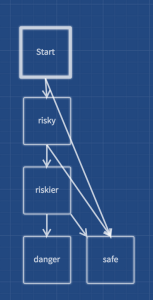 Confirmation-required Choice. One of the things Jon talks about sometimes is the use of text to let the player opt in to doing something profoundly stupid, through a series of escalating choices. Are you sure you want to do this? It looks like the monster is getting angrier. Are you still sure you want to attack? Yes? You notice that the monster’s bite is poisonous. Are you going to attack now?
 Track Switching Choice. A variant on the Confirmation-required choice is one where the player is allowed to change their mind in either direction for several beats. Later beats might introduce some potential drawbacks and warnings about whatever track the player is currently pursuing. Like the confirmation-required choice, this is a way to give some extra weight to a decision and emulate a situation where the protagonist might be genuinely conflicted about what to do next.
 Emily Short's Interactive Storytelling