Missive is a choice-based optionally-puzzly CYOA. I played through it several times, including to a final “correct” outcome.
Author: emshortif
IF Comp 2014: Jesse Stavro’s Doorway (Marshal Tenner Winter)

Jesse Stavro’s Doorway is a parser-based story of time travel and time-travel-related mysticism. I played to the end, though I relied heavily on the walkthrough to do so.
Continue reading “IF Comp 2014: Jesse Stavro’s Doorway (Marshal Tenner Winter)”
IF Comp 2014: Paradox Corps (John Evans)
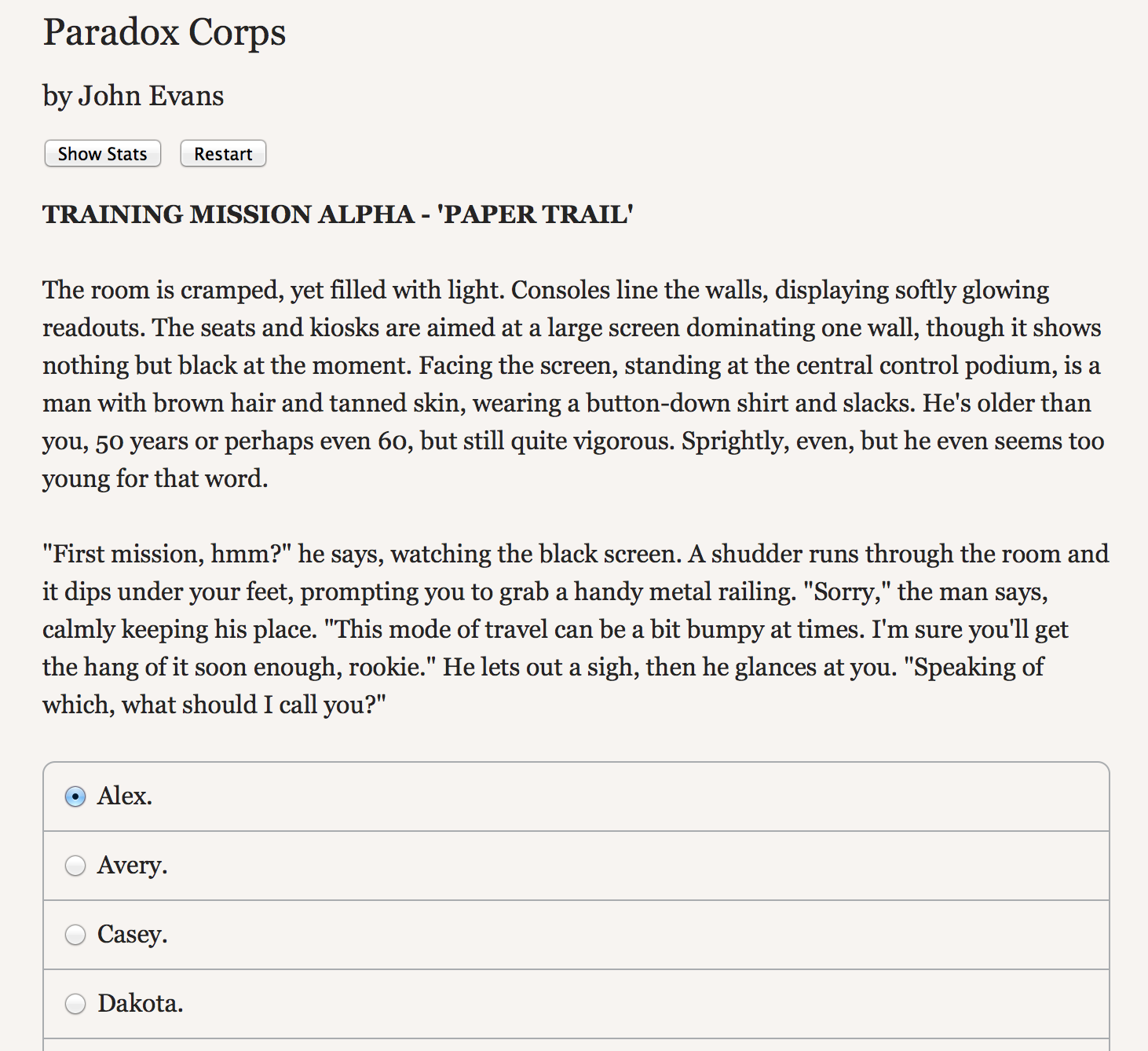
Paradox Corps is a ChoiceScript game about being part of a temporal law enforcement group. I played through to a negative ending, but am not quite sure what I should have done in order to get a positive one instead. No walkthrough is provided.
Elegy for a Dead World (Dejobaan Games)
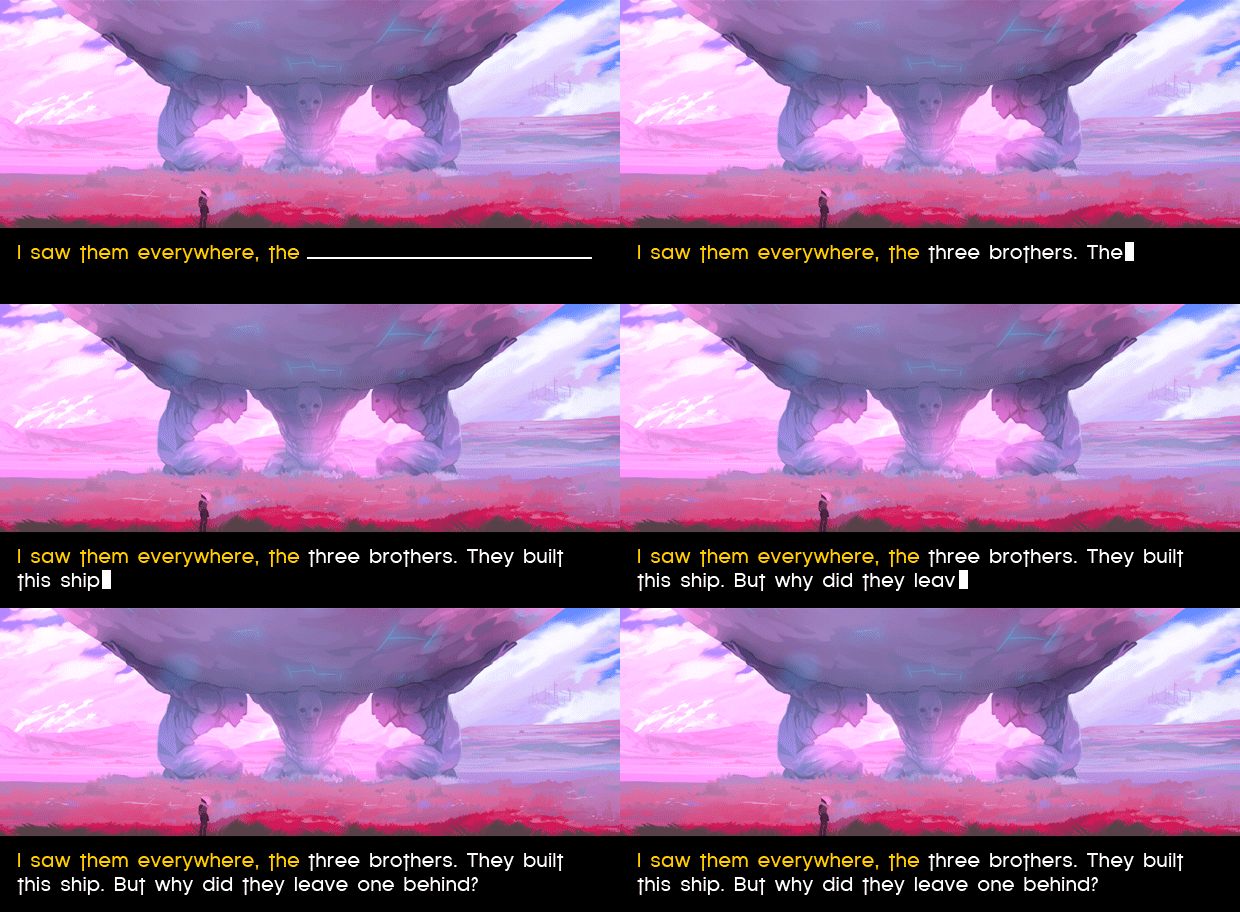
Elegy for a Dead World is a game almost entirely about aesthetics and interpretation. As the player, you traverse artistically rendered side-scrolling environments, and from time to time you find a place where you’re encouraged to make some sort of annotation. The idea is to develop a story of your own based on the images you see, and then (if you wish) to make your version of the story available to others.
I played the version that the team submitted to IGF last year. At that point, it was a little more freeform than it looks currently (judging by the screenshots); you could stop and annotate anywhere you wanted, rather than having sentence-starters that you need to fill in. I spent quite some time going back and forth over one of the worlds, developing it into a storyline and then returning to edit earlier bits to keep the whole thing consistent. That was a little bit laborious, but also cool, because I could wait until the background and foreground elements were arranged just as I wanted them and then write something that corresponded to that precise spot.


This is sort of what I was trying for with San Tilapian Studies, but that was such a one-off experience that it was difficult to collect meaningful player feedback; likewise, the (now long ago) Walkthrough Comp, which provided a bare series of commands and invited authors to write games or full stories around those commands.
I’m particularly interested — though I think there’s not yet enough evidence to come to any conclusions yet — in the question of what sorts of prompts and images prove to be most richly productive of different interpretations. Again, I’m going off my experience at the time of last year’s IGF, so things may be substantially different now, but my impression then was that most people’s stories felt somewhat similar: while there were these evocative and non-prescriptive images to work from, they nonetheless tended to suggest roughly similar events and tonalities to the players. Contrast, I suppose, the tarot, which is notoriously fluid and variable in what different cards say to different people; Mattie Brice has written several intriguing articles on this topic.
Is there a form of interpretive game design that consists of coming up with especially resonant, multivalent images? What would skill in this area look like? How much does it matter that the tarot is a system with a built-in structure of relationships between the images?
Speculation aside, Elegy is really one of the only video games I know of to be seriously exploring this area.
IF Comp 2014: With Those We Love Alive (Porpentine, Brenda Neotenomie)

With Those We Love Alive is a choice-based nightmare-fantasy game, with music, which also requires that the player draw on her own body during play. I played it to completion.
Continue reading “IF Comp 2014: With Those We Love Alive (Porpentine, Brenda Neotenomie)”
The Uncle Who Works For Nintendo (Michael Lutz)
Michael Lutz, author of the deeply creepy My Father’s Long, Long Legs, has a new piece out called The Uncle Who Works For Nintendo.
Continue reading “The Uncle Who Works For Nintendo (Michael Lutz)”
 Emily Short's Interactive Storytelling