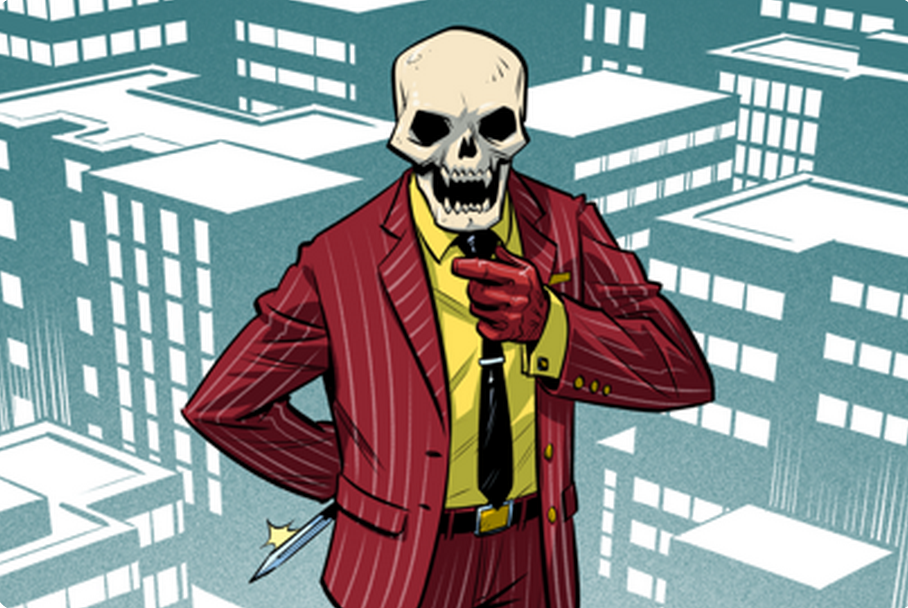
Choice of the Deathless is the latest piece from Choice of Games. Written by Max Gladstone, it’s billed on the Apple app store as “a necromantic legal thriller,” and it moves well away from the Choice of [Generic Trope] format of some of CoG’s earlier releases. Gladstone is writing within the same universe that he used for his two novels, Three Parts Dead and Two Serpents Rise: a world where high-powered law firms are engaged in the partially legal, partially magical exercise of managing the contracts that bind gods and demons. The Craft is a technical and brutal magic, done with blood and shards and entrails and a great deal of legalese.
The result is the most solidly written Choice of Games piece I’ve yet played. Gladstone’s descriptions sometimes run a bit wild for my taste: strange settings are extremely strange; painful experiences are bloodily painful. As a reader I find it hard to invest in a story that is kicked up to eleven that way on every single page. Nonetheless, his prose is confident, and he spends enough time with the various characters to develop them in detail.
Choices are often about the internal politics of the firm: whom to trust, whom to betray, whom to ask for a favor. The plot is fairly linear, in the sense that the major cases you encounter will tend to be the same over again on multiple playings — but the motivations you choose for yourself, and the relationships you have with other characters, do change substantially. One character was a minor enemy in one of my playthroughs, only to become my lover in the next. It’s a less branchy structure than some of CoG’s past stories, and I’m not sure I’d replay it as many times, but I enjoyed and cared about the individual playthroughs more. And those midgame choices about motive and affiliation do pay off in the endgame, when your range of options is very clearly tied to what you’ve done up to that point.
Indeed, in general I felt as though Choice of the Deathless was making less use of stats than the average CoG game, and more use of important narrative decisions that are remembered later. It’s the difference between having story gated on whether you’ve selected at least 5 “bold” actions so far, and story gated on whether you once did a single, memorable brave thing. Choice of the Deathless is tracking a range of stats for you, which you can go and look at, but the big outcomes seemed to involve callbacks to specific moments.
There were a few flaws.
Just occasionally I was offered a choice that seemed reasonable to me as the reader, but turned out to have been a mistake for some unanticipated reason — for instance, revealing my character’s ignorance about something she should have known. That was a bit frustrating, and I would have preferred the choices to be rephrased to reflect what my character knew about those options.
There is also a thread of decisions tracking how you’re spending money during the course of play, and you’re repeatedly invited to adjust where you live and how much you’re saving to pay down student loans. This is the case whether you come from a poor family or a wealthy one. The emphasis on this aspect made me think it must be an important part of the gameplay, but in fact it remained fairly peripheral to the actual story. I felt the piece would probably have done better just to jettison this; it felt to me like something introduced because the author thought this sort of stat challenge was necessary, but then underdeveloped. At no point in the body of the story did I notice my economy-management choices having a significant effect on outcomes. In all of my playthroughs I managed to pay down part but not all of my debt, but what exactly the numbers came to didn’t seem to matter.
Those quibbles aside, Choice of the Deathless is a pretty sizable piece, set in a detailed universe and confidently written.
(Disclosure: I received a review copy of this game.)

 Emily Short's Interactive Storytelling