Charlotte: Prowling For Enchantment

“I’m a vampire. It’s very boring.”
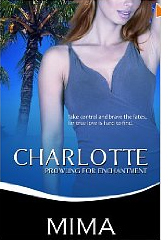
Thus Ryder, one of the love interests in the CYOA Charlotte, Prowling for Enchantment (Take Control) (also available for iOs). Personally I think it a little risky lamp-shading the tedium of your own characters, but Charlotte doesn’t have much fear on that front. Or how about this:

The bubbling sexuality eating at her flashed into steam.

This is one of those metaphors that’s not so much mixed as fatally mangled at the blender factory. How can a liquid both bubble and eat? Are we talking about a flash-boiled acid here? Or, speaking of hot things you don’t want to be dipped into:

Lava tickled the tender skin between her thighs.

Such a tease, lava. Or

She needed a drink. Of skin.

You just don’t really want to think about that too hard.

The prose is not good — not keenly observed, not stylish or lyrical, not surprising — but it has a glossy professional assurance. And, indeed, the author, who works under the name Mima, has apparently published a whole series of non-interactive paranormal erotic romances.

The premise is that the protagonist has gone on a cruise, not realizing that (a) the cruise is a singles cruise for fantastical beings and (b) she has paranormal powers herself. At once she is being fought over by a vampire and a werewolf (where have I heard this before?). The first choice, therefore, is about which of the two she’s going to spend the night with. From there, many of the additional choices are about whether she is going to use her power, as it turns out she can command people to do her bidding. You would think she would have noticed this before the age of 29, but apparently the power is activated by proximity to bodies of water, and she was raised to avoid them all her life.

Some of the paths have a fair amount of plot; others are almost entirely porn, the kind of porn consisting largely of boggling euphemisms. (“The pleasure roared past like the blue line metro had missed its stop.”)

As CYOA, it’s structurally unusual. The passages between choices are long — the app calls these chapters, and it’s not wrong to do so — and there can be only three or four choices in a complete play-through. This makes the choices seem more surprising when they appear, because there’s so much that Charlotte decides to do of her own accord that getting agency back is a little startling. It is also a bit of a drag on replay (at least, I thought so), because there’s necessarily such a lot of previously-seen text to reread before one gets to any new branches.

It does offer a fairly polished interface, though, and the credit text on the iOs version is interesting: it invites published authors or professional writers to contact Branching Path Books to get their adventures out there.

The tactic of approaching static-fiction authors with an established fan base and getting them to write various types of interactive fiction has been discussed before, but I don’t know of a lot of cases (post-80s, anyway) where it’s happened. Mima isn’t exactly Stephen King, but there are those 19 published erotic romances; and the result is a CYOA that feels fairly different from the average example of the genre, both because of its subject matter (mostly the “silken bar” the vampire has in his pants) and its structure (choice points are rare and feel arbitrarily placed, with the emphasis of the experience still mostly being on the author’s story vision).

The King of Shreds and Patches for Kindle

Jimmy Maher’s The King of Shreds and Patches is now available for Kindle. That makes it to the best of my knowledge the first piece of stand-alone parser IF to appear for sale on that platform. (There are choice-based stories by Choice Of Games, a piece or two by Jon Ingold, and Inheritance, which apparently offers a menu-driven approach to an IF-style world model, but I believe this is the first release that offers a standard command line.)

What’s more, Jimmy’s blog post on the topic seems to suggest that the underlying engine may be able to present other Glulx games on the Kindle in the future. This is a relief to me. I’m constantly being asked why there isn’t IF for sale on the Kindle. Now there is! Look! See!

I haven’t had a chance to play the Kindle version myself — I can read Kindle books on my iPad but not play the interactive Kindle games. But I have played the original, and can say that it’s a massive, meaty, plot-rich piece of work. (Review here.) Recommended.

My Secret Hideout

A secret treehouse
Treehouse with observatory
“My Secret Hideout” is a new iPad application from Andrew Plotkin, which bills itself as interactive art or poetry or a toy. Technically it’s a bit easier to describe: it’s a text generator manipulated by an intentional cryptic and evocative graphical UI. You drag and drop new nodes onto a tree, and the text on the lefthand side changes in response to what you’ve just done. The structure you build maps to a random seed that determines the textual output. Move nodes, and content changes. What it creates is a description of a location or a string of linked locations: IF-like room descriptions, only without the ability to manipulate the objects directly. Consequently it shares some of IF’s appeal — the visionary access to a place of someone else’s imagination. There are a lot of zarfian ideas here. The secret hideout you produce will likely feel like a Myst-like place, a dwelling for mystical inventors, combining machines and instrumentation with natural materials.

For instance, the tree image here produced the following description:

My secret hideout is a ring of beautifully-ornamented cubbies hanging in a pine stand. A doorway, engraved with territorial diagrams, opens out to a core room, overgrown with ivy.

The hideout is powered by a miniature steam boiler, rattling cheerily on a side platform, in a small cabinet.

An observatory is on the left side. A high-powered telescope is set up by a smoky grey beanbag chair. An antique mechanical clock stands on a pile of blocks. A bookshelf of astronomy reference books stands to the side.

This isn’t in any meaningful sense a game: there aren’t any goals, scores, win/loss states, etc., and it’s hard even to see how one might project such things onto the structure.

It’s also not a story. I’ve often argued for the power of setting as a story-telling mechanism, and the significance of objects as conveyors of narrative, My Secret Hideout doesn’t entirely respond to that kind of treatment. The descriptions are too flexible, the whole output too mutable and dreamlike. While it’s possible to make up theories about why the narrator built this particular hideout and what it all means, there’s too little control over content — or opportunity to select and label favorite content yourself — to encourage that mode of thinking for very long (I found, anyway).

To the extent it is a toy, the toy-nature is about figuring out how it does what it does and how much agency you can reasonably exercise over the output. As you may want to work that out for yourself, the rest of the discussion might be considered moderately spoilery, hence the cut.

And then I’ll talk about what I think it is, and to what extent it’s good at being that thing.

Continue reading “My Secret Hideout”

The Night Circus

The Night Circus is a new game by Failbetter, the creators of Echo Bazaar, set in the fictional world of the forthcoming book of the same name by Erin Morgenstern. (I should say as a disclaimer, before I go any further, that I’m not a completely disinterested party — I’ve worked with Failbetter several times in the past, and hope to do so again in the future, and I also did some beta work on the game of The Night Circus.)

A few of my mementoes
Structurally, The Night Circus is quite a bit like Echo Bazaar, but tighter and easier to get into. If you’ve ever looked at EBZ and thought that it was more confusing or more of a commitment than you were ready for, Night Circus is doing some similar narrative experiments in a more streamlined fashion, with a shorter lead time and fewer optional extras. (There’s no store to buy objects from, for instance, and no map to move around — just a set of storylets to choose from at any given moment.) Brief text passages let you explore the environment of the circus and make choices about what you’re interested in pursuing. As you go, you accumulate mementoes — an inventory of physical and non-physical rewards from your exploration, some of which are required to open up new possibilities. Because it’s about exploring the mysteries of a setting and making serendipitous connections, it’s light on plot and strong on imagery, but there are some gradually accumulating ideas nonetheless.

The art is disciplined and evocative. Night Circus’ commitment to a black-and-white-with-red-touches scheme means the iconic art fits together well, even when the images are of quite different things.

There is a diary, to which you can save the text of events that are most important to you, and there’s the option of adding your own brief comment to something you’re recording. (Here’s mine, containing some of my favorite snippets from play so far, and here’s another from someone who comments more extensively than I do.) The diary is something EBZ does also, but (IMO) less effectively: Night Circus lets you add things to your diary even if you don’t simultaneously choose to tweet them to your friends, which means that you can make decisions about what you want to include in your personal narrative record without agonizing whether you’ve annoyed your twitter list enough for one day. I’m keenly interested in this technique: it encourages players to think about which events are important and memorable to them, and cooperate in constructing a narrative for themselves. I’d like even more to be able to go back and change the tagging on past events, I think, but that might be a bit heavy-handed for this particular piece.

Alexandra Leaving

There’s a review of Bronze on IFDB that I’ve been thinking about a lot lately.

After hearing so much about Bronze, I was expecting a very satisfying and pleasurable experience. This was not the case for me… I came away feeling like the entire experience was rather hollow and somewhat forced… Beauty and the Beast is a beautiful love story, but in this version of the tale, I felt that the protagonist’s relationship with the Beast lacked very much warmth or deep love.

This is a challenging review for me. Obviously, I’m sorry the reviewer didn’t have a good time. It’s possible that I could or should have done something to frame the presentation of the game to make clear that it was not going to be a traditional fairy tale happy-ending romance. (The closest thing to that I’ve ever written is Pytho’s Mask, which, not coincidentally, has some pretty shallow characters and a heavily gender-bound treatment of love; even so some subversive elements snuck in before the end.) Perhaps I seemed to offer something the game was never going to deliver — and, for what it’s worth, I do think that players have the right to want specific things from their games. Indeed, if the player doesn’t want something, she’s not likely to play for long.

However. The unromantic aspect of the game is not a mistake. On the contrary, it is the summation of the effort and thought that went into its creation.

Continue reading “Alexandra Leaving”