IF Comp 2015 is Open

ifcomp15 And we’re off! The games of IF Comp 2015 are now available. There are a record number of games this year — 55 in all — beating out the previous high of 53 in 2000. This is especially impressive when you consider this competition is now in its 21st year.

I will be reviewing, but I’ve made some changes to my reviewing policy: specifically, no longer reviewing works for which my overall impression is negative. This doesn’t mean I’m binding myself to say only positive things, just that the overall take of the review needs to be a net Recommend. In doing this, I’m responding to assorted feedback over the years that the comp can be too harsh to new authors and to those unfamiliar with its expectations. The IF world has grown bigger, richer, and more diverse over the past couple of years, which is a terrific thing; it means we get games from everyone from published authors and pro game devs to teenagers making their first experiment with a game making tool. But the diversity also means that not every game is likely to be for everyone, and that’s okay.

If you are also reviewing, thank you! I love reading other people’s reviews, and one of the great things about the comp is the community of discussion that surrounds it. Also, hydrate. 55 games is a lot.

Okay. :Puts on Batsuit.: Let’s do this.

IntroComp 2015

IntroComp is a yearly IF competition which invites participants to send in the first part of a game. Judges vote on how much they would be interested in playing the rest of the submitted game, and authors who finish and release their pieces within a year are eligible for a prize based on where they placed. The games for 2015 are currently available, and judging is open through August 21.

Below, thoughts on the pieces I ranked highest.

Continue reading “IntroComp 2015”

ShuffleComp, 2015 edition

ShuffleComp is an interactive fiction comp in which participants send in lists of songs; the songs are shuffled and redistributed, and each participant writes a game based on one or more of the songs they received. (Last year’s competition yielded some 34 games and is responsible for not one but two games titled Fallout Shelter.)

Here are some favorites from this year’s comp:

Continue reading “ShuffleComp, 2015 edition”

Spring Thing 2015: Ruiness (Porpentine); Missing Since ’77 (Andrew Watt)

Ruiness is a Porpentine game, and as such is typically difficult to summarize. It takes place in an evocative post-apocalyptic wasteland in which people have roles like “scavenger” and “dustrunner”, as well as apparently belonging to different species and riding various creatures.

Most of the gameplay is exploratory and concerns uncovering new places to go, or else new kinds of character to be — in this regard it reminded me of Contrition. Both Ruiness and Contrition take some concerted work to explore fully; they don’t feel like puzzle games, precisely, but they are more demanding to navigate than the average Twine. (In fact, I’m reminded a bit of Toby’s Nose, here.)

I’m not sure I could summarize what happens here at a plot level, and sometimes the descriptions become more prose-texture than denotative. One of the curious things about Porpentine’s work is her ability to make worlds and stories that are navigable even when they take place in an utterly alien environment. This effect is fully in force in Ruiness.

Through both mechanics (the replacement of one protagonist with another and another) and content (the endgame), the story suggests that the experience of individuals is relatively unimportant, that their culture and history is being shaped by supervising forces far beyond their comprehension. I found this simultaneously bleak and comforting: bleak because it was hard to enter into any one character’s life in any depth, comforting because the supervisory force seemed to at least desire positive outcomes such as a reduction in war.

*

Missing Since ’77 was entered in the Back Garden because it’s a demo of an unfinished game. The results were certainly polished enough to have made this a reasonable contender in Introcomp, and I’m glad to see the Back Garden option used for a variety of purposes.

The game identifies itself as fantasy, but most of what we see in the setup is set in the real world. This appears to be a portal story in which a character has gone missing in an alternate fantasy universe, but it’s told from the points of view of those looking for him, namely his wife and the young detective she’s hired. The game starts out in the detective’s view, then switches to the wife’s and retells the same events (some of which depend on what the player did the first time around) with an alternate perspective. Like KING OF BEES IN FANTASY LAND, it uses a change of typography to indicate when we are seeing through new eyes.

This is an ambitious approach, uncommon if not absolutely unknown in other IF: Stephen Granade’s Common Ground did multiple-perspective retelling in the form of parser IF, and a handful of time travel puzzle games record what the player has done and repeats these back to allow the player to collaborate with other selves — Fifteen Minutes being a notable recent example.

To work, this kind of design requires rigorous state tracking (though possibly this is less fiddly in Twine because there’s less state to worry about) as well as good enough writing to make a second pass through the same scene interesting to the player. Missing Since ’77 did pull this off, at least for me.

I enjoyed this and would be curious to see more.

Spring Thing 2015: Toby’s Nose (Chandler Groover)

tobynose

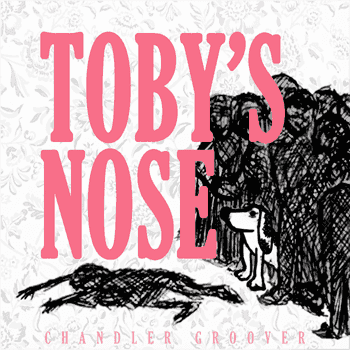
The premise of Toby’s Nose is that you are Toby, a dog belonging to Sherlock Holmes, and your task is to sniff out a murderer from a roomful of suspects. There are quite a few possible suspects to choose from, so while you could solve this by a process of elimination, it is more satisfying to try to work out the clues for yourself.

There are no intermediate puzzles per se: the entirety of gameplay consists of examining and smelling things until you’re satisfied that you’ve pieced together a backstory that makes sense of the whole. Playing the game well is about being very thorough; and though “explore a conceptual space via parser” is a relatively recent design trend, it reminds me of the exploratory aspects of old-school IF. It used to be — back ca. Curses or so — that authors considered it totally fair to hide things under beds and behind paintings without providing the player with any clue that they should look there. Thorough and relentless examining was just one of the things that a IF player was supposed to do.

Chandler Groover cites Castle of the Red Prince and Lime Ergot as inspirations, and indeed the influence of both is very clear. As Toby, you can not only smell things that are in the room, but you can dig deeper into the remembered and trace scents from other places; so, without moving, you can smell (and thus get descriptions of) other rooms of the house and indeed parts of the countryside and of London that turn out to be relevant to the mystery. The traditional locational model of interactive fiction melts away and is replaced by conceptual movement — just as, in Lime Ergot, it’s possible to zoom in on a particular remembered image, or in Castle of the Red Prince it’s possible to interact with far-off things and bring them instantly into scope.

Continue reading “Spring Thing 2015: Toby’s Nose (Chandler Groover)”

Spring Thing 2015: Mere Anarchy (Bruno Dias)

I didn’t run reviews during Spring Thing because of having my own Back Garden entry. I’ve also changed my review policy for comps: moving away from trying to be thorough (a goal at which I didn’t always succeed anyway), and focusing on covering games about which I have a fair amount to say and/or that I really want to recommend to other players.

For Spring Thing, that starts with Mere Anarchy.

Screen Shot 2015-04-07 at 3.04.58 PM

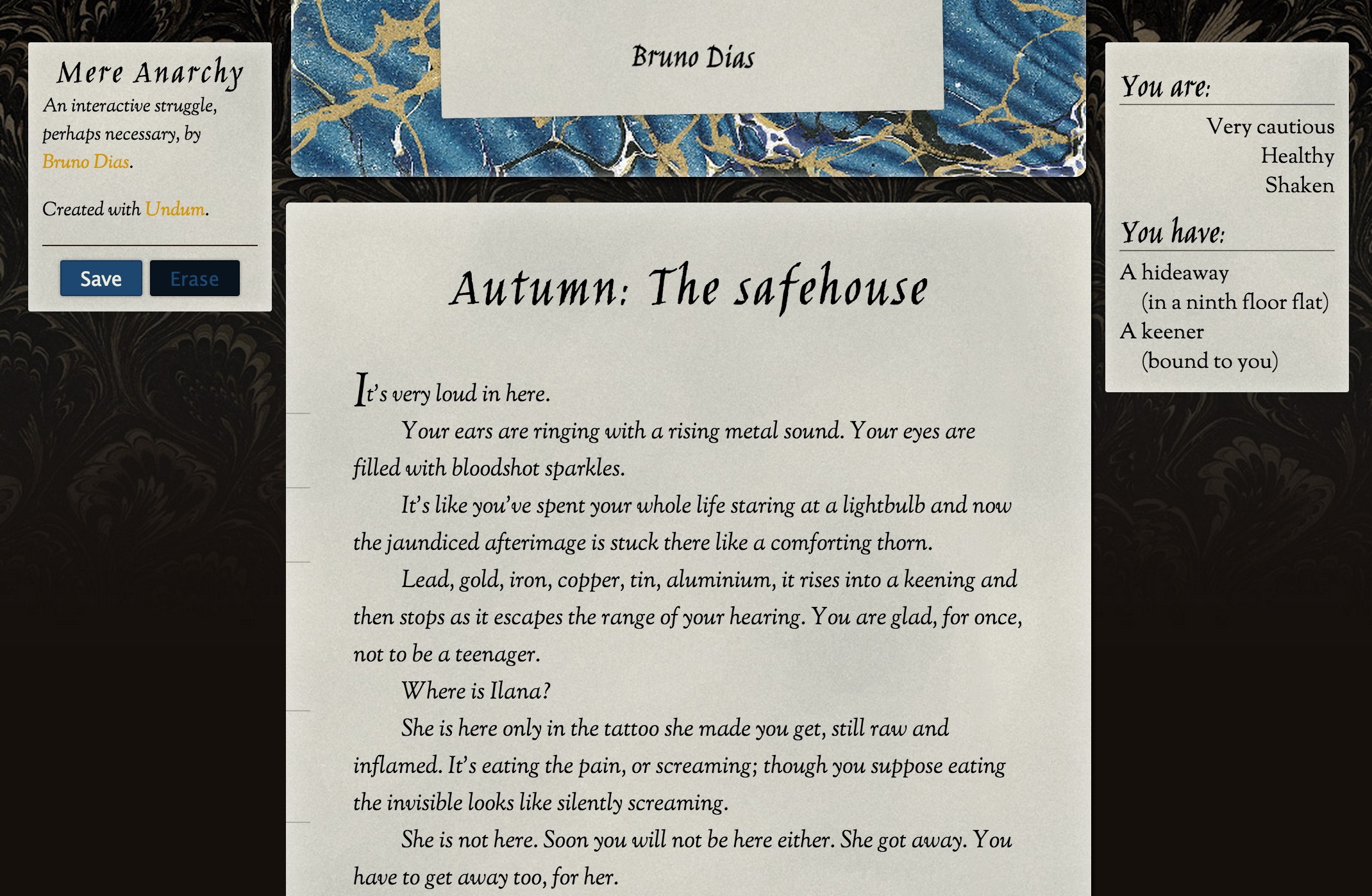
Mere Anarchy (Bruno Dias) — this is a choice-based game in Undum by the author of ParserComp’s Terminator Chaser. As usual for Undum games, Mere Anarchy looks really good — Undum is still in my view the prettiest-by-default of the available choice systems, and the only real strike against it is that it offers so little by way of authoring tools. I’m impressed that Dias submitted two such complex games in such a short window. And this is a fairly complex piece: I think the state space is smaller than in Squinky’s The Play, but there’s a fair amount going on relative to most Undum games. Many early choices quietly play into the descriptive text later, even if they don’t substantially branch the story.

Mere Anarchy describes itself as “urban fantasy”, which led me (despite the title) to imagine cops-who-are-also-werewolves literature. This is less trope-y and goofy than that, but “urban fantasy” still fits. The protagonist is a magic user in a modern city environment, in which a wealthy cabal controls most of the high magic and which has been having lesser magic-users killed. The story details the preparation and execution of a strike that might be considered a terrorist attack, a coup, or a revolution, depending on your point of view. There’s not much leeway about what you will do or how it will come out, but you can choose details of how the protagonist will act and what their motivations will be. Many of the choices here are about the protagonist’s inner life rather than anything else.

Continue reading “Spring Thing 2015: Mere Anarchy (Bruno Dias)”