The Making of Bronze

A reprint of a 2006 article about iterating on a puzzle design.

Making of “Bronze”

The brief: Bronze began as a Speed-IF, a game written in two hours. The premise was to take any fairy tale (in whole or in part) and retell it with a bit of a twist. Subsequently, I decided to take this lightly-implemented shell and try to extend it into a game with more solid puzzles and backstory, but maintaining the expansive geography and sparse object distribution of the original.

Initial Speed-IF

Speed-IF is a light-hearted competition in which the contestants each write a game in two hours. As might be imagined, the results tend to be a bit sketchy. Nonetheless, the exercise of coding a winnable scenario in two hours can be useful.

My initial idea was that I would re-tell Beauty and the Beast, and — just as a departure from my usual approach — I’d make the game map very expansive but very lightly implemented: only a handful of items per room, with short room descriptions and minimal simulation for the objects. That would allow me to focus the player on moving around the map. What I wanted was to reproduce the fairy-tale sense of a very large, very strange space that — when the Beast is gone — suddenly feels quite empty.

Most of those first two hours of implementation went to writing room descriptions and connecting up the map. At this point, Inform’s syntax and map index became extremely handy: I wrote a few rooms, compiled, looked at the map index, decided where I wanted to add more rooms, etc., until I had constructed a large space.

To make sure that plenty of wandering happened, I arranged the code so that the Beast would only appear after the player had explored at least half of the game’s fairly substantial map.

As I did this, I came up with a sketchy backstory to explain the situation: the Beast inhabits a castle that enslaves everyone who walks in, with or without the will of its owner. Not only that, but the castle was owned by a line of kings who had the power to enslave people in eternity, even after death, so that the spirits still haunt the castle and provide food and so on.

Given all this, the player might have two goals: reviving the Beast and freeing his servants. So on the initial writing, I wrote one way to do each of these things: get food for him using the gold bell to command his kitchen staff; or get vengeance on him using a bronze gong that summoned an angry demon. I also added the silver bell, contract book, and reading room so that the player could find out a little information about the player character‘s own history — though at this point the contract book was pretty simple.

Player Experience

The first thing I did when I decided to expand Bronze beyond its Speed-IF state was retrofit it with some conveniences for the player. The map isn’t a huge one in an absolute sense: at 51 rooms, it’s a bit bigger than Infocom’s Witness, but considerably smaller than Enchanter (at 74) or Zork I (at 110). But it is a large map for the amount of game that happens in it, which means that the player will spend a lot of time trying to make sure he’s seen all the available rooms, and then walking back and forth across the map to get things.

To ease the pain of this, I borrowed a few items from examples in the Inform documentation: a GO TO action that allows the player to move automatically; a FIND action that allows him to retrieve articles left elsewhere; a status line that shows a compass rose with unexplored rooms marked in red; and PLACES and OBJECTS commands so that he can review what he has and has not already seen.

I also built in an adaptive hint system using the documentation example, allowing the player to ask for hints about any object or room in the game.

Expanding the Puzzle Structure

The next step is to consider how to expand the game productively. Here we have a basic puzzle diagram of a very early state of Bronze. (Normally I don’t make these diagrams in a diagramming program, but I do scribble them on a notebook next to the keyboard.) The diagram shows each step the player must follow to get to any given ending. There are several endings available, depending on whether we want to punish the Beast or save him from himself.
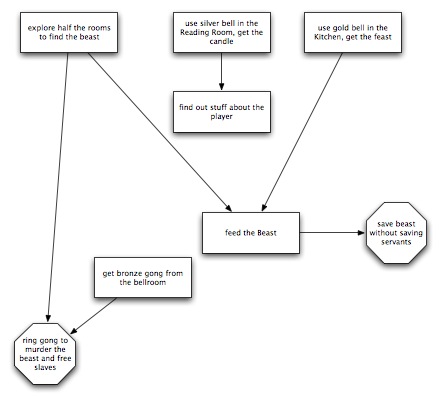
Not so bad for two hours, but from a story-telling perspective, this structure has problems. The contract book, one of the most interesting items in the game, is not required for either ending, so the player might breeze by it entirely. Meanwhile, the bronze gong is stored openly in the Bellroom, so it’s possible for the player to find and use it without ever learning its purpose.

A natural preliminary would be to put this information in the contract book — and then refuse to let him use the gong until he’s read that passage. So let’s say that some of the bells in the bellroom don’t become available until the player has already read about them. That makes sense: we’re told that the room is full of bells, but we don’t recognize all of them.

The player will need the candle in the reading room to read the contract book anyway, but we’ll also protect the secret of the elephant harness by putting the whole Crypt area in darkness. This is really for the player’s benefit: it will stop him trying to use the things down there (which are only interesting once he has the contract book) until he has solved the light puzzle. Thus we cut down the number of leads he has to follow at a time and make sure that he discovers information in a somewhat sensible order.

And, while we’re at it, we’ll put a lock on the Bellroom door to ensure that the player has navigated other parts of the map before he gets there. We don’t want him ringing any of the bells too early.

I also want to add another ending — this structure doesn’t have what you would call a happy conclusion yet. We want to be able to destroy the contract book in some way that doesn’t involve the Beast’s death. I considered some boring approaches (burning it, tearing it up), but those are too mundane for such a powerful object. Then it occurs to me: what happens if you check something true into the Lie Library? The Lie Library was a room that I added more or less at random during the Speed-IF phase of creation, but now I find that it strikes my fancy.

So let’s add the possibility of checking the contract book in here. To do this, we will need to summon the librarian. And let’s say that the librarian can only be summoned with a glass bell, which we find through the contract book.
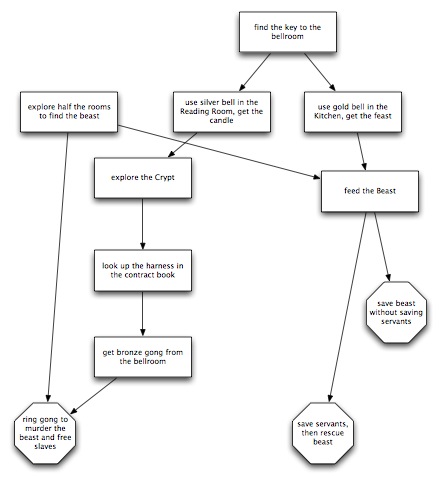
With this puzzle arrangement, we still have the problem that Crypt exploration becomes unnecessary unless the player wants the bronze gong. (And it seems safe to say that many players won’t want it, or won’t think of trying it.) We’d like the player to at least encounter the elephant harness, even if he gets no further than that.

So how about adding in a puzzle to force the player to see what’s in the drawer before using the Lie Library? The easiest structural approach is to seal the Lie Library off. We’ll give it an ivory door and key: an ivory door is traditionally associated with false dreams, and an ivory key would go nicely in the same drawer with the elephant harness.
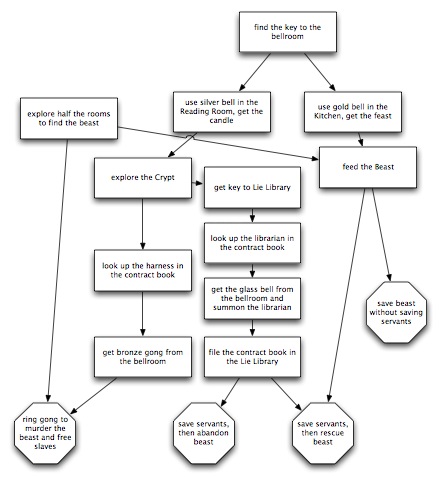
My next concern is that the branch with the feeding of the Beast (if we don’t also save the servants) is very short and not very interesting. Besides, I’d like to sneak in some more backstory about how the Beast got to be like this.

What to do about that? Add a whole additional puzzle: he’s been made into a Beast, after all, so what if we also have to do something to free him from that condition?

Traditionally the cause is an enchantress who punishes the Beast for some unkind act — selfishness, or failure to see beneath a person’s appearance. But I had a more specific history in mind: the Beast’s particular crime is that as a young man he used to bring women he fancied to the castle, whereupon they would be unable to resist his wiles. One woman so brought turns out to have magic powers of her own, and when she realizes what is about to happen to her, on the drawbridge before the castle, she casts this curse on him.

I don’t want to completely remove the elements of the original tale: we’ll keep the kiss as an element of the puzzle. But there has to be more to it than that. Perhaps the player needs to be wearing something unusual: I recollect a business with a magic girdle from Sir Gawain, which has the right flavor for this story. So we say the player has to have that. We also say he has to get it by consulting with the spirit of the dead woman who cursed the Beast, by scrying in one of the mirrors. That gives us an excuse to require the player to find an object in the Crypt area, look it up in both the contracts book and the paperwork, and then use the hint in the Scrying Room to perform the actual summoning up in the Bedroom — making good use of several parts of the map that have previously been neglected, and guaranteeing that he does use the papers at least once.

This is starting to get complex, so for the sake of clarity, I also colored the nodes that the player MUST experience to get to any one of the endings:

From a structural perspective, things are starting to look up. There is a lot more to do in this game than there used to be, the player is more likely to see all of the important junctures, and we have enriched the map. Some of the puzzles are not especially novel — I wouldn’t mind replacing any of the locks and keys with more interesting problems for instance.

To this end, I have two puzzle ideas I’d like to work in somewhere: one, that you can find a trapdoor in the crypt area by placing the bright candle in an adjacent room (and casting a raking light over the floor, illuminating the otherwise unseen outline); the other, that there are spirit-guards on certain passages, who can be eliminated if the player stills the windchime that is summoning them.

The guards idea is good for early in the game: it will let me set a large area as off-limits. Might be a good way to keep the player from exploring the really powerful rooms — the law library, the reading room — until he has been to much of the rest of the castle, and it would stand to reason that those powerful places would be the ones under spirit protection. So I set a region of the map and rule that the player can’t enter this region while the windchimes are in play. (Because the windchimes rule is tied to a region rather than to a specific door, I don’t have to worry that I’ll introduce bugs if I later create more entrances to the sealed area: no matter how many ways in there are, they will all be subject to the same restriction.)

But what should the player see first? Well, let’s say we’d like him to visit the zoo area, the kitchen, and possibly the upstairs: enough that he’s had a bit of a hint of our life with the beast. So I’ll put the chimes in the rose garden, and make it so that the player can only reach this point by traveling through the dark rooms of the Crypt. This raises a further problem: I don’t want the player to have to thrash around down there in darkness. He might stumble on the right way out, but then again, he might not. So let’s make it so that the windchimes are audible, leading him in the right direction, from inside the maze; and also that a magic helmet in the zoo allows him to hear them for more rooms, so that they’ll be audible right from the first room he steps into. So that gives us this…

Notice the trapdoor puzzle is still sort of free-floating at this point. I haven’t decided what to do with that yet, but I like the idea, so I’ll keep it in there.

At this point I also decide I want to restructure the endings, because some of them are still more difficult to reach than others. How about saying that the gong brings revenge on the beast, but does not free the servants? Then we get:
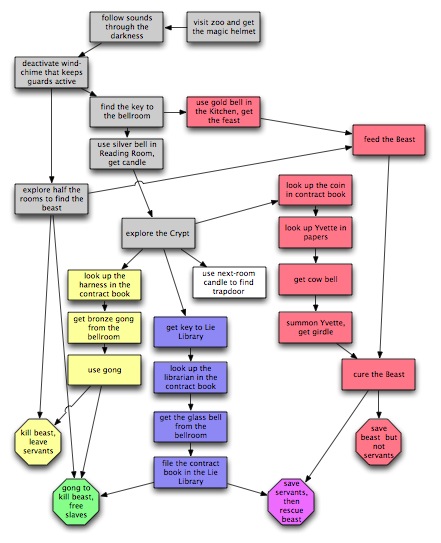
…a somewhat more balanced distribution of outcomes. I’ve redone the colors again here to show myself which endings are requiring the most work.

I like this raking-light trapdoor puzzle, but I’m worried that it’s going to be too hard, wherever I ultimately put it. Maybe it would help to give the player a little (better hinted) prior experience with using indirect lighting in the dark rooms; so it occurs to me to add a puzzle about reading the inscription on the wall. This is going to require both the candle and the stool.

While I’m at it, I’ll add a prior, easier use for the stool as well, to help the player get the idea of using it as a portable height-increaser:

Now, I think I’d like to add the raking-light puzzle to the strand involving the contracts and the Lie Library. For one thing, that strand is an important one, and it currently feels too easy; and I’d also like the person who solves it to have spent a little more time with the idea of the contracts, learning how the family came to have this power in the first place. So I add a study for Lucrezia down in the Basement area, with an inkpot; and I make filling the inkpot the quest solved by entering the trapdoor. So:

And at this point I also spend a while fussing with the map: moving the Reading Room upstairs, for instance, and making the hourglass rooms the means of access to it. This has several intended effects: one, to make the player take off the helmet (so that he will have to put it back on when investigating the trapdoor — I want that to be a solution worked out, rather than one stumbled over); another, to compact the use of space on the ground floor and make more rooms on the upper floor, for balance. I moved Records upstairs too, while I was at it; and added in the still life gallery and the white gallery, as conceptual balance for the scarlet and portrait galleries, and in order to offer a little more backstory about Lucrezia.

At this point I’m becoming less concerned about adding more puzzles (we have a fair number now, at least for the size of game this is meant to be) and more concerned about story. The puzzle structure makes it likely that the player will find out about Elzibad, Lucrezia, and Yvette, the three main elements of the backstory I want to tell. There’s less here about why the player should want to save the beast, though — less of their relationship. I’m also concerned because, after an initial quest to find the Beast, he becomes more or less a non-entity (interactively speaking) for the remainder of the puzzles. We don’t need to do anything more with him after he’s fed and before the curing, which is likely to leave a lot of time wandering through the Crypt not doing anything with him. And that seems unbalanced, motivationally speaking.

At this point I thought: what if in order to go to the Haunted Area, one needed the pair of the Beast’s shoes? I’d already put a pair of cloven shoes into the Lucrezia still life upstairs, and they are the only magical implement from that image not to appear in the game. These shoes might also allow you to experience some small measure of the Beast’s own feelings about the rooms you visit. This may produce a little sympathy for him. Even if it doesn’t, it will keep his personality and presence constant throughout the player’s later explorations.

I like this idea, but if I make the shoes a prerequisite for Crypt-visiting, what do I do with the inscription/cord scenario that is the current prerequisite? Well, we could always make that the requirement to get into Lucrezia’s study, instead…
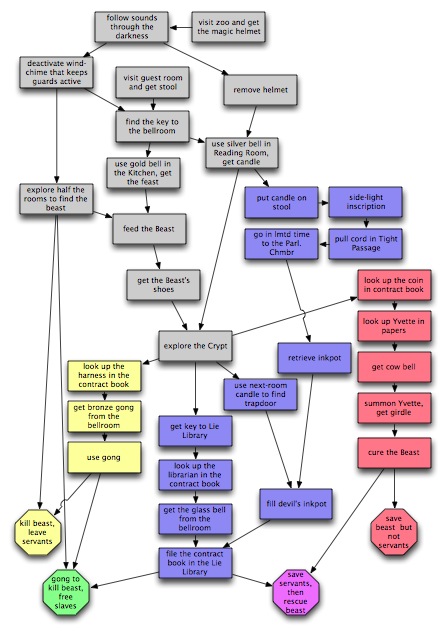
I now had a set of puzzles I liked and a bunch of story material, enough so that it wasn’t possible to deduce what was wrong by reason alone. Time for some alpha-testing.

Puzzle Review

Next I played through to each of the possible conclusions to make sure that the puzzles worked as intended in the diagram, and to build a usable skein.

As I did this, noted things that bothered me. One: it was possible to get the Beast’s shoes and the candle in such an order that we never notice the shoes are necessary to get into the Crypt section. This seems like an opportunity for some further elaboration, perhaps another puzzle. Addressed this by adding the shoemaker, providing an extra purpose for the empty bedroom and an extra article to look at in Lucrezia’s study.

There was now sufficient distraction that it didn’t feel like looking up the coins and harness in the contract book was obvious enough. Addressed by adding a line to the harness description, to encourage the player to look it up.

The inkpot was presented a little too baldly (just found sitting there in L’s study).

There was very little in the area around the Lie Library.

Alpha-Testing

The puzzle work up to this point was the effort of a weekend of fairly steady application. Then I set the game aside and came back to it as a player for a number of shorter evening sessions, two or three hours each. This I find a critical part of my writing process: wandering through the game, trying to forget what I know about what’s been implemented and simply interact with it as though I were a new person coming to the game fresh. What do I expect to have implemented? What do I try to examine? How do I feel about the pacing, tone, and motivation?

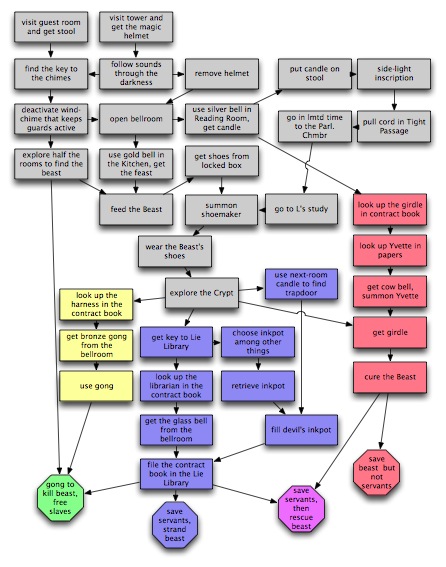
Most of the changes at this stage were individually trivial: room descriptions revised, objects moved to more interesting locations, hints tested, lots of extra messages added for specific actions. I added quite a few specific memories to round out the backstory, and came up with functions for a handful of rooms that were still placeholders. The Black Gallery entered the game at this stage, as did the Apothecary, the Burnt Frame, and the Smoke-filled Chamber: I had become more interested in the question of what the Beast did between the time he was cursed and the time you arrived on the scene, so I added these elements to hint at his unsuccessful suicide attempts. Instead of having Yvette indicated by a coin, I put in the miniature that is in the game now, and wrote more content around it, as well.

Revised puzzle chart looked like this:
Beta-Testing

Finally I put the game into beta-testing, requesting that testers send me a summary of any problems they found, from outright bugs to deficiencies in the puzzle design; I also asked for transcripts, which allow me to comb through people’s play experiences and see where they got hung up on something that I didn’t intend to be difficult.

This led to a lot of added synonyms, new commands, and similar adjustments; it also became clear that I hadn’t provided quite enough hinting about some of the puzzles (such as the raking-light puzzles with the candle, and the fact that Yvette could be summoned to the mirror). So much of what I added at the beta-stage was what one might call significant scenery: objects, images, and memories that might lead the player to a better understanding of what was going on. This phase lasted about two weeks, with a couple hours’ worth of work processing each set of transcripts as it came in. We tested two copies and then I sent out a release candidate for final comment; the game as released wound up much like that candidate.

Extras

During this period I also constructed the extras for the game. It didn’t seem to need feelies, exactly, but since it is so novice-oriented, I thought perhaps it should come with a manual. I also decided to furnish it with PDF maps (one spoilery, one not). To make the map that comes with the game, I used Inform’s EPS export, setting all rooms and connecting lines to be fairly large and white; that meant that when I put a black background behind these objects, the result already resembled a primitive floorplan. I then cleaned up the results in Adobe Illustrator (reshaping some rooms, making the staircases wider, applying warp-effects to the underground rooms) until I got the current maps.

The manual also includes a list of commands — based on the action index — and a sample transcript. I always feel a little uncomfortable writing sample transcripts from the top of my head because there is a real chance I will forget or misrepresent some key piece of library behavior. So I mocked up a short scenario as an extra “chapter” of the Bronze code, played through it, and copied the transcript into the manual. Because of Inform’s code style, it was easy to add Igor and his environs for the duration; all the pathfinding and similar code from the real game were thus applied to Igor’s scenario as well.

Ebb and Flow of the Tide

The Ebb and Flow of the Tide is another entry in what now turns out to be a series of fantasy adaptations by Peter Nepstad. Like Journey of the King, Tide is based on a story by Lord Dunsany, which means that it relies on rich, lyrical, intentionally archaic language.

I found Tide considerably more accessible, though: there are no long cut scenes or overwhelming passages of conversation, just a strange, dreamy environment which one must explore to make progress. It can take a little while to find the right trigger to move events onward, but there aren’t any puzzles otherwise. (If you find yourself stuck, try all your senses on everything around.)

Journey of the King

Recently I tried Peter Nepstad’s new game, Journey of the King, which was nearly entered in the IF Competition. Like a couple of other games that did get finished in time for the competition, it’s an IF version of a short static story, in this case by Lord Dunsany.

In general, I haven’t been completely convinced that these translations of static fiction are successful: there are a lot of design challenges involved in transferring what was a straight story into something interactive, and I’m not satisfied than anyone has solved them yet. Journey of the King does not, I think, transcend this set of problems either. In fact, it starts out with a very uninteractive sequence of conversation in which the player has to question a series of visitors and read a great deal of straight text.

I gather that there are some puzzles that arise after this initial phase of the story, but I found the first conversation dumps a bit hard to get through, so quit. It doesn’t entirely help that the conversation here is very flowery and abstract.

I may come back to this piece later; we’ll see.

IF Comp 2006

This year, since I’m not judging the competition, I played to enjoy
myself: I avoided games I was certain I would dislike, and I closed
some without giving them a fair chance because the style or genre didn’t
appeal to me at the moment. I may come back to those later. Scores are
just what I would have assigned if voting, prior to a rounding-up — I
would probably have reset the upper end of the scale upwards to give a
10 to my favorite game (Elysium Enigma) and a 1-point bump up to
several of my other favorites.

I played several games almost entirely from walkthrough. I think I was
feeling less tolerant of puzzles than usual this year — or at least,
less tolerant of puzzles that were out of place or not contributing to
the story. There seemed to be a lot of this going around. Mobius and
Delightful Wallpaper both did innovative and fun things with puzzles,
and I enjoyed them. Labyrinth may have as well, but this was presented
so abstractly that I couldn’t get into it right then. (I did have a lot
of flashbacks to David Bowie in tight leather pants, which may or may
not have been the author’s intention.) But in several other games, even
including Elysium Enigma, there were quite a few times where I was
conscious that the story had been hijacked to make room for an IF-style
puzzle when there was really no *need* for such a thing, and where the
puzzle itself was nothing that terrific. This is not, I should add, a
rant against puzzles in all cases — I like a really well-designed
puzzle for its own sake, and I like it even more if it can be justified
in the context of the story or if it sheds some new insight on what’s
going on. But I felt that several of the more narrative entries this
year did an awkward job of incorporating the puzzles, and should either
a) have done those puzzles better or b) come up with a different form
of interaction for the player. The feeling of puzzle artificiality kept me
from getting into Traveling Swordsman, which otherwise looked like something
I might enjoy.

I did appreciate the prevalence of walkthroughs and hint systems in
these games — another bit of polish that makes a game much more fun,
especially under competition conditions.

My comments on individual games follow, and, as mentioned, I skipped
a lot of things either because they didn’t look good or because they
didn’t suit my mood at the time. And some things I finished, but didn’t have
much to say about. So these only cover:

Elysium Enigma
Mobius
Moon-shaped
Delightful Wallpaper
Tower of the Elephant
Unauthorized Termination
Aunts and Butlers
Primrose Path
Carmen Devine
Legion

They have spoilers. Read at your own risk.

=====

Elysium Enigma (8)
Interesting story, though I got frustrated in a few spots about not
being able to confront Leela as directly as I wanted to. The secret
truths here were not especially shocking, I thought — no vast twists
that surprised me — but I did enjoy uncovering what there was to
uncover. (And I didn’t end the game with full points, so it is possible
that there was still more under the surface here that I just did not
ever get to.)

The puzzles felt a bit old-school for the narrative, though — this
doesn’t really feel like the kind of ‘verse where we ought to be
catching trout with a conveniently sharp hook just in order to move a
cat. Unless cats on this planet are much larger than they are on Earth,
I’m usually able to dislodge even an unwilling one by force. So the
puzzles of that sort felt a bit forced. There were also several that
were just too hard or guess-y: I would never have gotten the datatab
password without the hints, nor would I have thought of CRAWL UNDER
TARPAULIN as a plausible command. On the other hand, the hints *are*
pretty thorough, which kept this from ever getting to be too
impossible, and I did finish in just a bit over two hours.

The coding is strong and the work is well polished, as I would expect
from Eric; the game feels thoroughly tested and smooth.

There were a couple of conventions I disliked. The exits command lists
even the exits I have discovered are useless (like going outside the
borders of the town), and I found this distracting. I also found the
room description in the center of town quite confusing, in that it
suggested to me that I should go north, *then* east or west. Which
was wrong.

On the other hand, Leela’s interactions were very good. My least
favorite moments are the ones where she feels a bit too automatic —
the way you trick her seems too easy, and sometimes her behavior
is too obviously dictated by the needs of a particular puzzle.

But I’ve never before felt like I have been hoodwinked by an NPC.
I avoided her initially, figuring that she would lead to trouble,
because my orders warned me about people like her. Then I went
through a phase of thinking she really was the naive thing she seemed,
possibly trying to use me for food, but not otherwise untrustworthy.
But that evolved too, in subtle ways: I found myself telling her
things confidently at the beginning, then becoming suspicious when her
questions seemed unusually pointed for a person in her position; then
finally starting to think that maybe I had already said too much. The
whole way through, I knew she was trying to manipulate me, but I didn’t
always know to what end (just because she was hungry? because she
wanted a rescuer? because she was bored, or sinister?). And
that was really cool.

It was also good interactive story-telling. One of the things
interactivity can do for a story is get the player to buy into dubious actions, whereas
the reader might be standing back a bit: when you read a novel and the
protagonist does something foolhardy, you may mutter a bit at the page.
But how mad can you really get if that was *you*, innocently prattling
on with imperial secrets because you thought you were talking to a
naive village girl? I’ve played other games in which this was a gimmick, but
this one does something with it that is important to the story.

For me, that aspect of the game was the neatest, most art-revealing
thing to come out of the competition, and it’s likely to stick with me.
But this game had a lot else going for it as well, including its
extreme technical competence.

Mobius (8)
Tightly implemented, fun variation on the repeating-time-loop format. I
am a little tired of this idea — I didn’t finish “All Things Devours”,
for instance — but this was version was a fresh take on the puzzle. No
story worth speaking of, I’d say, but satisfying as pure-puzzle game.
It did occasionally get a little annoying that when I had screwed up an
iteration I had to then wait (or sleep, or commit suicide) a couple
times to get the chance to start over. Still, this is a minor gripe.

Moon-shaped (8)
A few of the puzzles were non-obvious, but overall, this was pretty
solidly constructed, with some interesting areas to explore. I did wind
up relying quite a bit on the hints; this may have reduced my
frustration with some of the less obvious bits.

I was a little weirded out by the idea that the seductive wolf was also
Red Riding Hood’s father — shades of the Baron, there. I did enjoy the
gradual realization of my true nature, though. The things that made
sense only in moonlight were neat, too. Good work overall.

Delightful Wallpaper (7)
Strange, evocative, and with the entertaining outlines of a plot in the
middle distance. But still really a puzzle game. There were a few
moments that felt a little-underclued, but generally it was good; I
even found I was able to solve the map puzzles, which at the very beginning
dismayed me with the prospect of something tediously labyrinthine. The
notebook helped a lot. Still, I enjoyed myself more when I got past
that phase of the game and into the business of placing the intentions. (The
distinction between the two phases did give the game a slightly odd
disjoint feel, but I suppose either side on its own would have felt
insufficient; and I do see that we want to get the player to
explore the environment thoroughly before expecting him to make use of
that knowledge when placing the intentions.)

Another point in its favor: the Dark City/Gorey/”Hush”-episode-of-Buffy
flavor, which was unlike anything else entered.

(Disclaimer: I played this game in beta.)

Tower of the Elephant (7)
I don’t generally have high hopes for games adapting pieces of static
fiction. It’s hard to do this at all convincingly: the pacing of the
original story is often wrong; there are usually elements that
are hard to convey in IF terms; often the protagonist of the original
does at least one thing that is weird and hard to get the player to
emulate. What’s more, the original usually doesn’t go into as much
detail about setting as IF has to, which means that there’s a lot of
text for the IF-adaptor to supply, and if he doesn’t have a very
strong sense of language, the result is prose that clashes with itself
stylistically. “Tempest” didn’t quite work for gameplay reasons.
Neither did Francesco Cordella’s “Land of the Cyclops”, though
its problems were more diverse. (Which I went on about at length here:
http://www.ministryofpeace.com/if-review/reviews/20020719.html)

And then I’m also a little suspicious of the impulse in the first
place. Why are we adapting this story to IF anyway? Is it because the author
actually has an interesting idea about why that particular piece of
fiction would make good IF (and, to be fair, I think both Nelson and
Cordella did have some such reasons in mind)? Or is it because he
simply couldn’t think of a plot of his own and/or wanted to cash in on the
popularity of the original? Derivative IF works, whether based on a
book or emulating/parodying previous games, often leave me cold. Where’s the
invention? Where’s the author’s new take on things? This is not to say
that it’s impossible to write a good retelling or re-envisioning of
existing work — people have been retelling classical mythology for the
last several thousand years and haven’t run out of interesting versions
yet. But the the existing art or story doesn’t mean that the author can
get away without doing any imaginative work of his own.

Anyway, Tower of the Elephant is one game where, unexpectedly, I think
the adaptation worked reasonably well at a craft level. Not perfectly:
I don’t care for the section where my PC watches the
thief do things. The problem here is not just that this section is
railroaded; it’s that the PC is completely passive. In static fiction
we can accept stories where someone else takes over the action for a while
and the protagonist doesn’t do that much; in IF, this doesn’t work so
well. In fairness, I discovered later that it’s possible for the player
to take another path through this section, but since it seemed (at least
to me) like the most obviously advantageous course was to hang out
waiting for the thief to clear my path, that’s what I did — and then
felt mildly miffed at the game for not giving me more to do. So the point is
not just that the player has to be *able* to do things, but that he
needs to feel encouraged to do them. I’ve played a few games where just
waiting was suspenseful and felt like real action, but that wasn’t
the effect for me here.

It did take me several tries and a hint to get past the spider; I think
this could have been better clued. There were also some implementation
faults in the endgame, where the syntax to cut out and use the heart
was fairly restricted and a number of (I thought) sensible phrasings were
not honored. This could be cleaned up before the final release.

Still, on the whole, the structure of the game essentially worked with
its source material, and that’s an achievement in itself.

I’m not quite so sure about the value of adapting this story to IF
rather than coming up with something new, but again, I was more
sympathetic this time than I usually am. In particular, the adaptation
provided texture: the game did a good job of preserving the prose style
of the original. That style is unusual for IF, but not unworkable,
since it does dwell heavily on descriptions of objects and actions. I enjoyed
the novelty. We don’t see a lot of this exact kind of fantasy, really.
I was a little reminded of the Oz books, which I imagine could also be
selectively adapted for interactive fiction, since they tend to be
heavy on imagery, setting, and wacky objects, and episodic enough to slice
into pieces.

All in all, I don’t think this was a masterpiece, but it was competent,
playable, and fun, and some of what I liked about it did come from the
work it adapted. Which makes it perhaps the most successful
static-fiction adaptation I’ve played to date.

Unauthorized Termination (7)
This had a bunch of rough edges, implementation-wise — some problems
typical of ADRIFT parsers, and some others. It also has a somewhat
railroady presentation — there are usually only one or two sensible
things for the player to do, and often these are more or less
explicitly laid out for you — and there was one bit, involving finding an item,
which I would never have gotten without the walkthrough. The endgame
could have been better paced, I think.

All the same, I found this strangely enjoyable. The robots, despite
everything, came across with something approaching a genuine
personality. I found the encounter with the First One almost touching.
The mystery plot, though laid out in a linear way, still took enough
turns to be interesting as I discovered it. So yes, there were some
flaws, but this was fun.

Aunts and Butlers (7)
This doesn’t always *quite* hit the mark for tone, but it does manage a
general Wodehousian flavor much of the time. There’s a trick about
this, though: Wodehouse plots tend to revolve around completely bizarre
solutions to wacky situations. In IF, this is a problem, because the
player is required to come up with the bizarre solution on his or her
own. This is the same problem I had with Hitchhiker’s and Bureaucracy
— amusing games, but not particularly *fair*.

In the case of Aunts and Butlers, I tried to get the zany solutions
myself, but one of the early puzzles stumped me; when I looked at the
answer, I realized it was something I would never ever have tried, and
lost faith. So I played from the walkthrough for most of the game. This
was probably wise, since in passing I noticed several other points
where it’s a good idea to do things in a certain order without any particular
motivation, or where the solution is fairly esoteric. It says something
that I still enjoyed the game anyway, but I would have enjoyed it more,
if, somehow, these implausible puzzles had been solvable.

I did very much like what happened with the pheasant hat, though.

As homebrewed systems go, this was pretty decent, too. Missing just a
few conveniences from other systems, but it didn’t annoy me nearly as
much as nonstandard IF systems usually do.

I also enjoyed this game a little more because it strayed from the
conventional genres of the rest of the competition. A fresh setting or
genre is worth a lot to players trekking through 40-odd games.

Primrose Path (6)
One great visionary puzzle/moment; confusing plot that I never quite
got a handle on; some minor annoyances in play. I felt pretty extensively
led by the hints, again because I was not sure how to make sense of
what happened by any other means. I used to be more tolerant of games where
I don’t get the plot; these days, I’m inclined to think that if I make
a solid effort, I should wind up essentially understanding what just happened.
(All Roads, e.g., I remember as a collage of nifty images, and I assumed at
the time that I had trouble putting them together because I played the game
in a feverish state. But I’ve never heard anyone else explain the plot in
a way that makes sense, either. [But I digress.])

I also wound up not liking the protagonist and Leo as much at the end
as I had in the middle of the game — possibly because some of the early
remarks about their relationship promised a substance and complexity
that never in fact materialized. I can easily believe in a relationship
that has gone through phases of romantic attraction and phases of
friendship and phases of distrust or dislike. What I can’t believe is
that said relationship would feature so few concrete events or specific
feelings. What draws these people to one another? What pushes them
apart? You turned Leo down before; why? And so on.

I guess it’s not necessary to spell all that out if this is a puzzle
game, but it felt like it was reaching to be a story game in spots —
especially since I get to decide whether the protagonist accepts Leo’s
offer of marriage. And before I can feel much of anything about that, I
need to have feelings about him — more detailed than “I guess he’s a
talented artist and his mom has some real issues”.

I don’t know — I guess ultimately it seemed that this game was trying
to do several different things, and it didn’t quite succeed at any of
them. But the climbing of the raindrops is an awesome scene and will
stick with me. I would encourage the author to write more. Preferably
with a bit more clarity about what he’s trying to accomplish.

Carmen Devine, Supernatural Troubleshooter (5)
There are some writing issues here. Unfortunately, one of the worst
offenders is the first room description in the game: “Bouncing along in
a 4×4, the harsh bite of Chen’s cigarette burns in your lungs as his
smoking fills the jeep.” “Bouncing along in a 4×4” is a dangling
modifier: grammatically, it should apply to “the harsh bite of Chen’s
cigarette”. Even when we rule that out, it’s not immediately obvious
what it *does* refer to — not Chen’s cigarette either, presumably, but
Chen himself? Or perhaps the player, who is not mentioned in the
sentence at all? We can work out what sort of scene we’re probably
supposed to be imagining here, but it requires some unraveling of that
very first sentence.

This wasn’t the only thing about the beginning that made it hard for me
to get immersed. I’ve never been to northern China, and I could have
used a few more elements of physical description to set up scene and
atmosphere. What’re the road conditions like? What’s the landscape?
Flat, mountainous? Dominated by huge abandoned steel mills from the
1950s industrial push? Rural, with the occasional house or farm? Empty
wasteland? Is it just cold, or is there snow or ice on the ground? What
does Chen look like? What is he wearing? For that matter, what am I
wearing? Not that we need to answer *all* of these questions by any
stretch. The author obviously did enough research to choose a specific
city for the protagonist to land in, but more sensory detail would have
helped flesh this out.

Finally, and perhaps worst, it took me a little while — possibly
longer than the author intended — for me to understand who and what the
protagonist is. There are hints in the cover art, I guess, but they’re
not entirely clear. If I examine myself, I’m told I have “natural
weaponry”, but there is no indication what that might be or how I might
find out. Result: I am reminded of the distance between myself and the
protagonist by the fact that she knows a bunch of important things that
I don’t — and have no way to explore. Attempts to look at myself, the
landscape, Chen, my outfit, my “natural weaponry”, etc., aren’t very
revealing.

Well, all right. So after this stark beginning, I was not able to get
Chen to do anything, at first, and then READ FOLDER inexplicably
crashed the game.

Tried again, now with more confined expectations. Managed to read the
folder, arrive in the village, and so on. Then found that most of the
puzzles seem to require a certain amount of reading the author’s mind,
and that the walkthrough doesn’t actually give the commands needed to
win, just a general description of what you ought to do. Which
unfortunately is not quite enough to get me through this one. Oh well.

I wish I liked this better than I do — “Chinese werewolf story” should
be a fun departure from the usual fare, but unfortunately this is not
developed far enough for me to get into it. The setting is not very
rich; the werewolfiness is not very fully explored. In its favor, I do
like the fact that the player can do different things depending on
whether or not she has shifted into wolf form. Still, this could have
gone further and been more interesting. That interesting material could
have been revealed through puzzles, plot, or exploration, and it
wouldn’t really have mattered to me which the author picked: I would
have enjoyed learning more about the PC’s history and powers, or
solving more puzzles using her wolfiness, or having more plot events that
turned on the politics and behavior of the pack she meets. But as it was this
potentially novel premise was really underused.

The reason I’ve gone on about it so long is that I felt Carmen Devine
could have been so very much better than it was, and that possibly
there
were some neat details that remained languishing in the author’s
imagination rather than making it into the game so I could see them
too.

(Random aside: I can only remember one other IF game about a werewolf.
Does this comp really triple the existing corpus of werewolf IF?)

Legion (5)
Managed to get rid of “her” by descending into the core and waiting.
Suspect from the hints that it is also possible to do other, more
complicated things, but never really got the hang of what I was
supposed to be doing and how. I am told something way more interesting is
possible, so maybe I will try this again later. However, I think it is
a major tactical blunder to have a trivially easy win-state that can
distract the player from the actual point of the game. The *author* may
know that that side path is just there as an easter egg of sorts, but
the player — especially in a game like this where the goal, setting,
and even the nature of the PC are all completely mysterious at the
outset — is likely to explore blindly and reach it by accident.