The Oxford/London Meetup group is meeting Wednesday May 13 in London (conversation in a meeting space and then drinks at the pub). Please join us if you are in town and are so inclined — we’ll have some guests from the Seattle IF group this time around.
Other meet-ups for May that I know of:
SF Bay, May 2.
Baltimore/DC, May 3.
Boston/Cambridge, May 29.
Oxford, May 31 (a smaller meet than the London meet; feel free to bring WIPs to share).
*
Mike Berlyn, one of the original Infocom implementors and author of (among other things) Infidel, needs some assistance: the costs of cancer treatment have outrun his family’s ability to cover.
*
For a little under two months now, Leigh Alexander and Laura Hudson have been editing Offworld, a games site with contributions primarily from women. I’m consistently surprised by how much the site speaks to my interests, even when I’ve tended to consider those interests fairly unusual. Here’s an article about the second-person storytelling and pseudo-interactivity of ASMR videos, including an interview with one of my favorite ASMR creators. Here’s one about Anna Anthropy’s new tabletop game about witch pageantry. The site covered Mike Berlyn’s fundraiser, too.
*
I’m going to be keynoting ICCC 2015: The Sixth International Conference on Computational Creativity in Utah (June 29 – July 2, 2015), talking about some Versu and post-Versu work.
I’ll also be giving an hour-long seminar on the artistic possibilities of interaction more generally at IRCAM June 4. Timing on that is still being worked out.
*
The 2014 XYZZY Awards were given out; 80 Days won Best Game. That it’s both commercial and choice-based is something of a departure for the history of that award, and there were a surprising number of commercial nominees overall. In past years, even when a commercial game was in theory eligible, those games tended not to get many nominations, let alone win — maybe because the barrier of paying for a game was more than players wanted to invest in? But the landscape is changing.
There will likely be a set of XYZZY reviews covering these award categories, in time, but it usually takes a bit of a hiatus to set those up.
*
Sorcery! 3, inkle’s latest gamebook app, is now out, to rave reviews.
*
Feral Vector is a two-day conference, May 29-30, in Yorkshire; IF authors Meg Jayanth and Harry Giles will be presenting, as will the terrific Holly Gramazio. I also am going, though I’ll be somewhat hurrying back in order to do the Oxford May 31 meetup.
*
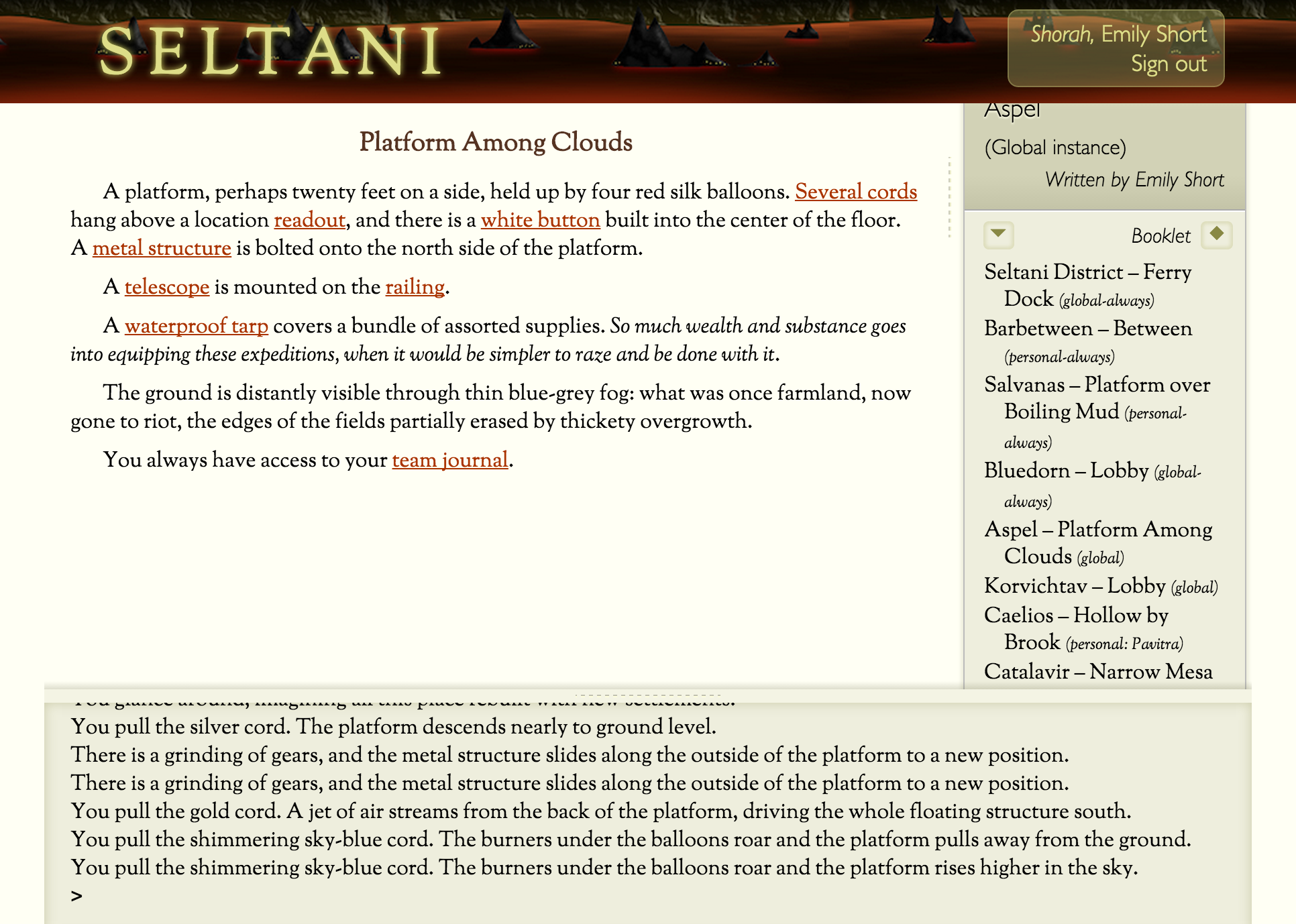
Andrew Plotkin has a longish post about world models and choice-based IF, talking about Bigger Than You Think (his choice-based Glulx game) and Seltani (multiplayer choice-based platform) along with other possible models.
*
Source has turned up for Wander, a mainframe game with text adventure propensities that predates Colossal Cave.
*
“A freelance QA specialist has started archiving an unusual project online that he has been working on. A mysterious company named BUCOLIC ehf, a “digital literature publisher”, is developing an interactive version of Lord Dunsany’s collection of essays about World War One, Unhappy, Far-Off Things. (Lord Dunsany is probably best known as the fantasist who was an early influence on Lovecraft.) Each essay in the collection is being tested as a “Session.” But something is not quite right with the first one.”
Alan DeNiro is releasing a serialized interactive story, Feu de Joie, which is Patreon-backed. It’s a decidedly odd piece, melancholy both in its present day narrative and in the post-World-War-I material on which it builds, and pulling together both the literary flavor of a lot of DeNiro’s work and the sinister-secret-communications-with-evil-corporation flavor of a lot of ARGs. (Tonally, it’s nothing like Alethicorp, but certain elements were reminiscent anyway.)
*
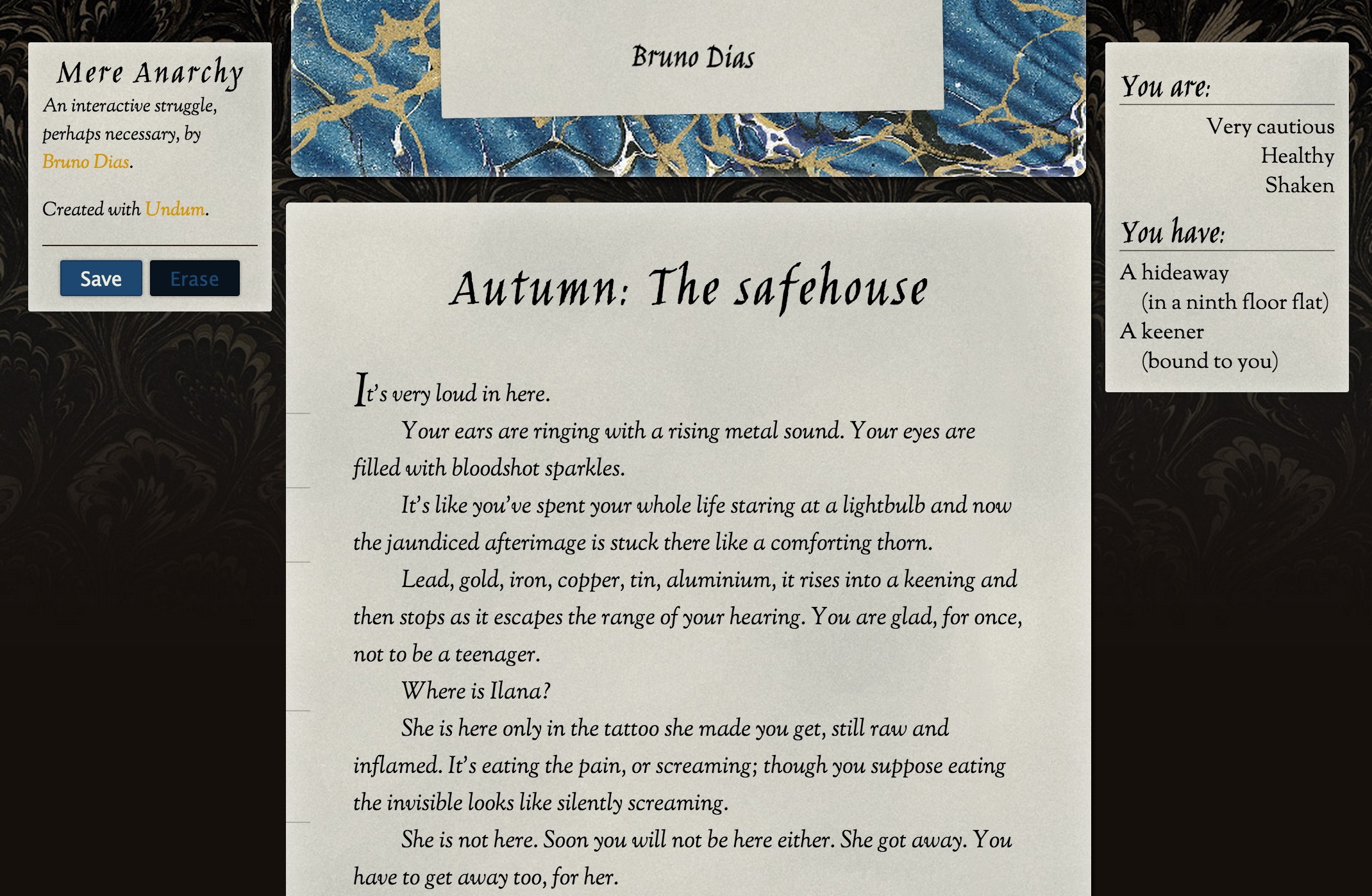
Bruno Dias has released a new framework for writing with Undum, which is designed to remove some of the challenges associated with coding your choice-based game up in javascript.
The new system is called Raconteur, and there are tutorials on Bruno’s site. It is still, to some extent, designed for programmers — you’ll need to install various packages to use it, and it doesn’t present a Twine-like interface to the material you’re working with — but it does significantly reduce the fiddliness of using one of the more attractive hypertext IF tools out there. For instance, to quote from the Raconteur site:
Raconteur is built with adaptive text generation in mind. Defining snippets of text that vary whenever the player sees them is easy. Raconteur takes inspiration from Inform 7, commonly used Twine macros, and other popular IF development systems. Text that varies across printings, hyperlinks that modify or insert text, and other common functionality is already there to use.
*
Speaking of tools and systems, Alex Warren’s Squiffy project is now at version 3, which is substantially more accessible to start with than previous versions because writers can work directly via browser. Squiffy is an entry in the choice-based space that offers a little more by way of variable support than Twine.
*
Wade Clarke has released Leadlight Gamma, an inexpensive commercial Glulx version of his survival horror game originally for the Apple II. He’s also, very usefully, publishing a series of post-mortem-type posts specifically focusing on accessibility concerns for interactive fiction and what he encountered in putting Leadlight Gamma together.
Interactive fiction has historically been one of the gaming forms most accessible to visually impaired players, and that’s something we should bear in mind during the current swing towards using more multimedia and providing more visually compelling experiences for players.
*
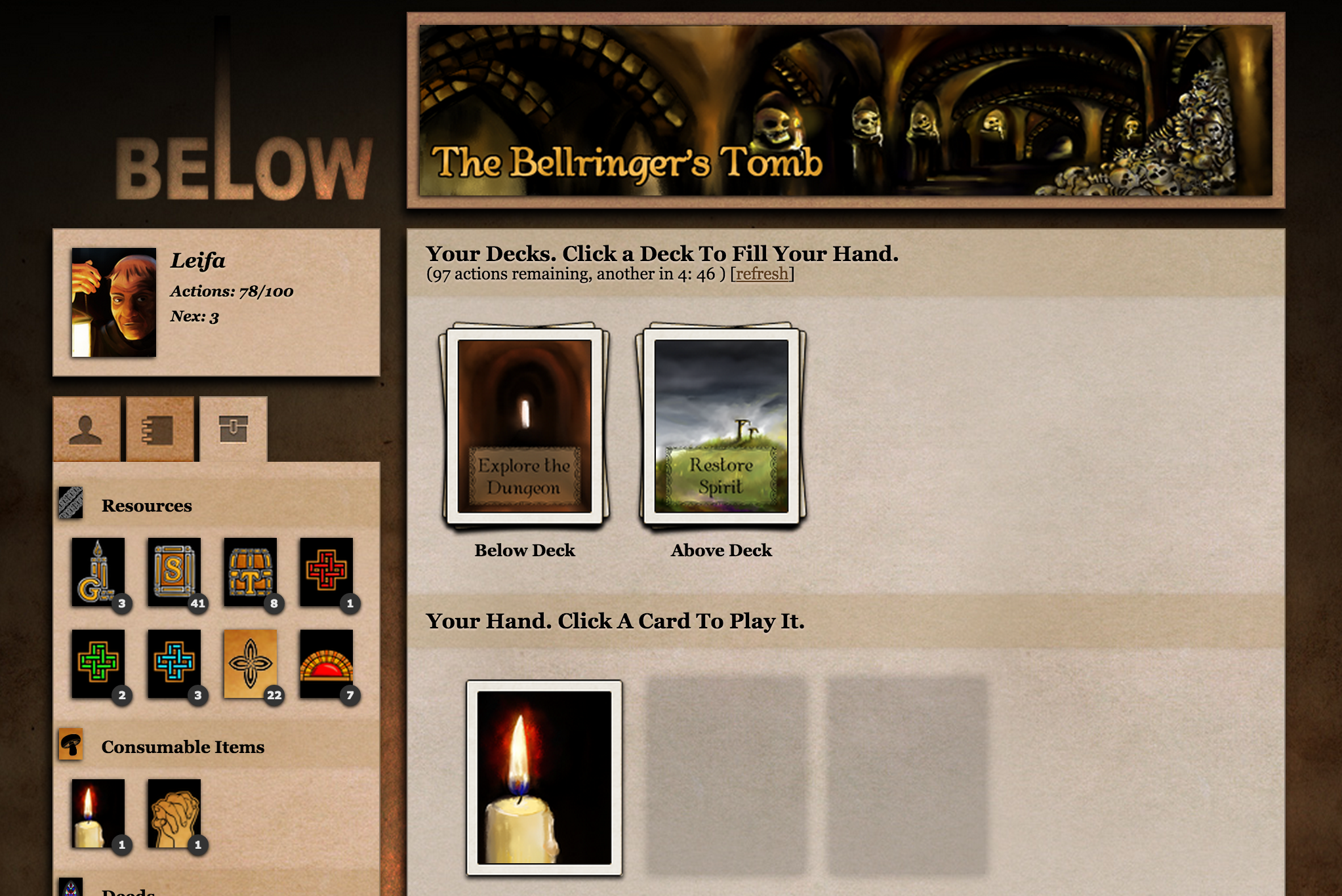
Richard Cobbett has a long piece on Below, which I also enjoyed and wrote about this month. Richard’s article goes into a bit more detail about the fascinating use of the Above deck in the game design.
*
This document on why women leave tech jobs was really interesting to me, and summarizes a lot of research.
I recoiled a bit at this section, though:
Stereotype threat is reduced if the individual experiencing it de-emphasizes the parts of their identity that are stigmatized and emphasizes those that are not. (For example an Asian-American woman will experience less STEM-related stereotype threat when she focuses on her race rather than her gender.) [Retrieved 11:27 AM BST April 30 — this is a google doc in progress with multiple editors]
This seemed to me to suggest fighting stereotype threat (the tendency to do worse when you’re conscious of being in a stigmatized minority) by focusing on the non-stigmatized aspects of your identity… in ways that leverage other personal and systemic prejudice. I want to find and root out any unconscious racism/classism/etc that may be influencing my actions, not build on it. The solution needs to be something that doesn’t actively reinforce other sick aspects of the system, something that’s available to people in multiple minority categories.
For impostor syndrome reasons, sometimes it’s hard to make use of the valid defenses here. One can always find ways to answer “Person X I respect praised me for how quickly I picked up this new programming language, and Person Y was impressed by my solution to that code problem” thoughts with reasons why you were lucky to hoodwink X and Y was for some reason deluded and therefore their positive feedback definitely does not mean that you’re in any way actually competent at your job. Nonetheless, shoring up the ability to internalize that kind of praise as part of one’s self-image would be way more useful and less destructive than trying to wield your privilege categories as a +.5 talisman against self-doubt.
But other aspects of the document’s analysis rang really true with me, especially the parts about reacting to feelings of self-doubt by putting in a lot of solitary labor, trying to catch up in secret so no one will know you’re having problems. It took me most of grad school to learn to ask for help as soon as I needed it, and I could have saved a lot of heartache by not trying to play that game.

 Emily Short's Interactive Storytelling