Interactive Narrative GDC Talks (Part 2)

As I noted here, there is a bunch of GDC content that might be of interest to interactive story folks. Last time I looked at talks that were really focused specifically on interactive fiction, especially work by inkle and by Choice of Games.

This time, two related subjects: social simulation and character modeling of various types, and complex morality. (And character with complex morality, as a bonus.)

Thinking About People: Designing Games for Social Simulation, Mitu Khandaker-Kokoris, The Tiniest Shark. (Recorded talk.) I’ve linked already to the Gamasutra presentation of Mitu’s slides, so you may have seen me mention this talk before. Gets into a number of types of games and also a series of criteria for thinking about social simulation games. Some of those criteria are pretty-much-always-desirable things such as “communicating to the player”; some describe a spectrum with many possible spots for productive work (“autonomous vs authored”).

Designing Morally Difficult Characters, Dan Nagler, Gigantic Mechanic. (Slideshow only.) This talk calls out the idea of giving characters complex, non-binary ideologies, and also shouts out to some of the very same tabletop storygames that I mentioned in my microtalk. If you follow the links, you’ll also find that this talk relates to a partially live action educational simulation that is sort of Senate LARP.

Beyond Binary Choices: How Players Engage With Morality, Amanda Lange. (Slideshow only.) This one gets at the issues with simplistic good and evil choices, offers some statistics about how people tend in practice to play simplistic-choice games, and then pulls out a couple of interesting exceptions to the general rules (like: Spec Ops: The Line manages to get a lot of players to do the pure-evil choice by laying enough emotional groundwork to make them feel their protagonist might be quite angry at that point).

Desire is Not A Dirty Word: Writing Healthy Fanservice for Games, Michelle Clough. (Slideshow only.) As with several of the other slideshows, there’s definitely some information being missed if you can’t see the full recorded talk, but there’s still enough here to give the gist: it’s about writing characters who are meant to be sexy and perhaps romantically active without falling into creepy objectification.

Measuring and Manipulating Player Trust, Chris Hazard, Hazardous Software. (Slideshow only.) This is the kind of talk I love to go to because it expands the boundaries of what I think I should bear in mind when working on a game. It’s an AI summit talk, it’s fairly math-heavy, and it’s about mathematical models for a) describing how likely NPCs are to make barters and do favors given various levels of trust in the player and b) conversely, assessing what the player feels about the risks and rewards in the game using similar trust modeling. It’s sufficiently abstract that I think one would have to put in a good amount of work to get from “these are some really interesting concepts” to “here is what gameplay based on this would feel like.” But I find this kind of thing fascinating.

And a bonus link not from GDC: this now-in-progress orc dating sim looks like it takes on a lot of the issues in Mitu’s and Michelle’s talks.

Spring Thing 2015, and Aspel

Spring Thing is now open, with nine new games: six in the main category, three in the “Back Garden” area for games that aren’t in competition for prizes and have somewhat looser entry requirements. There’s a mix of systems, too — Twine, Undum, Seltani, Glulx and z-machine, and Ren’Py.

My contribution is a Back Garden game called Aspel, which is a realm in the choice-based multiplayer Seltani platform. As my entry blurb says:

Aspel is an experimental interactive experience designed for multiple players, featuring asymmetric information and collective decision-making. The text you see on the screen won’t necessarily be the same as what everyone else sees, so you’ll need to communicate with your fellow players in order to experience it most fully. To make that easier, I’ll be around to participate/host at the following times:

Tuesday April 7 at 8 PM British/3 Eastern/noon Pacific
Sunday April 19 at 8 PM British/3 Eastern/noon Pacific
Friday May 1 at 8 PM British/3 Eastern/noon Pacific

…but of course people are more than welcome to arrange their own visiting hours.

At some point I’ll likely write something about the experience of writing for Seltani.

March Link Assortment

Screen Shot 2015-03-20 at 3.26.14 PM

The movie Interstellar now has an official text adventure tie-in. It looks like this was hand-rolled in javascript. I haven’t had a chance to play it through (and I didn’t see the movie, which may be important), but here’s Wade Clarke’s take.

*

The Shadow in the Cathedral is a parser-based, puzzly, adventure-rich game in a steampunk setting, developed commercially by Textfyre. For a long time it was available only for sale, but you can now get it from itch.io for free. (Back in the day, I put up an IFDB review, if you’re curious what I thought then.)

*

The McFarlane Job is a new game by Jason McIntosh (Barbetween, The Warbler’s Nest).

*

Bus Station Unbound is perhaps the biggest inklewriter story to date.

*

The Oxford/London Meetup group is meeting Sunday April 12 in Oxford (leisurely lunch or drinks or whatever you feel like ordering) and Wednesday May 13 in London (conversation in a meeting space and then drinks at the pub). Please join us if you are in town and are so inclined.

If you’re elsewhere, here are some other upcoming meetups:

April 4 – San Francisco.
April 4 – Seattle.
April 10 – New York. ITP at the NYU Tisch school, off the 8th St. N/R stop.
April 13 – Boston. 6:30pm in the Trope Tank (MIT room 14N-233).

*

Those who want to use IF educationally may like to know about Brendan Desilets’ book on the topic, now available in PDF form, based on years of using parser interactive fiction with middle-school students; and also Creative Writing in the Digital Age: Theory, Practice, and Pedagogy, which includes a chapter by Aaron Reed on using Inform 7 in a creative writing workshop.
*

IF Answers is a new Stack-Exchange-like site for collecting answers to IF-related questions, especially technical ones. The aim of the project is to provide a more searchable and consistent collection of help than is currently available from the intfiction forum, where the same basic issues often get raised repeatedly. IF Answers is currently in a kind of seeding phase in which people are asking and answering some expected FAQ, but it is only likely to get off the ground with the help of contributors; so if you feel like asking or answering some IF tech-related questions, have a look.

Alex Warren goes into more detail about the project.

*

Javy Gwaltney, who has written several Twine games and now organizes the Interactive Fiction Fund for commissioned interactive fiction, wrote for Paste Magazine about representation of disabled people in video games: why we need it and what it means to him. He also covered Antholojam, which includes several IF pieces.

*

Liz England provides a blog overview of what Twine is, how it fits into the interactive fiction tradition, why people might want to use it and which Twine pieces she recommends. It’s intended for a game developer who is not already familiar with Twine; so if you read this blog, it might not be something you need, but possibly you know someone else who would find it a useful entry point. The categorization of Twine games and recommendations within categories may be particularly helpful as a counterargument to the assumption that all Twine authors are writing the same kind of thing.

*

GDC was excellent. Not all of the content is publicly available, but here’s a blog-format version of Mitu Khandaker-Kokoris’ GDC talk on social simulation games. Well worth checking out, and I’m not just saying this because of the discussion of Blood & Laurels.

Brandon Dillon did a talk on the design of Hack ‘N’ Slash, which is free on GDC Vault. Though it’s not IF per se, there’s lots of fun stuff here about systematic challenge design and coming up with a series of levels that will challenge and instruct the player.

*

Here’s Tronmaximum talking about alt games — games beyond the typical indie sphere — and the role of friendships and ideological similarities in creating communities that can then become productive spaces.

*

Squinky writes about community and family and loneliness, which is kind of an interesting pairing with Tronmaximum’s piece above.

*

Max Gladstone writes about narratives of friendship, and how they often get lost because romance and sex are so often treated as primary, the things of greatest importance. It goes into a lot of detail about Agent Carter, a show I don’t watch, but I found it accessible and moving anyway.

I also filed it among my arguments (though I don’t think Gladstone intended it this way exactly) for more moments of intimacy in games, including those that are not romantically coded. I’ve argued for a while that we need better game romance, but I think what I’m really looking for is better character connection.

One of my favorite moments in movies is the scene in the middle of Heat where a cop and the hardened criminal he’s been chasing sit down for a cup of coffee. And although they are in one sense enemies and recognize that one may end by killing the other, in another sense they understand one another better than anyone else. Another is the moment at the end of The Fugitive where the federal marshall who has just recognized Harrison Ford’s innocence takes the cuffs off him.

Neither of these are moments within the kind of friendship that Gladstone is arguing for, but they are about connection, mutual understanding and affection even under adverse circumstances.

These are rare in games — perhaps because real intimacy is challenging to portray in a game context. One of the reasons I liked 80 Days so much is that it offered several of these types of connection with characters you meet only in passing. (I have a special fondness for the man dressed as Death, in New Orleans.)

*

Katherine Cross has a detailed review of the world-building tabletop RPG Microscope up at Offworld. I’m fond of this game and have written it up before; it’s great to see more attention for it. I’ve recently been playing the related game Microscope Union, which explores a specific family tree; I’ll probably write that up here soon.

*

Folks interested in indie sales numbers for narrative-driven games may like the deep dive into Sunless Sea’s numbers, provided in multiple parts on the Failbetter blog. [1: Kickstarter], [2: Steam Greenlight], [3: Early Access and Release].

*

Tim Fowers (creator of Paperback, a wordplay card game) is Kickstarting a new heist-themed board game, Burgle Bros. It’s already successful, but there are a few more days to get in on the action if it looks like something you’d like.

*

From earlier: Shift Escape is an iOS puzzle game by Toby Nelson, who is the Mac IDE maintainer for Inform (and my brother-in-law, not entirely coincidentally).

The Toaster With Two Brains (Thrilling Tales of the Downright Unusual)

Screen Shot 2014-12-07 at 5.03.13 PM

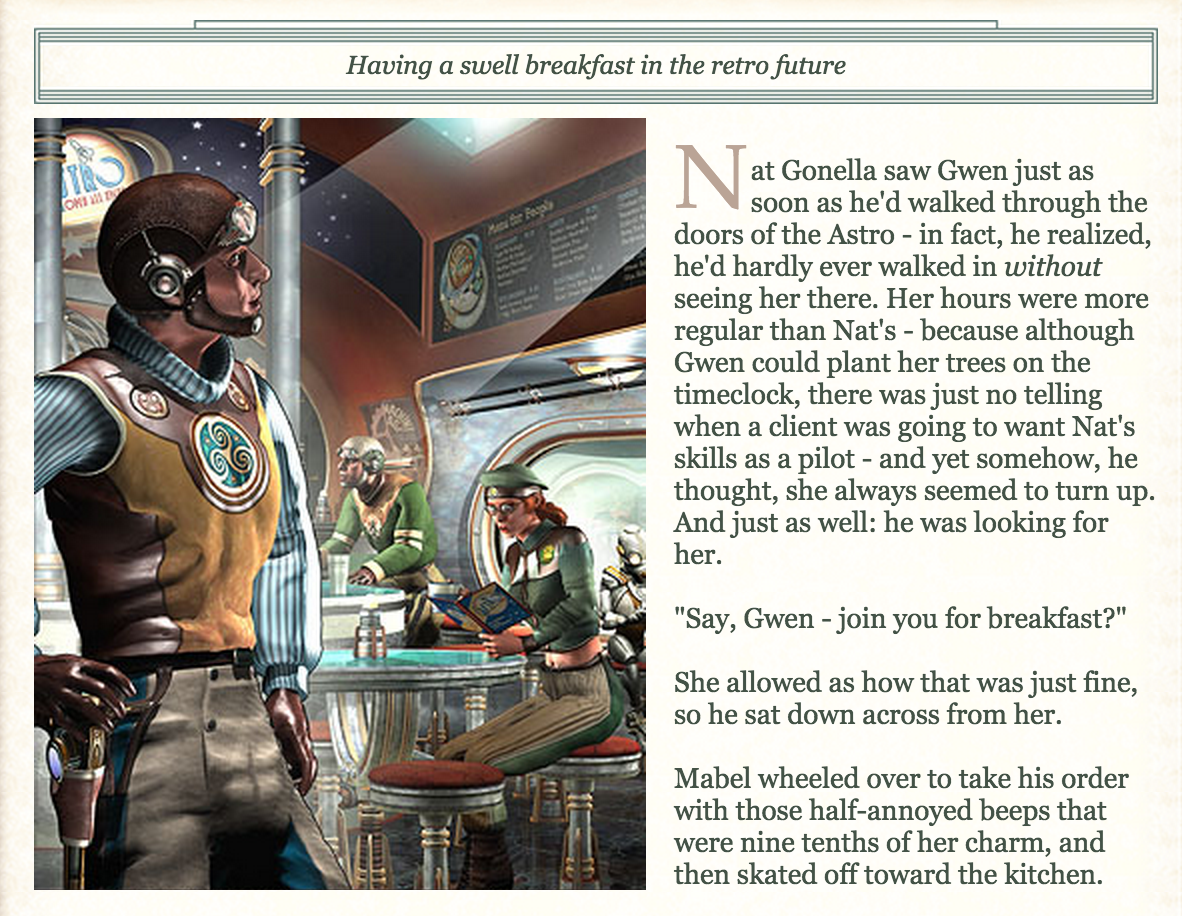
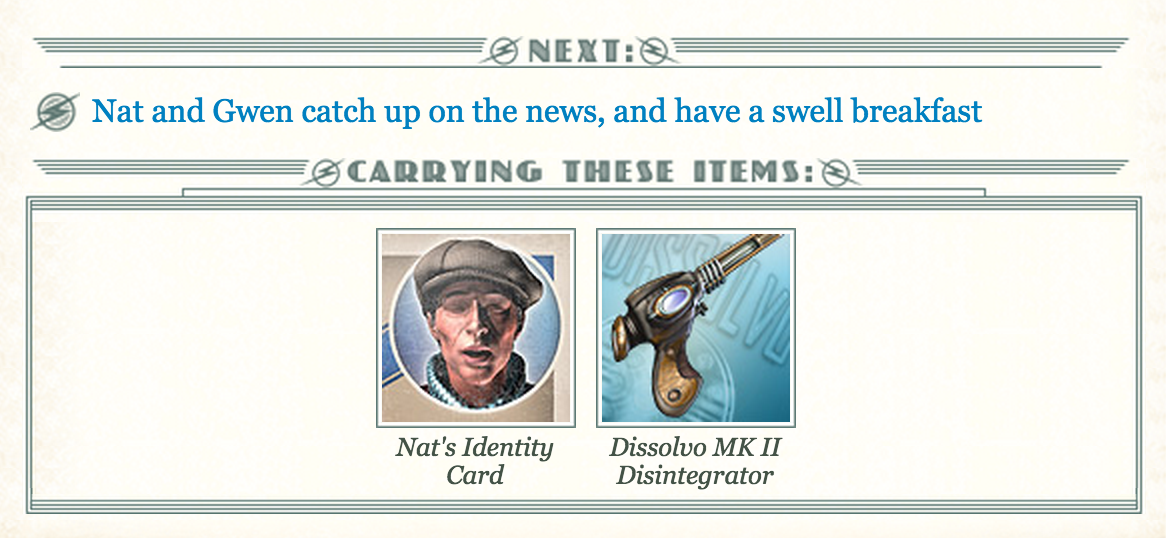
Thrilling Tales of the Downright Unusual is a website for retro-futuristic illustrated choice-based fiction, set in a shiny chrome and leather universe with lots of Deco machines and mad science. Choices often run to 1-3 options, and there’s an always-present inventory list, reminiscent of but significantly fancier than ChooseYourStory games:

Screen Shot 2014-12-07 at 5.06.24 PM

The majority of the choices are exploratory: you are choosing which objects to examine and which questions to ask of NPCs. Very occasionally you’re offered choices that seem like they might affect events, but the plot strands rejoin almost immediately, via standard sorts of agency-denial: you ask a character to come with you, but they refuse; you attempt to head the wrong direction, but it’s blocked. Even the inventory is a bit deceptive: games with inventory usually let you accumulate and drop things in ways that are likely to make a difference later in the story, but as far as I can tell, your inventory is very much determined for you, and it’s impossible to get to a particular story branch with any variation in your inventory list.

You also several times have the option of following the male or the female protagonist, getting a significant portion of the story from their perspective. Later, when the characters meet up again, you get filled in on what happened to the character you did not follow. The overall effect is that the story does contain significant branching, since you see different nodes if you’re playing as Gwen than if you’re playing as Nat, but that branching provides reader agency rather than player agency.

Continue reading “The Toaster With Two Brains (Thrilling Tales of the Downright Unusual)”

French Comp 2015

FrenchComp is a yearly competition for French-language games, usually with just a handful of entrants: the French IF community is not large. For someone with rusty French skills, playing through the games can be a bit of a challenge — I read French a lot better than I speak it, and coming up with commands can be a stretch, especially if the game wants a non-standard verb that isn’t covered in this French IF manual. This year, though, I had the good fortune of playing with ClubFloyd, where we could share verb guesses and reinforce one another’s understanding.

IF in languages other than English doesn’t get nearly as much coverage as I’d like within the English-speaking community, so I’d like to talk about the games here, but I should also say that I’m not really equipped to judge them in quite the same way I might review English IF. I can’t really judge French prose style; I suspect I struggled in a few places that were down to the quality of my linguistic skills rather than the quality of the design; and then there may be different conventions in French IF. (One of them definitely seems to be a love affair with “press any key to continue”. I think there were more “key to continue” pauses in these three games than in the whole of the English IF Comp last year.)

So consider this more of an experience report than a review per se.

It is also spoilerific, since I want to talk about the story endings of a couple of the games. If you are planning to play these works and just haven’t gotten to them yet, you should probably read no further.

Continue reading “French Comp 2015”

ParserComp: Chlorophyll (and a digression about female characters)

Cover

Chlorophyll is a lighthearted science fiction story by Steph Cherrywell, the author of Jacqueline, Jungle Queen. The premise is that you’re a sentient, mobile plant and have been brought along on a space colonization expedition by your mother, who is trying to discover what’s gone wrong with an abandoned space station. Your need to photosynthesize constantly provides a combined light/hunger puzzle that puts a fresh spin on a pair of rather elderly text adventure tropes.

The other puzzles work pretty well too. Eventually I needed to reach for the walkthrough, but that was mostly for reasons of time and general exhaustion and wanting to get through enough ParserComp games to vote, despite GDC travel. I think in other circumstances I would have gotten through most or all of the puzzles on my own. As in Jacqueline, Jungle Queen, I felt like the author had a pretty much textbook mastery of puzzle/map design for a game this size: you get a confined intro, then access to multiple puzzles at once, then narrow again to a more dramatic couple of endgame puzzles. It may be a standard structure, but it’s a standard for good reasons.

I had a stronger reaction to the story than to the puzzle structure. Except for the photosynthesis concept, the implications of your plant-based origins are developed gently and selectively. Plant culture bears a lot of resemblance to human culture, down to toy stores and hair leaf salons. Plant-person society is apparently all-female: male Xyloids are grown in special gardens and appear to be objectified and possibly non-mobile or even non-sentient.

Meanwhile the protagonist is right around (human-like) puberty, and this was handled with a few well-selected moments and bits of inner monologue. We see a growing desire for independence, a mixed curiosity and disquiet around sex, ambivalent feelings about a position somewhere between childhood and adulthood, and opportunities to play both sides of that divide at different points in the game. In a hair-dressing scene that fills no plot-critical function, the protagonist can explore different ways of presenting herself: does she see herself as glamorous? tomboyish? like a smaller edition of her Mom? And as simple as these options are, they capture something about the personal stakes of such decisions. Plenty of media present young teen girls as obsessed with hair and fashion, but flag up that behavior as shallow or “girly” in a negative sense. From the inside, all this is the opposite of shallow: it’s a whole complicated and confusing process of figuring out who you are as a social being, where you stand relative to sex and adulthood, and what set of signifiers will help you communicate those discoveries — or, if need be, camouflage the things you’re not ready to share.

In an understated way, Chlorophyll understands all that. Its protagonist is, yes, immature in an absolute sense, prone to sullenness and resentment of adults. But she’s doing a good job of handling the life stage she’s at. She’s capable of handling machinery and scientific problems as well as anyone her age could be expected to; she’s perceptive about work culture, sensitive about her changing relationship to her mother, and brave in the face of danger, while still being distinctively a girl and dealing with the kinds of issues that female-identifying people often deal with during puberty.

Then there’s Mom. The protagonist’s mother is put out of action fairly early on, in classic children’s/YA-literature style: the only way to get young people into adventure-hero roles is usually to remove the adults who would normally be responsible for dealing with serious situations. But this is handled reasonably adroitly. And despite the mother’s absence for the majority of the time, there are still a number of references back to her. I wouldn’t go so far as to say that the story is mainly about your relationship with her, but there are several points where it is important, and in particular one of the game’s key puzzle rewards doubles as a re-assessment of how Mom thinks of you.

This was enough to make me reflect on how rarely IF touches on mother/daughter relationships at all. There’s a bit of this in Common Ground, and some in my own work Bee, but I’m not thinking of a lot of other examples.

I wouldn’t really have pointed out mother-daughter relationships as a Thing That Is Lacking before playing Chlorophyll, but when I encountered it here, I found it refreshing all out of proportion with what actually happens in this game — which is a pretty good sign of an unsatisfied longing.

This is perhaps related to another wish I had previously identified: I want to play more games featuring middle-aged and older women in established career positions. I might be interested in a show about a female superhero or a female soldier, but I don’t identify with or aspire to those situations. I’m more excited by women who have agency and enjoy respect because of what they’ve built and accomplished, through dedication and talent and social savvy. I know women like this in real life, and am fortunate enough to count some as mentors and friends, but such characters don’t come along as often as I’d like in any of the media I consume. When you do get an older female character in a career role, she’s often portrayed as a stone-cold bitch, a Miranda Priestly or a Patty Hewes, having lost every humane impulse in the process of reaching her position. I want more CJ Creggs, please — and, indeed, more Annalise Keatings, because morally ambiguous though Annalise is, she is motivated by a mix of vulnerability, loyalty, ambition, and (sometimes warped) principle. Her brilliance and her success exist alongside all the other components of a human.

I want more of this kind of representation because, frankly, I am looking for hints. Navigating a career you take seriously often presents special challenges for women. There’s the challenge of finding a sweet spot between being too passive to be effective, and being assertive in ways that many people will accept only from men; between buying into the prevailing work culture too little to be an acceptable fit, or so much that one is doing nothing to make it easier for the generation of women who will come afterward; between being dismissed as unambitious, and being condemned for not being enough of a team player. In some positions and corporate cultures, no sweet spot exists. (See also Mattie Brice on The Lost Woman in Games.) Whether this issue is apparent on the outside or not, it is the subject of a lot of thought, and of many of the conversations I have with other women, both inside and outside the game industry.

So I welcome more examples of how to be, and when something with a mature female character with ambitions beyond family life does come along, I tend to watch/read/play that thing avidly despite whatever other problems it may have.

Anyway, Chlorophyll. I enjoyed it, and I’m glad to see another entry from Steph Cherrywell. I had a few implementation nitpicks I’ll put on the other side of spoiler space, but essentially it’s fun, gently challenging, with a fresh enough concept to keep things interesting, and a handling of its female characters that I found very welcome. And while it’s mostly focused on a pubescent girl, it sketches a few of those elusive mature female characters in the background, not only your mother but all the others who inhabit and run the station.

Continue reading “ParserComp: Chlorophyll (and a digression about female characters)”