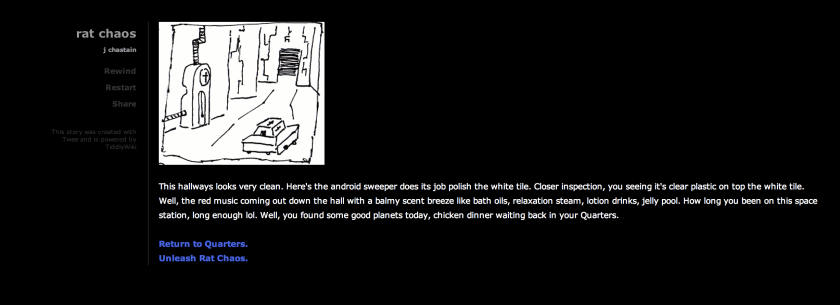
Rat Chaos (j chastain)

Rat Chaos is a very short Twine piece. It plays with agency not in the usual ways (discovering you have none, playing with how the protagonist refuses to claim agency, or revealing that the only meaningful agency the player can have is to quit the game). Instead, Rat Chaos explores the idea of surface agency as a distraction; the notion that solving the more obvious problems might be a way to shut someone up, to avoid listening to the deeper things they have to say. The first couple of screens may seem bewildering, but it’s a quick play whose significance reveals itself after not too long.

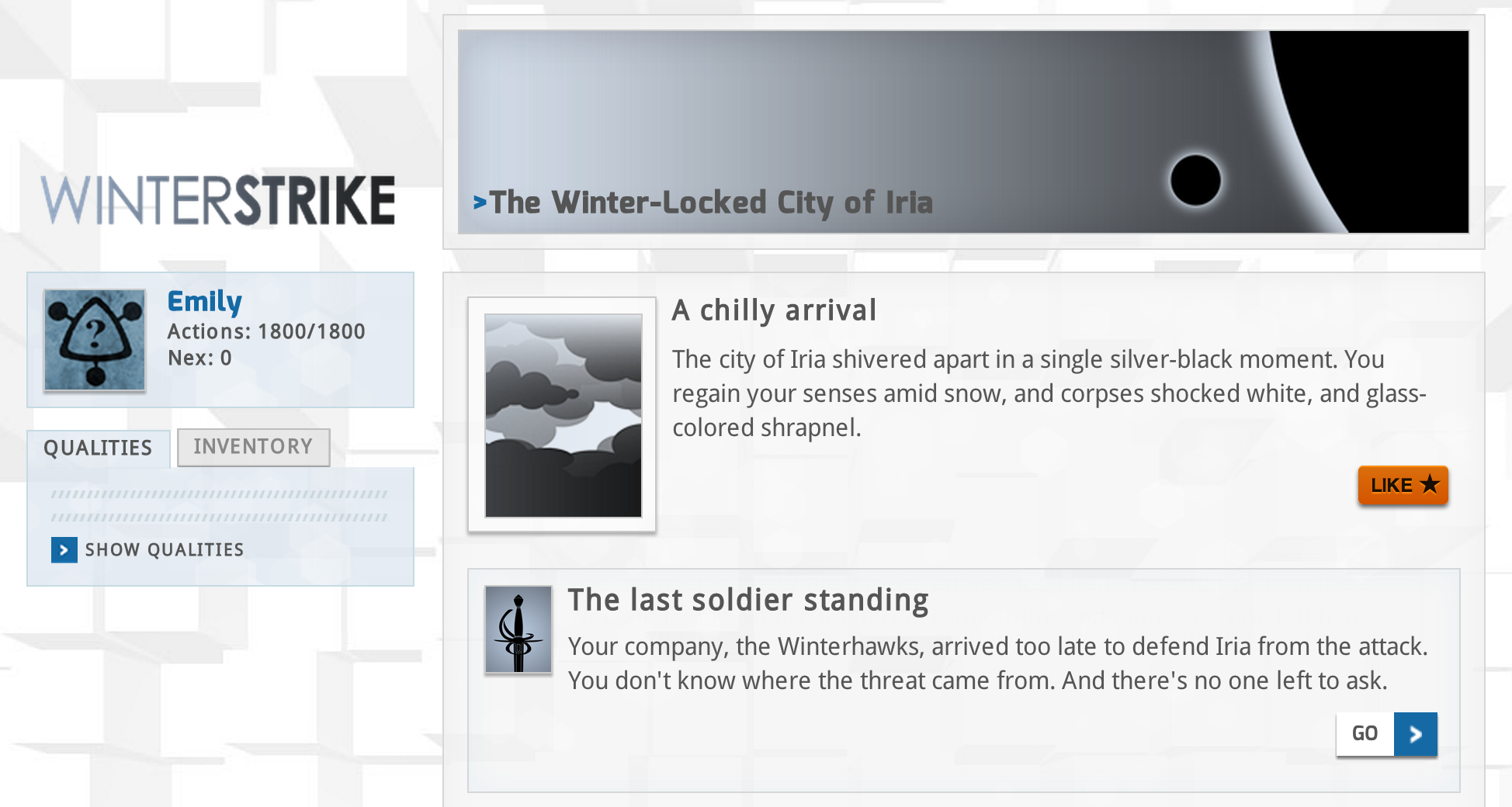
Winterstrike (Yoon Ha Lee)

Winterstrike is a StoryNexus world by Yoon Ha Lee, the SF/fantasy author whose previous IF work includes the art-show piece Swanglass and the evocative, elegant The Moonlit Tower.

Winterstrike takes that same gift for imagining a strange and alien world and presents it via StoryNexus mechanics: Iria is a city of etiquette and technology. It used to have spaceships and dueling clubs, architects and soldiers. Now suddenly it is oppressed by a heavy unnatural winter, the result of an act of war, though it is not clear who made such an attack, nor how. Bodies are frozen; buildings are broken; there isn’t enough hot food to go around. It’s not immediately clear how many races of creatures inhabit the city, let alone what their allegiances might be. Hints about the nature of the world accumulate slowly.

Plot grips less strongly here than in Samsara — at least during the opening stages. There are fewer of the pinned cards that represent ongoing plot threads. Some come in time, but to start with there aren’t many options of that kind. Instead, playing Winterstrike resembles exploring a foreign city when one has no special agenda of one’s own. A market, a street performance, an attempted crime, an interesting ruin capture the protagonist’s attention and then let it go again.

Meanwhile, the action bank is very generous, which means you can play more of Winterstrike at a time than you can of some SN games — a good move, I think, because it allows the player a little more scope to begin putting together clues and fragments before an enforced hiatus helps her forget them again.

As with Fallen London, the player character seems to be intentionally short on allegiances and long on self-preservation. Sometimes you have opportunities to act altruistically, take a side, help someone in trouble, but there’s also plenty of freedom to cross the lines and combine multiple strategies. It grows on me more slowly than Samsara did, I have less clear sense of what my character might in the long run wish to accomplish, but in the meantime the worldbuilding and imagery are intriguing, and there seems to be a lot of content to explore.

And a side note which is not really about Winterstrike per se:

I am not quite sure how I feel about StoryNexus’ recurrent use of a pool of iconic images. Playing Winterstrike one finds the same bridge over a river, the same sword, the same flag that make constant appearances in Samsara: now tinted a grim blue-grey rather than Samsara‘s heated gold, but with the same forms. This is a much better outcome than having no art for StoryNexus games — the concept of interchangeable cards more or less requires the player be given some visual distinction between options. And the available set is fairly evocative while at the same time not committing itself too firmly to any one genre. Nonetheless I found myself struggling with the imagery set more in Winterstrike precisely because those images already had meanings for me; it was like trying to hang a second coat on the same peg, associating this new set of story options with the same pictures.

Ectocomp 2012

Ectocomp is a Halloween-themed IF comp, which takes entries just before Halloween and then runs judging through the month of November. All of the games are written in 3 hours or less, which means that they tend to be very brief and a bit on the buggy side. Even with that caveat, though, several of this year’s crop were rather entertaining, and of course none takes very long to play, so it’s worth a look.

If you’re interested, there’s still time to play and vote!

Continue reading “Ectocomp 2012”

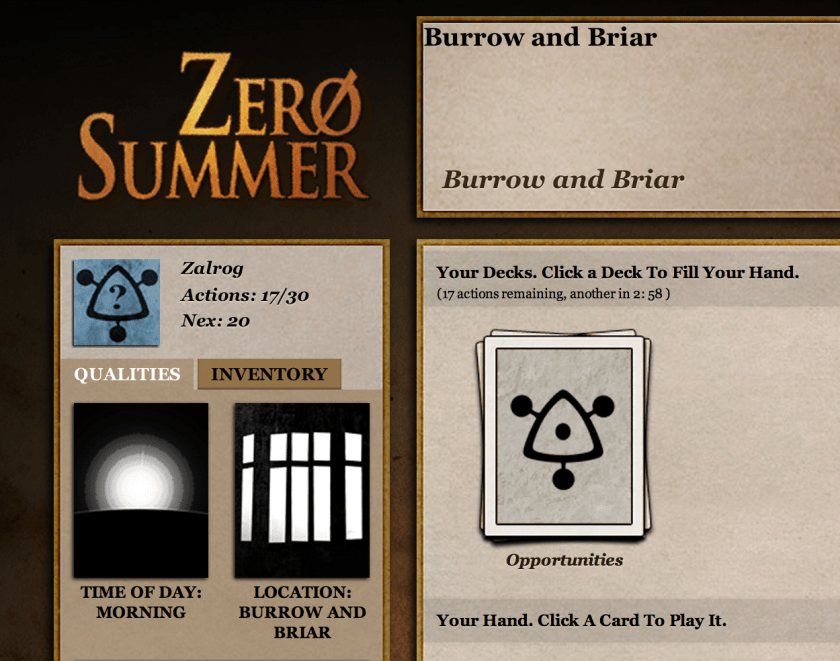
Zero Summer (Gordon Levine et al)

Zero Summer is the second place finisher in the seasonal StoryNexus competition, after Samsara. The setting is an apocalyptic western dated to 2026: Corpus Christi has become ground zero for an outbreak of monsters, and much of Texas has become essentially frontier territory again. And you’ve been clubbed on the head in a train robbery and forgotten everything, so that you are now the Man With No Name. Soon you fall in with people who offer to help you, and you begin to be embroiled in local plots.

There are several ways to go with this sort of setting. Happily (at least in my view), Zero Summer seems more interested in the society that might result from such a disaster, the sorts of people who would find themselves living in it, and how everyone gets on, than in dwelling on the monstrosities first thing. There’s a good establishing scene of creepiness, but it’s played with a lot of restraint, and then the player is sent out to get to meet people and be part of the life of the town.

The setting and the writing alike set Zero Summer apart from what I might call the StoryNexus house style — aspects that are not at all inherent in the system of StoryNexus, but that show up a lot, because a number of the existing works are written by Failbetter and then many of the others were written by people who liked Failbetter’s content and to some degree were inclined to emulate it. Fallen London, Samsara, Night Circus, Winterstrike, Cabinet Noir, The Silver Tree share a tendency towards artisanal virtuosity; towards luxury and violence, slashed silk and blossoming wounds; towards perfumed encounters with NPCs forgotten in the morning. If a story were a meal, the archetypical StoryNexus work would be a box of tiny, exquisitely intense bonbons — not chocolates, but Turkish delight, crystalized violets, spun-sugar caskets of anise liqueur.

This is by no means a complaint. StoryNexus is hardly the only language or system with a house style. Twine’s house style tends towards stream-of-consciousness and highly personal narrative, perhaps thanks to Anna Anthropy’s championing of it as a tool for self-expressive game design, while ChoiceScript’s tends towards highly customizable protagonists with a lot of stats and minimal pre-defined characterization. There’s no reason that has to be the case. Twine and ChoiceScript have most of their feature set in common — just different ways to visualize those features, and different supporting cultures.

So I tend to think the use of a system is driven as much by the community of people who are already using it as by the technical affordances. If a new author doesn’t like what’s been written already, or is not on the same wavelength with the existing experts who could help her, she’s much much less likely to be drawn to using that system. Eventually, if you’re lucky, you get a sufficiently complex ecosystem that the house style starts to break down, and people are trying lots of new things, and tool becomes separate from genre. But it takes time, and examples, and variation.

Zero Summer takes StoryNexus a step in this direction. Zero Summer is not a box of sweets.

Continue reading “Zero Summer (Gordon Levine et al)”
IF Comp 2012: In a Manor of Speaking

In a Manor of Speaking is a fairly brief, surreal parser-based word-puzzler of easy to moderate difficulty. As usual, the jump will be followed by non-spoilery comments; then if I have anything spoilery to say, there will be spoiler space. The fact that I am reviewing it at all indicates that there are beta-testers.

Continue reading “IF Comp 2012: In a Manor of Speaking”

IF Comp 2012: Andromeda Apocalypse (Marco Innocenti)

Andromeda Apocalypse is a parser-based science fictional puzzle game. As usual, the jump will be followed by non-spoilery comments; then if I have anything spoilery to say, there will be spoiler space. The fact that I am reviewing it at all indicates that there are beta-testers.

Continue reading “IF Comp 2012: Andromeda Apocalypse (Marco Innocenti)”