I should have posted about this more immediately, but I came home from PAX East with a bad cold and I’m just now getting really over it. However: the IF Demo Fair went off with a minimum of fuss and a lot of great entries. (And if you’re curious what the physical setup was like, there is a stream of photos by Mark Musante here.) I’m planning to cover the full list more thoroughly in SPAG — a little more official and permanent than my blog, as the entries deserve. But I did want to look at a few trends and examples.
The Demo Fair specifically invited people to experiment with the interface and/or UI, and we saw several experiments in dealing with the parser challenges that have been so frequently discussed lately.
Vicious Cycles with hyperlinksSimon Mark submitted Vicious Cycles, a game that already existed as a parser-based piece of IF from 2001, but now re-envisioned as with wholly browser-run, hypertext-like interface. It sometimes feels a bit like Undum, but sometimes branches out a bit, with windows of explicit inventory — an inventory that includes thoughts and ideas as well as objects. The effect is sleek and streamlined, though (in my own opinion) it makes the sacrifice that all CYOA makes relative to parsed IF: as soon as the player is thinking only in terms of a single set of choices (which object to interact with, say), some of the texture and depth of the world is set aside. And I did sometimes miss having a full transcript and scrollback. However, there was a lot about the experience I did like — its smoothness and accessibility — and it is relatively rare for CYOA/hypertext to come so close to suggesting an IF-style world model. (Though not completely unheard of.)
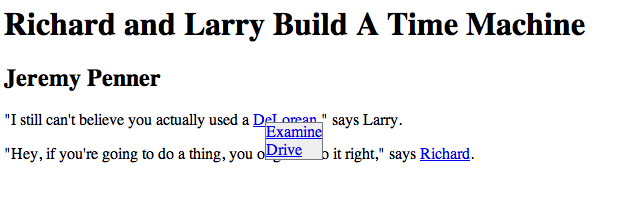
Richard and Larry Build a Time MachineA related demo was Richard and Larry Build a Time Machine, by Jeremy Penner. Interactive objects are hyperlinks, but clicking on them brings up a contextual menu with a couple of suggested verbs. The whole transcript expands — and in keeping with the time-travel theme, things the player does later in the game can insert new content earlier in the story. What’s more, the player can click on any section of the transcript to undo the action there — sending other ripples of causality through the transcript. It’s a short piece, and worth a look. More information, and the source code, may be found here.
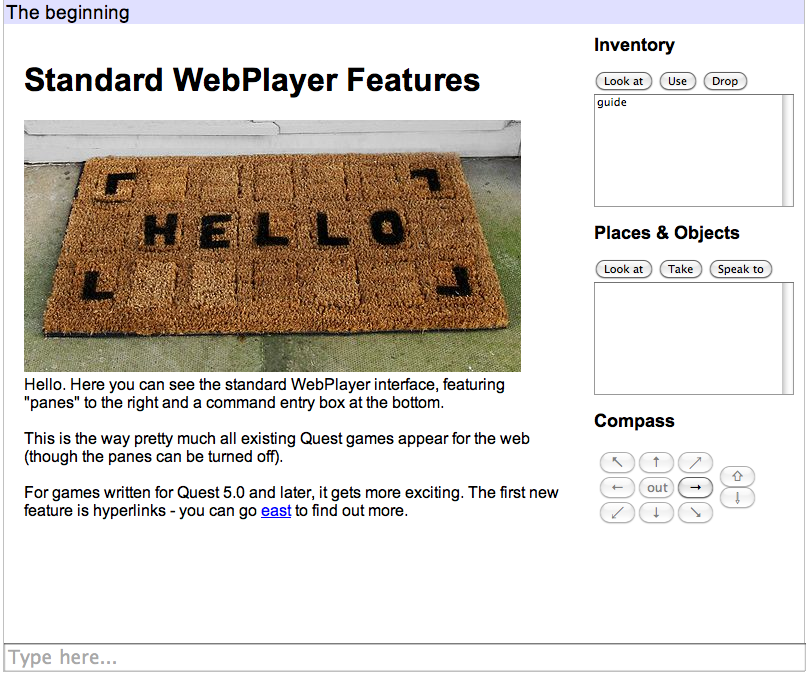
Quest 5.0 WebPlayerAlex Warren brought us the web player for Quest 5.0. The standard features (easily turned off, however, I gather) include a constant inventory window, another window of items present in the game world, and buttons for the compass directions. As in “Richard and Larry,” clicking on an object name in the game produces a drop-down menu of possible verbs. The inventory and stuff-in-this-location windows are more than I personally would want on-screen all the time in many games, but it’s clear that these are highly modifiable features of the system. (The flexibility of the system is clear from Warren’s second small demo game, in which two side by side windows present command lines and descriptive text, and the player can type on either side to see what happens from both points of view.)
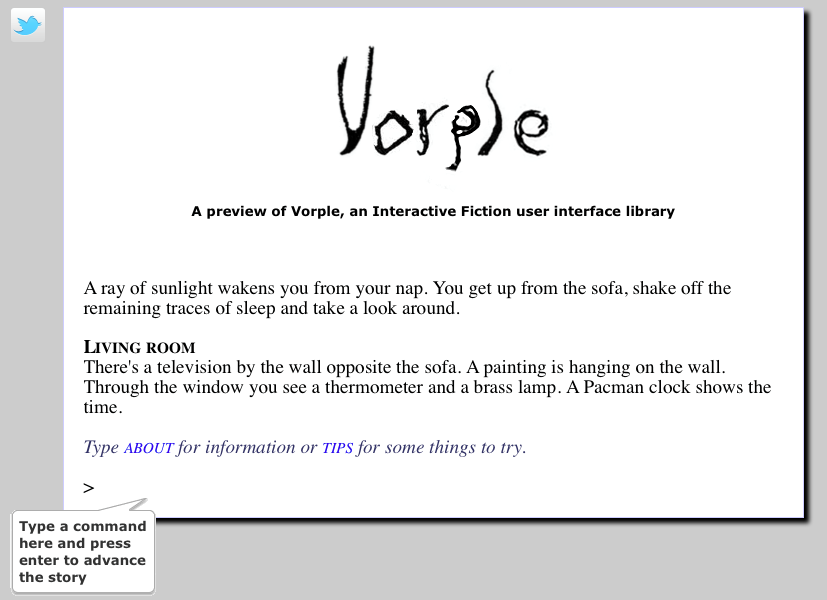
Vorple, with a tooltipI was also excited by the possibilities in Juhana Leinonen’s Vorple interface demo. Vorple is a javascript front end that Juhana plans to adapt to multiple game engines, including CYOA tools like Undum and conventional parser-based IF systems like Glulx and the Z-machine. The example in the demo fair showed off a number of neat abilities, like the ability to erase parser error messages after a turn, leaving behind a clean transcript. But I especially liked its ability to bring up a tooltip-like guide when hovering over game text. This is a mechanism I currently find really appealing as a way to provide help and affordance clues to the player: hover over a word or phrase in the text to get some tips about what verbs will work on that noun, a bit like the menu constructions in “Richard and Larry” above. Move your mouse away again, and the tooltip is gone. Alternatively, click to paste the command in line. Without getting rid of the command line entirely, and without cluttering the transcript or the screen with unattractive structures, a tooltip system could offer helpful glosses using UI conventions people are already familiar with from other web pages and applications.
Vorple is still a long way from completion, as I understand it, and the tooltip concept is only one of a number of things it can do. But I’m currently quite enamored of the possibilities.
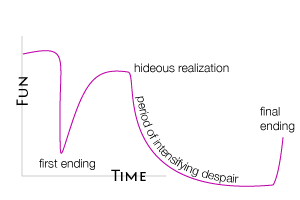
Date/Warp is a visual novel from Hanako Games, paced out with puzzles. I liked a lot of things about it, but had some issues with the structure; essentially, my discussion is about how to handle situations where you want the player to replay and try most of the alternate versions of a multiple-ending game, where that will mean that late replayings will be mostly the same experience over again. Date/Warp enforces this more than many other games (though in a way I gather is not unusual for visual novels) by having the best ending be completely locked and inaccessible until you have played through almost every possible variation.
It’s a problem that has some bearing on multiple-path IF. I know, for instance, that there are people who did play Alabaster this way and found it exasperating to do so — see TempestDash’s review here — even though the intention was to steer players aggressively towards interesting endings and point out which mysteries were missed, rather than to encourage complete exploration of content. So, though I’m critical of Date/Warp as an experience in that regard, I think it raises some useful questions.
My take on Deirdra Kiai’s latest work. Though my column doesn’t go into this aspect, the making of “Life Flashes By” is also pretty interesting — it’s Kickstarter-funded independent work, and Deirdra has some cool posts up about it on her blog.
ETA: This was up, and then GameSetWatch seems to have taken it down again. Don’t know why. Presumably it will come back again at some point. And it’s back.
 I should have posted about this more immediately, but I came home from PAX East with a bad cold and I’m just now getting really over it. However: the IF Demo Fair went off with a minimum of fuss and a lot of great entries. (And if you’re curious what the physical setup was like, there is a stream of photos by Mark Musante here.) I’m planning to cover the full list more thoroughly in SPAG — a little more official and permanent than my blog, as the entries deserve. But I did want to look at a few trends and examples.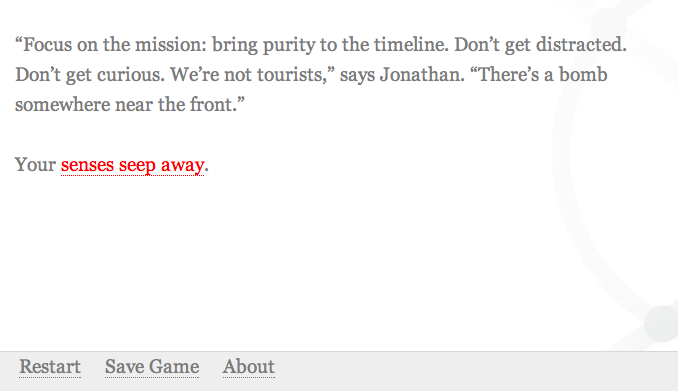
 Emily Short's Interactive Storytelling