Finished Infidel this evening, after consulting the hints about just a couple of points (which turned out to be guess-the-verb-y things where we had the right idea).
Overall, I’m surprised by how relatively easy it is — the hieroglyphics puzzles are fun and consistent but not that hugely brain-teasing. It’s really easy to lock yourself out of victory by doing the wrong things in the wrong sequence, but mostly that’s about execution (remember to pick up your knapsack again before leaving an area!!) rather than about figuring anything out in particular. I found myself thinking that the emphasis on performance actually makes it a little more like a platformer than modern IF tends to be. It’s very hard to get to the end without having to replay parts — probably most of the game at least once, and some pieces perhaps multiple times — and even when you’re replaying it’s easy to screw something up if you drop the wrong thing in the wrong place and forget to pick it up again, or take a wrong direction by accident.
After a while it becomes a kind of proficiency run, to do all the necessary steps with no extras and no mistakes.
 After hearing about it for a while and thinking it basically sounded like a silly gimmick, I finally tried
  These days I mostly don’t play time management games unless they’re sent to me for review, they’re demonstrating some new mechanic, or they show hints of having a more interesting storyline than average. The first few were fun, but I’ve now pretty much been there and done that. But I made an exception for
 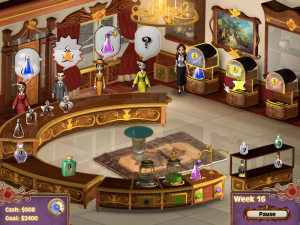 Now and then I get review copies of things that turn out to have too little narrative content for a Homer in Silicon column, but are decent enough that I play them for a while anyway.
  Emily Short's Interactive Storytelling