Hatoful Boyfriend

Screen Shot 2014-12-20 at 10.32.14 PM

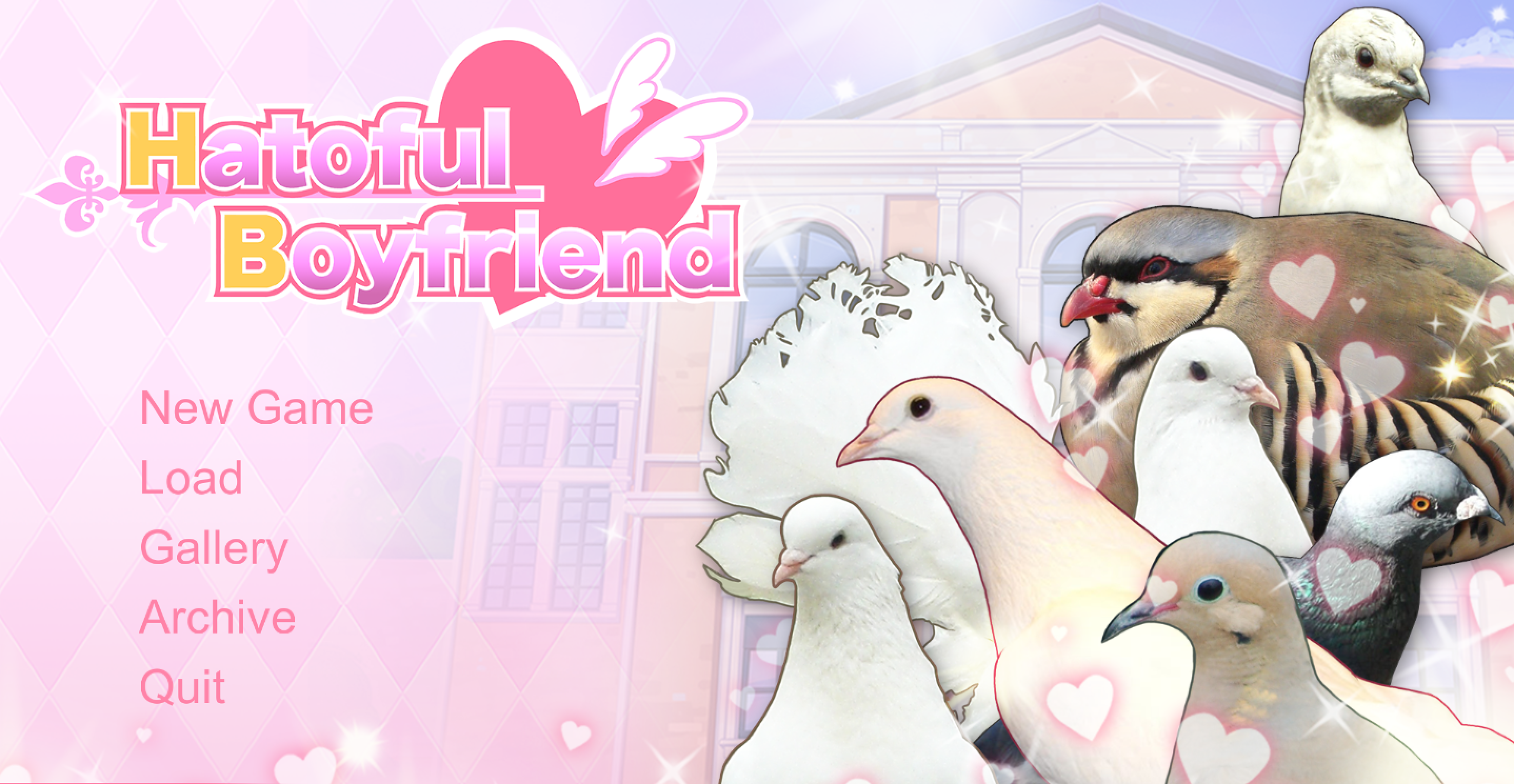
Hatoful Boyfriend is a visual novel of the dating sim genre(ish), in which all of the possible romantic leads are birds. You are a female human attending an otherwise all-bird school, and you have your choice of pigeons, quails, and doves, each possessing a characteristic personality. What initially seems like a whimsical premise gradually develops a bit more depth; there’s even a website devoted to the writings of a prominent in-world pigeon blogger.

Quite a lot has already been written about Hatoful Boyfriend, often by people more familiar than I am with visual novel conventions — though the visual novel community, like the gamebook community, often seems so relevant to interactive fiction that it’s a little mystifying that there isn’t more communication. As with many other dating sims, the game is designed to be replayed to unlock new content: you begin by romancing different suitors and finding out their secrets, which then allows you to access a different ending to the story. In contrast with a lot of “ultimate ending” finales, though, the unlockable content in Hatoful Boyfriend is both much longer than the per-suitor stories, and of a different genre: a horrific mystery, rather than a romance, and one that does a lot to explain how a world of sentient pigeons has come about.

I couldn’t help thinking as I played about some of the arguments in Creatures Such as We, especially the idea that it’s hard to explore consent in a game in which all NPCs are prizes for the protagonist. With Hatoful Boyfriend, I felt that I was experiencing the opposite effect of this: the game expects you to play many times, and each time you must mold the protagonist in order to suit the tastes of the bird she’s pursuing. There are only a few characteristics of hers that remain absolute, such as her vitality and love of running (and that proves to have an important plot relevance, eventually). Otherwise, a lot of the potentially freighted moral choices dissolve with repetition and the fact that she has to take different sides of each issue depending on whom she wants to impress. The cumulative effect, at least for me, was that the protagonist came to seem less and less important, even as my playerly understanding of the other characters increased.

But then — well, let’s give this a spoiler jump first.

Continue reading “Hatoful Boyfriend”

Device 6, The Sailor’s Dream, The Sensational December Machine (Simogo)

device_6_screen02Last year, Simogo produced Device 6, a game I found myself stubbornly disliking despite its massive app store popularity and the number of people hailing it as the next big thing in interactive fiction. Unquestionably a beautiful piece of typographical design with a 60s style evocative of the Prisoner, Device 6 disappointed me both as story and as puzzle collection.

As a story, it told about a largely unknown character in a surreal and unexplained environment: long on mystery, low on meaning. I tend to think of this as “Lost Syndrome”: writing that offers the player or reader a lot of suggestive and intriguing hints but does not demonstrably have any plan to resolve them all. In the end, it turns out that the entire business has been — oh, I won’t spoil it, since the evidence suggests that most people enjoy this piece more than I did. But let’s just say that the ending falls into a standard category that annoys the heck out of me.

As for the puzzles, they were not that well integrated into the story and varied widely in style and difficulty. More often than I liked, they turned on whether or not you had noticed some particular image or some particular correspondence between images: in my puzzle taxonomy, they’re basically all puzzles of surprise, typically without a lot of extra hinting available. If you got stuck, that meant a lot of time wandering around looking at things trying to have the perception shift that would reveal what you’d missed. Meanwhile, for a game requiring a lot of exploration, Device 6 didn’t make the process comfortable: you had to swipe back and forth (and back and forth, and back and forth) along long passages of shaped text. Over time the initially pleasing architectural nature of that text became a burden. By the time I got to the end I was thoroughly grumpy.

Now along comes The Sailor’s Dream.

Continue reading “Device 6, The Sailor’s Dream, The Sensational December Machine (Simogo)”

Necklace of Skulls, The Sinister Fairground (Cubus Games)

cubusCubus Games is a maker of gamebook apps, and they have released a version of Necklace of Skulls by Dave Morris as well as a game called The Sinister Fairground.

In both cases, I felt that the UI was a bit clumsy and a bit unpolished, compared with the sleekness of 80 Days and inkle’s other work, or the splashy dynamism of Tin Man Games’ Appointment with FEAR. When you encounter new objects in the text — things that you might write down as keywords in a paper gamebook — you have to tick off a checkbox to acknowledge them as part of your inventory. I didn’t realize this in my first playthrough of Necklace of Skulls and got really confused about why I seemed to be missing objects that the text said I possessed; and indeed it’s not quite clear to me why it’s useful to make the player do this.

Along the same lines, the navigation through the helper pages for Necklace of Skulls (map, items, journal, checkpoint, table of contents) had me thoroughly confused and tapping in circles: there isn’t a clear hierarchy of how these pages relate to one another, and the icons and back buttons don’t all do quite what I would have expected.

Continue reading “Necklace of Skulls, The Sinister Fairground (Cubus Games)”

Hybrid interfaces: Texture; Contrition (Porpentine); Spondre (Jay Nabonne)

Lately we’ve been seeing more and more work that falls somewhere between parser-based IF and hypertext: in the past six weeks or so, I’ve run across two new games and a creation tool that push the boundaries in various directions.

Jim Munroe and Juhana Leinonen recently released Texture, a system designed especially to produce touch-based IF that will play well on mobile devices. Texture features the idea of applying verbs to passages of text:

Screen Shot 2014-12-16 at 11.55.07 AM

When a verb is used on text, it replaces that text with something new, or else moves forward to a new page, mimicking the change-or-advance link distinctions in many Twine games. (With Those We Love Alive actually makes this distinction obvious by coloring these links different colors.)

The pairing of verbs and nouns means that navigation is a bit less obvious than in most pure hypertext Twine pieces, allowing for puzzles. The back end is still extremely simple, though, so although it might appear to be a system that would compete with the parser, in practice there’s no way (yet) to build up an extensive world model. The verbs that are available may change from page to page, and the author is handcrafting each verb-phrase interaction.

To the best of my knowledge there aren’t any released pieces yet that use Texture, but I’ll be interested to see what comes of it.

Continue reading “Hybrid interfaces: Texture; Contrition (Porpentine); Spondre (Jay Nabonne)”

Transcript Live, and a few other Changes

The IF Discussion Club met again, this time on New Directions in IF, and the transcript is now available.

Also: for a long time the “Reading IF” section of this blog has had lists of games to play, but those lists hadn’t been updated since ca. 2007 and were getting seriously out of touch with what is going on in current IF. (A lot of the links pointed to Baf’s Guide or the IF Scoreboard rather than IFDB, for instance, which made them essentially deadweight.)

I thought about just cutting this portion of the site entirely, but site stats suggested that some people were actually reading the lists still, for all I considered them horribly rusty. So I have now totally overhauled these pages. They’re now explicitly intended as lists of lists. That is, there are various topics one can explore and get a little bit of an overview of some of the kinds of features that occur in IF games, but when it comes to delivering specific suggestions, they then mostly point onward at IFDB polls, lists, and tags, as well as game-list-y blog posts (and in one case, a Pinterest board of screenshots of IF interface types).

My hope is that by relying partly on IFDB, I’ll have an at least partially self-maintaining system (in that other people besides me add tags). Even if that part turns out over-optimistic, at least I’ve gotten rid of the stuff that treats choice-based IF as a rare and peculiar deviation from the norm. I also got rid of the “world model” page, which were feeling — not even 2007, but more 2001 or so, thanks to the somewhat breathless excitement about games that implemented ropes and fire. (I was really excited about ropes and fire back then.) Likewise, the “setting” page was very heavily oriented around the assumption that IF was always organized into rooms, and that’s so far from being the case now that it just seemed a bit silly.

Some things went in, too. Added more puzzle types to the puzzle page, especially wordplay things. Added more narrative structure coverage. I expect I’ll keep tweaking this, and/or linking in additional game lists as appropriate, but if there are things I could be doing to make these resources more useful to people, let me know. (And then I may or may not do anything about it depending on how demanding the request is, but…)

Windhammer Prize for Gamebooks

The Windhammer Prize is a prize for short traditional-style gamebooks: distributed in PDF, but designed to be played with a pencil and paper and sometimes dice. Windhammer contestants have to be short — no more than 100 segments allowed — and the contest is run yearly. It feels a bit odd, especially now that the IF community itself produces so much choice-based literature, that there’s so little discussion of gamebooks or awareness of the surrounding community. So as part of my continuing mission to cover IF-adjacent material, I tried out a bunch of Windhammer contestants.

Some highlights follow.

Continue reading “Windhammer Prize for Gamebooks”