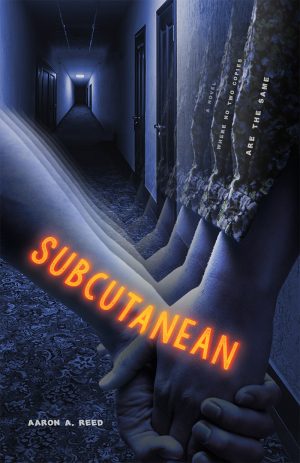
Subcutanean (Aaron Reed)

Most of my first-Tuesday-of-the-month posts cover books about craft, writing, or game design in some way. This is an exception, though: recently I had a chance to read Aaron Reed’s horror novel Subcutanean. It tells the story of a young man who discovers his basement is much larger, deeper, stranger, and more branching than any basement has a right to be. It’s also written with a generative text process that means no two copies are alike.

As a premise, “basement is bigger than it should be” might not seem to be that horrifying. But in this case, it genuinely is. I don’t want to spoil the story, but I was surprised at how effectively Aaron made what might seem a fairly passive menace into something really threatening.

From about a third of the way into the book, I was hooked in a way that rarely happens to me these days — that kind of MUST READ NEXT PAGE attention that makes you put off going to get a glass of water for two or three hours on end because the spell just hasn’t broken yet.

I also found it interesting as a project in novel-length generative text. It’s different from a lot of generative projects in that it feels human-written from end to end. There is no point where I found myself thinking, “oh yes, this was made by a grammar.” That’s because it largely is human-written, and then machine-elaborated, or machine-varied. The alternate forms of a sentence are all things that Aaron explicitly planned for; it’s the combinations of forms that he might not have anticipated.

At which point, you might think, well, why do a generative text at all? If it doesn’t feel like it was made by a machine in some way (and I’ve talked about the aesthetics of intentionally mechanical-feeling text), and if it doesn’t need to be instantly generated or arbitrarily long, then what is the point?

The point, at least in Subcutanean, is the divergence. My copy isn’t your copy; it’s different in all sorts of ways; and that chimes with the core conceit of the story. This is a novel about the unknowable proliferation of motives and outcomes; about the fact that the same set of events might have many different interpersonal explanations, or lead to many different consequences; that the same people might follow dissimilar trajectories.

At the end of the copy I read, there is a page that describes differences between my Subcutanean and some other versions. Some of those differences were significant, suggesting major plot points that could have gone another way. When I finished my version of the book, I was immediately curious to try other variants, to try to get a sense of what the whole plot possibility space would look like. But even if I ordered another copy, or two copies, or more, I’d never fully map that potential space. Knowing the story’s territory cannot be completely mapped brings a provocative uncertainty into the realm of static text that I generally associate only with interactive stories. Which is a perfect for the book’s themes.

End of February Link Assortment (and a bit about GDC Cancellation)

Non-Event

March 16-20 will not be GDC this year. The event has been canceled due to coronavirus concerns.

(They’re talking about doing something else in the summer that will be GDC or GDC-esque, but it’s hard to know at this point what that will look like, and it’s hard to imagine it will have anything like the same scope.)

I suspect this is the right choice, but it’s also a significant loss for many people who were relying on it for various personal or business reasons.

Meanwhile, this occasion is also an opportunity for talking about and reflecting on how the advantages of GDC might be made more accessible to people from more backgrounds. Solutions that we come up with for the current situation might have some broader applications later.

So some resources:

Financial

https://gamedev.world/relief/ . Some developers have invested a lot in being able to go to GDC, and this turn of events can be really problematic for small indies or companies that are otherwise on the edge. This fundraiser looks at ways to help offset that for people.

Mental and Emotional

Take This has some advice on emotional handling if this is more distressing than you expected.

Professional Visibility for Speakers

If you’ve written a talk and now don’t have anywhere to give it, there are some conferences currently accepting pitches for events later in the year. The Nordic Game conference has its call for speakers open through March 4, for instance.

UBM has also said that they’ll be accepting recorded talks and putting them on the GDC Vault and on YouTube for free. Whether that’s a good deal for you will depend on your individual circumstances (and how hard it is for you to set up a recording that you wouldn’t find embarrassing). But it may mean that some talks are available to the general public that otherwise wouldn’t have been.

Community and Knowledge-Sharing

notGDC is an initiative that’s been around since before GDC was canceled. It’s meant as a way for people to share information and enthusiasm around games, without needing to splash out on travel. The website is still up and they are coordinating events.

In narrative games specifically, NarraScope is still expected to happen this year — late May, in Illinois. Feral Vector is one of my favorite indie spaces just for its relaxed and friendly vibe; that is upcoming in the UK as well.

Local events like meet-ups are also a useful way to develop ongoing connections and support, and find people who will help you through a long project; as always in this post, I’ve listed below the events I know of in the interactive narrative space.

For developers looking for connection and support, there are a number of Slack and Discord channels that allow for some connection. Some of these require you to be invited, but some will take open applications. A couple that I know of:

The hallway conversations and the dinners

The things I will find hardest to replace myself are

  • social, in-person time with friends, former colleagues, and people I have been wanting to meet. Video calls exist, but a meal with someone is a different kind of experience, one that feels more personal and less like work.
  • chance meetings. In-person events vs online ones are like bookstore browsing vs Amazon searching: they let you find things and people that you didn’t know you were looking for. That element of randomness is actually really useful.
  • time set aside. The week of GDC, I’m not generally expecting to do anything else, which means a relative lack of distraction and ability to be wholly engaged in what’s going on there.

I’ve heard a few people talk about Google Hangouts with people they’re missing at GDC, and that’s something I’m still thinking about — especially if they’re not 1-1 hangouts (which can be a bit time intensive) but perhaps 4-6 person chats with a group of people of shared interests. Mulling whether there’s something worth exploring in that model.

Continue reading “End of February Link Assortment (and a bit about GDC Cancellation)”

GDC 2020 Previews

Every year I write up a list of interesting-looking narrative-related talks I’m looking forward to at GDC. (I also have an old post about surviving your first GDC that still mostly holds true, though Samovar no longer takes reservations, alas.)

This is a longish list, with a lot going on Monday and Tuesday especially given all the narrative and indie talks presented in the summits.

Continue reading “GDC 2020 Previews”

Mailbag: Development Process for Storylet-based Interactive Fiction

I’ve been a fan of your site and writing since 2009. Two of your older articles have been nagging at me recently — the one about writing prose for IF, and the other about your drafting process (with examples from Metamorphoses and Bronze, respectively).

I have been wondering how they would look updated for writing prose/process for storylet-based designs. I’m having a bit of a difficulty transitioning from the static fiction mindset, with all its attendant shortcomings in the IF context (text not bite-sized enough, difficult to decide on salient information , too much linearity, etc.)

If you had to address these two articles’ topics today, how would it be different? 

This is asking for an update to two articles, and so I’m also going to split out the response.

This piece will focus on the process side rather than the prose question. If you’re writing a game using storylets, how do you plan it, and how do you stay on track through executing it?

Continue reading “Mailbag: Development Process for Storylet-based Interactive Fiction”

Mid-February Link Assortment

Events

February 29 is the next London IF Meetup. We’ll be playing and discussing games with trans protagonists.

March 5, “Game Over,” the radio play I wrote about indie game development, is being rebroadcast by BBC Radio 4 at 14.15 (or 2:15 PM, for those of us still keeping time in the US fashion). This is a chance to catch it if you didn’t hear it the first time around and you’re interested. Sometimes the Radio 4 website also hosts the programs from that month for streaming.

March 7 is the next meeting of the SF Bay Interactive Fiction Meetup.

NarraScope organizers will be May 29-31, in Urbana-Champaign, Illinois.

Podcasts, Articles, Videos, etc

The excellent Anna Megill, Lead Writer at Massive, talks about writing for video games.

Competitions

If you plan to enter Spring Thing 2020, you have until March 1, 2020 to declare your intent to enter. Spring Thing is a long-running competition for interactive fiction that welcomes longer games than IF Comp can accommodate, and features a “back garden” section for games that are unfinished, commercial, experimental, or where the author just wants to opt out of the competitive aspect of the competition. The games themselves will be due March 29.

Mailbag: Breaking into Writing for Voice UI

Dear Emily,

[personal information redacted] I have been following your articles for a long time and I decided to write to you because I am stuck: I would like to expand my skills in the game design field but at the same time I started to get interested in voice applications. I have read that writers and copywriters can make a great contribution to the development of VUI, so that they can understand the language and the context in which conversations take place. I saw that you managed to combine these two areas – game narrative and natural language programming – so I would like to ask you where I can start if I wanted to take this career path? What skills should I focus on? I’m looking for courses on platforms like Coursera and Udemy, but it’s not clear to me what criteria I should consider for the choice. Except for HTML, I don’t know the development software that are proposed, all I know is that I am interested in understanding how an editor, who deals with finding the best plot structure for a story or making characters believable, can contribute to the development of an Avatar or a dialogue flow, for example. And if companies are interested in this type of profile.

I definitely wouldn’t want to discourage you looking into natural language processing if you think you’re interested in it: it’s a fascinating field, and currently under lots of demand.

I didn’t approach the subject with Coursera or Udemy myself, so I don’t know the offerings there very well, but I would imagine that there are introductory courses that would explain a lot of the basic ideas and tools. Another way in would be to look through the resources listed here.

It’s also possible to play with transformer-based language models using Google colab notebooks. These models take a huge amount of skill, data, and computation time to build, but once they’ve been trained, they can be used in a range of applications. For instance, this notebook by Max Woolf will let you experiment with a trained GPT-2 model, which has applications both in generating text and in creating machine translations (among other things).

Then there are also sites such as https://huggingface.co/ where groups doing active research regularly post their progress, sample code, or trained models. You would need a good grounding in the basic concepts in order to make sense of these.

That said, you might not need all of those skills even if you were building your own voice-based system from scratch.

Continue reading “Mailbag: Breaking into Writing for Voice UI”