Interim CM Release

Release 2 of Counterfeit Monkey is available from emshort.com. (I know, it still says release 1 on the website.) This release does not tackle all the bugs that have been reported to me, but it does handle several that were particularly significant to the play experience: one that prevented highlighting from working as it was supposed to, and two affecting the endgame that were under some circumstances preventing people from seeing all the outcomes it should have been possible to see.

I mean to tackle the rest of what’s been reported as well, of course, but as that might take a few more days to complete, I wanted to make this available now.

New SPAG!

After more than a year’s hiatus, SPAG is back with a new issue, in a new hosting space. For those who aren’t familiar with it, SPAG is a long-standing (but occasionally on-vacation) IF community zine with editorials, interviews, and, in the old days, lots of reviews. As IFDB and personal blogs collated at Planet-IF have become review hubs, SPAG’s review content has dropped off a bit: the new editorial direction is moving largely away from reviews. But SPAG is still a useful place for longer articles, interviews, and discussions, so it’s great to see it make a reappearance.

The current issue features interviews with the three top-placing authors from IF Comp, an editorial from the new editor Dannii Willis, and long-form articles about shared-world creation and about detective IF as a genre.

Counterfeit Monkey

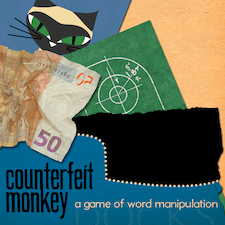
Cover art for Counterfeit MonkeyAnglophone Atlantis has been an independent nation since an April day in 1822, when a well-aimed shot from their depluralizing cannon reduced the British colonizing fleet to one ship.

Since then, Atlantis has been the world’s greatest center for linguistic manipulation, designing letter inserters, word synthesizers, the diminutive affixer, and a host of other tools for converting one thing to another. Inventors worldwide pay heavily for that technology, which is where a smuggler and industrial espionage agent such as yourself can really clean up.

Unfortunately, the Bureau of Orthography has taken a serious interest in your activities lately. Your face has been recorded and your cover is blown.

Your remaining assets: about eight more hours of a national holiday that’s spreading the police thin; the most inconvenient damn disguise you’ve ever worn in your life; and one full-alphabet letter remover.

Good luck getting off the island.

Continue reading “Counterfeit Monkey”

Yuletide IF

Archive of Our Own runs a Yuletide project in which participants write each other stories in different fandoms, as a holiday gift. This year’s Yuletide haul includes several IF pieces:

  • Bigger Than You Think, an astonishing xkcd/Italo Calvino fandom crossover about exploring untold caves. Glulx, but it plays with a hyperlinked keyword interface for greater friendliness.
  • And a Hippo New Year, a parser-based I7 game hosted on Playfic, in which you play a mouse-sized hippo.
  • Out of the Night, which deals with the experiences of Dale Cooper after the end of Twin Peaks. Ren’Py, with extensive imagery.

The names of the authors are concealed until Jan 1, but there’s some sweet stuff here. Check it out.

AdventureX in London this weekend

Those of you who are in London this weekend (15-16 December) might be interested in checking out the AdventureX conference.

Of likely interest to readers of this blog, there will be presentations by Alex Warren (on Quest), Jon Ingold (on inkle interactive narrative projects), and Dave Gilbert (doing cool narrative things in the graphical adventure indie space). There will be demos and exhibitors and game trailers. There will be visual novels, gamebooks, point-and-click adventures, browser and indie titles. It’s like a big old family reunion for IF’s siblings, cousins, and in-laws.

All this is free, ticketless, and held in a wheelchair-accessible space. Also there will be snacks!

(My secret selfish agenda is that I am sad I cannot go myself, so I am hoping other people go and report back.)

CIA: Operation Ajax

CIA: Operation Ajax is an enhanced graphic novel about the 1953 coup d’Ă©tat in Iran, engineered by the CIA and British intervention.

The story is compellingly told, with the clear intent of both teaching the reader something and establishing a particular attitude towards what happened. CIA: Operation Ajax works to establish its credibility. It is thorough — it runs about a dozen chapters and took me multiple hours to read; this is not a brief pamphlet, and to lay out a story about 1953 it starts with originating events in 1908 and works its way forward. There are also a number of supporting documents that are embedded in the story or accessible through supporting menus. In some panels, a star appears — a kind of visual footnote marker, which will bring up citations or background articles for claims that the story is making. And yet this is also not a documentary. The choice of dialogue, the manner of drawing, the narrator’s plainly expressed horror and regret about what happened, all convey an unmistakable attitude towards events, and the final chapter drives home the point that the effect of American intervention was to destroy a democratic government and create significant future problems in the region.

The production values are extremely impressive, and it makes the most of the idea of a computer-aided comic format: panels slide in and out of frame, speech bubbles pop up and disappear, characters shift positions; but the comic book metaphor never drops away entirely, and the screens never cross the line into the territory of animated movie. The only exception is that old newsreels are embedded at intervals, documenting events such as the arrival of Mossadegh in New York to speak to the UN. There are no voiceovers, but background sound effects and music do a great job of establishing mood. I would suggest being sure to read with headphones or somewhere where you can afford to leave the sound up.

By the standard of most things I review on this blog, CIA: Operation Ajax is only very barely interactive at all. You can tap to advance the story; you can tap stars or look through the character roster to bring up supporting evidence. The affordances are roughly equivalent to turning pages or flipping to a set of end-notes in a conventional book — and if accessing notes is less annoying in this format than it would be on paper, conversely you’ll be tapping to advance many more times than you would turn pages under ordinary circumstances, just because of how many different frames there are. There’s too little connection between reader actions and story events to establish a sense of complicity in what’s happening, much less to leverage some of the more difficult and complex player/story relationships we see in interactive narrative. So I’m not convinced by some of the more breathless blurb-writing about how it represents a revolution in interactive storytelling. What it does do is present a fairly uninteractive story in a very memorable and compelling form.