Another of my story contributions is now live at Echo Bazaar: subscribing players can play through it at the House of Chimes.
In other news, work on the Bureau of Orthography proceeds apace.
Another of my story contributions is now live at Echo Bazaar: subscribing players can play through it at the House of Chimes.
In other news, work on the Bureau of Orthography proceeds apace.
A big, ambitious new game from Robb Sherwin, previewed at the IF Demo Fair and in last year’s Introcomp. Check it out!
An interesting analysis of moral choice in games, with particular attention to Fallout 3, which makes the argument that choices need to be (a) expressed through extended play rather than through a single choice and (b) involve interpersonal dynamics more complex than the average conversation tree.
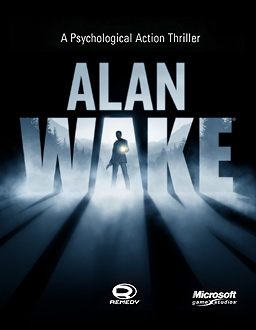 Ordinarily, a critique of storytelling in a mainstream game would end up as a Homer in Silicon column. But I don’t quite like to do that with a game that I couldn’t finish, despite multiple bouts of play.
Alan Wake was widely hailed as “story-driven,” a “psychological thriller,” and “movie-like.” Its wikipedia article says it is “often revered for its narrative, pacing, and atmosphere” (though that looks like it’s just begging for a “[citation needed]” tag to me). The premise could be interesting: the eponymous hero, a horror writer, comes to the Pacific northwest for a bit of R&R but rapidly finds himself plunged into a nightmare based on his own work, in which creatures attack him every time he strays into the darkness, and his light source becomes as important as his weapons.
So I wanted to play it and wanted to like it. Neither of those really worked out.
Some mild spoilers, but as I haven’t seen the ending, I don’t spoil that.
 A couple of weeks ago, I was asked about Narrativist games, and despite a lengthy (and interesting) discussion in comments, there wasn’t a lot of consensus about a corpus of narrativist IF/videogames; indeed, some commenters thought that it was more or less impossible to do narrativism properly except through a human GM.
In general, I think there are two problems with using GNS theory outside of the human-run RPG context. First, the narrativist approach in particular requires a lot of freeform input from the player, which it is difficult to express in computer mechanics; and second, most of this theory does tend to assume that there’s a more or less one-to-one relationship between characters in the story and players, whereas many computer games and interactive narratives disrupt that assumption.
It may be more successful to think in terms of the relationship between player and story. Even where the player character is the protagonist and the player is assumed to share the protagonist’s goals, there are plenty of distinctions to be made (and not just the “characterized” vs AFGNCAAP distinction, either). But that’s just the beginning. Some of the more common possibilities that don’t identify player and protagonist together:
The player controls a character who is really just a foil to the real main character, whoever that might be. The player-character’s interactions with the real protagonist serve to reveal and/or develop her character, but our own character remains something of a cipher.
The player is most like the hand of fate, or the protagonist’s own failings. He guides the protagonist through various challenges, but in a way that leads the protagonist to an unhappy outcome. The player may be explicitly aware that he’s moving towards an unhappy ending, or the protagonist may be framed as a villain/antihero.
The player is most like an actor, improvising a performance to a script of the author’s creation. Play turns on things like gesture and style, focusing the player on motive and personality while not allowing him to control action.
The player is most like a reader, though maybe of poetry rather than of prose. There are no real challenges at all, but the ergodic process of gaining access to different parts of the work encourages the player to be conscious of structural points she might not otherwise notice. Interaction often focuses the player on thematic links between apparently unrelated elements.
The player is most like a student, being quizzed with challenges depending on how well she understands the terms of a story that she doesn’t fully control (or perhaps doesn’t control at all).
The player is most like a coauthor, directly manipulating aspects of the story at a high level. Not a lot of these exist, but I might include
Hmm. What other possibilities are there in this space? Translator, director, prose editor, reteller?
[Edited to add: Ruben and Lullaby might come close to being directorial, though it’s low on specific event content, so possibly this is at the expense of plot. But still.]
 SPAG #60 is now available, and it brings with it the promised write-up of the IF Demo Fair from PAX East: entry names and descriptions, links to the entries and/or the authors’ websites where appropriate, and commentary from people who were there. Many thanks to the Demo Fair audience members who helped me assemble comments on all of the pieces: Sam Ashwell, Jacqueline A. Lott, Sarah Morayati, Johnny Rivera, and Rob Wheeler.
 Emily Short's Interactive Storytelling