End of October Link Assortment

Upcoming Events.

November 4, the SF Bay Area Meetup gets together to look at a few IF Comp games and possibly the start of Bob Bates’ Thaumistry as well.

Also November 4, the Baltimore/DC IF Meetup discusses the Comp game Alice Aforethought.

November 9, Hello Words meets in Nottingham to write IF.

PROCJAM, the procedural generation jam, runs now through November 12. It is very friendly, very informal, and will accept items that might not technically be games, if that’s what you’d prefer to do.

November 11-12 is AdventureX in London, where there will be talks about narrative games of all kinds including IF.

Also November 10-11 in Pittsburgh, Demosplash is a huge demoscene party.

November 15 is the next PR-IF meetup in Cambridge, MA.

Wordplay 2017 takes place in the Toronto reference library under the guidance of the Hand Eye Society, November 18. The event always features talks focused on word-based gameplay as well as a showcase of submitted games.

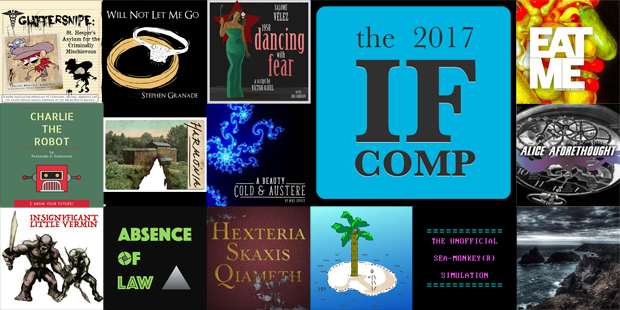
IF Comp continues, with judging running through mid-November.

Articles, Podcasts, Reviews

There’s plenty to read about the IF Comp games as reviewers continue to engage with those. I particularly enjoyed Sam Ashwell’s thoughts about survival and crafting mechanics in his review of Textcraft: Alpha Island. Dhakajack has also been covering a large selection of the games, and you can find further discussion of individual games on the intfiction forum.

Meanwhile The Short Game podcast covers some favorites from IF Comp as well.

Also recommended: Jimmy Maher on Kinoautomat and Sherlock Holmes: Consulting Detective.

From Stella Wisdom, some slides on the British Library’s support for, co-creation of, and curation of literary games including interactive fiction. The British Library has been a great supporter, including making Rob Sherman writer in residence for a time and housing the London edition of WordPlay, and running a weeklong IF training camp this past summer. This slide set includes even a few other projects I wasn’t previously aware of.

New Releases.

Mentioned earlier on this blog on their October 26 release were Don’t Make Love, the praying mantis conversation game, and Bury Me, My Love, the Lifeline-esque piece about communication with a Syrian refugee.

*

Screen Shot 2017-10-22 at 4.26.53 PM.pngSeedship, the colonization game that’s been available for web for a while, is now out for Android. I really enjoyed this one — it feels deceptively simple but there are a load of entertaining procedural outcomes. A phone or tablet seems like a good format for it, too — it’s a fun piece to while away a few minutes.

*

New from Choice of Games is The Superlatives: Aetherfall, which looks to be a steampunk/superhero mashup:

Lead a superpowered team of “Superlatives” to defend 19th-century Victorian London! Battle a Martian warship, clockwork monsters, and nefarious inventors.

The Superlatives: Aetherfall is a 260,000-word interactive novel by Alice Ripley. It’s entirely text-based, without graphics or sound effects, and fueled by the vast, unstoppable power of your imagination.

The prestigious Society for the Advancement of Individuals of Superlative Talent and the Protection of the Queen has invited you to become their newest member! But on the very day the Society plans to initiate you, unknown Villains destroy the Society headquarters and kidnap your colleagues. As the sole remaining full member of the Superlative Society, you must initiate new recruits to investigate the abduction.

Meet your team: Nimble—faster than lightning; Wailer—a “banshee” with sharp blades and sonic shriek attacks; Arturek—the gruff Martian warrior; Tua—a Venusian who commands the power of plants; and Black Orchid—a strangely familiar new recruit. Your efforts are bolstered by your faithful clockwork assistant, Gatsby, and your always-butting-in rival, Hallow.
 

Mailbag: Developing an audience

I know IF is hard to sell, but I’d appreciate it if you could give any advice on how to find my audience. I want to learn more about game promotion. I’m not familiar with the IF community, so I don’t know how to reach them. And well, my goal is to expand beyond the IF community, too, so perhaps you have any thoughts on the subject. 

The IF community used to be a pretty cohesive group with a few well-defined venues for interaction. You could be good or bad at making a splash in those places, but at least there were specific places to go.

That is no longer the case. There are lots of subgroups of people who write and play interactive fiction who don’t speak to one another much and who are basically unaware of one another. People who like traditional parser IF are probably hanging out in the intfiction forum, people who like ChoiceScript are on the Choice of Games forum, classic gamebook aficionados are somewhere else, and people writing Twine are all over the place. Different language communities have their own locations.

So putting your game on IFDB, announcing it on the intfiction forum, etc., are still good things to do — and an IFDB entry is mandatory if you want to be in contention for a XYZZY award. You can meet other IF authors on the euphoria channel, which is often a good way to garner some informal feedback. And there’s a fair amount of activity on Twitter, too — always an especially ephemeral and challenging way to network.

Competitions are another way to get some eyes on your game, including most notably IF Comp, now running. Sometimes, placing well in IF Comp leads to job offers from commercial IF publishers, and over time, a good standing in this context can build you a (localized) reputation. On the other hand, IF Comp‘s 79 entries this year mean that you’re swimming in a bigger sea than ever.

All of this is very much a retail kind of process, one that may get you a few dozen mentions on people’s blogs and some feedback from individual fans.

If what you want is to build the kind of profile that would allow you to do major crowdfunding projects or sell your IF online in the future — if you want this as a stepping stone, not just to being hired as a contributor, but to having your own creative brand — then it’s likely not enough.

At that point, you probably need to behave like an indie game developer. Figure out what games resemble yours, and how those games are being presented, where. Participate in those conversations, wherever they’re taking place. Consider taking part in some game jams and going to some meetups, so that you build a network of people who are also working in your sub-niche and can help boost you. Perhaps develop an itch.io portfolio. Look at submitting your game to indie game festivals and expo booths that are open to IF, from WordPlay to IndieCade to AdventureX. Look into whether you can/want to do public playthroughs or readings from your work, at a local IF meetup or as part of something literary-themed.

There are a handful of Steam curators that specifically curate IF, too, so if you have a game on Steam, it might be worth knowing about the Choice of Games curation list. Less IF-focused but still of possible interest: Choice and Consequence.

Another useful move is to write about or otherwise engage with other people’s interactive narrative work, and make yourself part of the conversation.

There’s a ton of advice online about how to do indie game promotion, so I’m not going to try to offer a full list of resources here — impossible! But the GDC Vault contains lots of past talks from the Indie Games summit, some of which are now free to watch. Also, presskit() is cool and Rami Ismail is an inspiration. [ETA: I’ve been told the indie games content is all free. Bonanza!]

Two Releases

Two slightly unusual new pieces in the IF/conversational game space are out today:

mantis.jpg

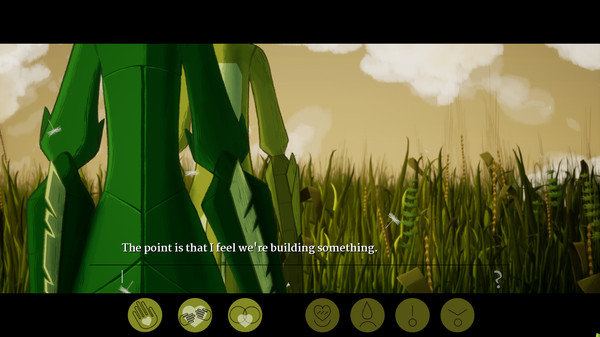
Don’t Make Love (Windows) is a natural-language-driven conversation between a praying mantis couple, trying to decide whether they should get together:

Assume the role of a praying mantis in a relationship. Constantly torn between their mutual love and the instinct to have sex – which could lead to the male mantis’s death – the couple are now on the verge of making a decision. Assume the role of either of the lovers, and try to keep their relationship in balance. Do your best to convey your feelings in a situation with no solution.

*

buryme.pngBury Me, My Love (iOS, Android) is a Lifeline-style game of conversation with a Syrian refugee called Nour, featuring real-time conversational exchanges and the possibility of running out of resources or encountering border closures. Communication includes text, images, and emojis.

Or, as the developers write:

You and your virtual counterpart Majd will be able to communicate with Nour and follow her journey, just as if you were chatting with her via WhatsApp. You will text each other and exchange emojis, pics and selfies, relevant links…

You will also be asked to make important choices – as you are required to do in the Lifeline series and other interactive stories. Nour will regularly seek help and ask for your advice. The happy unfolding of her journey is in your hands. She won’t systematically do as you say though, and sometimes she might also hide things from you. You’ll have to deal with that, as she is the one risking her life.


Mid-October Link Assortment

The big thing at the moment (as covered yesterday) is IF Comp, currently running with 79 games to play and rate. You only need to rate five to have your vote count, though, so please don’t be daunted by the size of the pool if you’d like to judge. We need more judges this year, not fewer!

October 21, probably, the London IF meetup plays Comp games. I say “probably” because nailing down the venue has taken more running around than I hoped.

As it has for many years, the Saugus.Net Halloween story contest accepts IF submissions as well as static ones. Submissions are due October 22.

October 23, the People’s Republic of IF meets in Cambridge.

Ectocomp is a traditional Halloween IF competition, with games due October 31.

November 4 is the next meeting of the San Francisco Bay area IF Meetup.

November 9, Hello Words meets in Nottingham to write IF.

AdventureX is coming November 11-12 at Goldsmiths in London. The event schedule is here.

Releases

If, somehow, the nearly 80 games released for IF Comp aren’t enough for you, you might also be interested in:

thaumistrypic

Thaumistry: In Charm’s Way. Bob Bates Kickstarted this classic-style parser game, and it’s now available:

Thaum: (noun). A unit of magical energy
Bodge: (verb). To hack or kludge

Eric Knight was a child prodigy who was featured on the cover of Invent! Magazine at the age of 13 for his invention of an anti-stain chemical treatment.

Unfortunately, he hasn’t invented anything since and now, at the age of 23, he has a strong case of imposter syndrome. He feels like a failure…

Andrew Plotkin has written up his impressions of this game as well.

*

Screen Shot 2017-10-14 at 5.32.57 PM.png

Trackless is sort of a cross between graphical adventure and text parser experience: you move through a visually realized world, but sometimes to interact with things you have to click on those things and type an appropriate verb. Usually, only one verb is correct, and typing the wrong one gets you the terse discouragement “NOPE”.

I wasn’t sure what this was gaining. Why not just treat a click as USE if there’s only one thing you can do with this item? It’s not like guessing the verb was the fun part of parser IF back in the day, except in special cases. (It does claim that you get more points for using more imaginative verbs or not repeating yourself, so flexing your synonyms may be a useful strategy. But at the same time, it doesn’t seem like it’s mostly a wordplay game, per se.) So it feels like Trackless keeps the least appealing thing about parser IF but dispenses with the richness of control, world model subtlety, and textual descriptions.

That said, I did not play the whole thing. It may be that the verb choice gets more interesting later.

IF Comp 2017, Belatedly

Screen Shot 2017-10-14 at 2.35.53 PMIF Comp is on, and you have another month or so to play and rate the games. This year’s selection of games is properly enormous — a record-breaking 79 entries. (The ceiling used to be in the region of 50, so this is a big jump.) That collection includes a rich selection of parser and choice-based games in many different styles; reappearances by some established authors alongside plenty of new names;  and three translations of Chinese interactive fiction, which I think may be a first for the Comp. I see lots of fantasy, horror, and SF as well as slice-of-life; not as much mystery as there are in some years.

If you want a look, here are some resources for you:

The Short Game podcast provides an introduction to the competition, including explaining what the competition is for people who aren’t familiar with it at all.

This post breaks down the games by genre and play style, while this subforum at the intfiction forum has discussion threads for many of the individual games.

Some blogs running reviews wind up on Planet-IF. This thread also allows people to link to their own reviews.

This year, the Comp allows judges not only to leave ratings but to add a few lines of feedback to the author. That’s a nice option if you have something private to say or don’t want to write a full review — authors very much value getting responses to their work — though please remember to be polite and constructive, and mind the guidelines for judges.