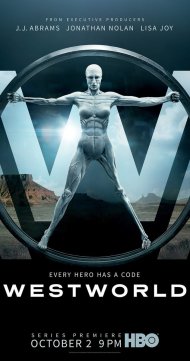
These Violent Delights

mv5bmteyodk5ntc2mjneqtjeqwpwz15bbwu4mdq5ntgwotkx-_v1_uy1200_cr9006301200_al_Before I’d seen a single episode of Westworld, a journalist reached out to me for comment about it. The show touches on the question of AI consciousness, narrative design, the evocation of empathy with non-player characters, and the morality of gameplay, which may be why it seemed like I might have some thoughts.

If you’re not familiar with the series, it’s an HBO show in which rich people can visit an incredibly detailed western-styled theme-park full of AI-driven robotic characters, called hosts. The human players are called guests. It quickly becomes obvious that they come to Westworld primarily in order to misbehave: they have sex with the prostitutes at the brothel; they assault the daughters of the ranchers; they maim and murder hosts casually or with elaborate sadism. And all of these things take place within the context of storylines crafted by narrative designers and then meticulously supervised. The hosts are able to improvise slightly in response to the input of humans, but then eventually they will revert to their core loops, playing out the same narrative tracks over and over again.

Naturally, when initially asked, I said that I hadn’t watched it and so couldn’t offer much direct insight. I added that I thought full AI consciousness in the sense imagined by science fiction was some way off, and that art about that possibility is often really about something else: about groups of people who feel entitled to the labor and service of others; about the self-perpetuating, semi-human, half-programmed entities that already exist in our world in the form of governments and corporations.

I have now seen Westworld, and I still think the same. The narrative design and the AI aspects are handled competently enough to frame the story, but Westworld is by no means a master class in what interactive narrative design actually entails, or how people actually use games to explore their morality, or again in the way a sort of pseudo-personality emerges in current AI research.

To the extent there’s a thematic point here of interest, it is about the nature of human identity, the role of suffering in how we understand ourselves, and the ways we construct ourselves. I would have liked to see the show go much further, but the plot is often allowed to trump the characters.

I am now going to dig into all those assertions in more detail, with spoilers. If you are interested in watching the show yourself, you should probably do that before going forward.

Continue reading “These Violent Delights”

2016 Retrospective

(As mentioned yesterday, this is about my own work in 2016, since I’ve already posted a year-in-IF overview at Rock Paper Shotgun. If that’s what you’re looking for, it’s over there.)

The Empress’ Shadow is my latest story for Fallen London, and it is now available for purchase if you’re a player of that game:

empressshadow_small

Teach at Sinning Jenny’s Finishing School! Recruit students and train them in important skills, such as deportment and maiming. Then send the class to plunder the secrets of the Empress’ Shadow – Queen Victoria’s eldest daughter, who is visiting from the surface!

Unlike some of my other recent Fallen London pieces, this one doesn’t require you to be an Exceptional Friend. It’s playable at any skill level, though at least a little initial familiarity with the world will make it more enjoyable.

I had a lot of fun writing this one, and it’s been warmly received by the first batch of players.

deceased_promoI’ve written several other pieces for the Fallen London universe this year: the three ports of Anthe, Aigul, and Dahut for the Sunless Sea Zubmariner expansion, a Sunless Sea officer storyline about the Cladery Heir, and an Exceptional Friends story called The Frequently Deceased. As always, Failbetter is a huge amount of fun to work with.

I’ve also done a lot of work on other commercial projects. Most of those pieces are not out, and several are not even announced as yet, so there will be more to share in the first part of 2017. One thing I can mention: my Choice of Games project Platinum Package has grown to a dauntingly large word count.

For much of 2016, I’ve been working on conversational and emotional NPC behavior for Spirit AI. It’s too soon talk much about the internals of that project, which is why I have kept this comparatively quiet, but I’m very excited about it. I have the pleasure of working alongside Aaron Reed of IF fame; Toby Nelson (who has done lots of AAA game work but is best known to this audience for his work on the Mac Inform app); Mitu Khandaker-Kokoris (whose work includes Redshirt and this terrific GDC talk on designing games for social simulation); and James Ryan (some of his awesome work on social modelling and dialogue generation is written up here).

*

Since roughly June, I’ve had a column with Rock Paper Shotgun called IF Only. Because RPS is specifically about PC gaming, I don’t cover the rich range of IF for mobile there — but there’s been plenty else to say. It’s great to have the opportunity to present interactive fiction to a bigger audience in that venue.

That’s moved a little bit of content off this blog, though I still do write here about topics that I think are too niche or specialist for the RPS audience. I figure that’s probably a net gain for the IF community, though: the audience for Rock Paper Shotgun is several orders of magnitude greater than the audience for this site.

Continue reading “2016 Retrospective”

Mid-December Link Assortment

Events

December, man. I don’t know about the rest of you, but I do not foresee having any time in the second half of December for IF-related events where you have to actually move your body to a new location in order to participate. This space left blank and possibly snowy.

Craft

Adam Strong-Morse from Choice of Games writes about how to do effective end-game structures:

An arm-and-fingers structure is a game with several different final chapters where the player’s decisions determine which final chapter they experience on a given playthrough. Most of the game is the arm, with chapter leading to chapter more or less automatically, but the structure of the end of a game is like a hand, with entirely distinct and separate fingers branching off in each direction. Kevin Gold pioneered this structure in Choice of Robots to great effect, and Lynnea Glasser also used it well in The Sea Eternal. It can maintain a manageable structure that does not require writing thousands of different branches, while still creating the feeling that the end of the game depends on the player’s choices, not just in determining a final outcome, but in determining the entire feeling and plot of the game’s climax.

Josh Giesbrecht has shared a current-Inform implementation of my Waypoint Conversation concept. He welcomes submissions from other people, especially upgrades to the sample content.

No Time to Play has an article on the space between parser and choice games, and how the middle ground has opened up in interesting ways this year. I disagree with some of the article’s points — particularly about how much agency is available in Twine work, where I agree with Juhana Leinonen’s assessment the there’s typically far more narrative agency in a choice-based game than in a parser-based game — but the article makes a pitch for the newish Elm engine and makes some other suggestions you may not have seen elsewhere.

Continue reading “Mid-December Link Assortment”

Congresswolf (Ellen Cooper, Choice of Games)

congresswolfCongresswolf is a Choice of Games story that debuted just before election. You play the campaign manager for a congressman or woman and make the sorts of choices one makes on political campaigns: go for grassroots donations or woo high-value donors? Allow yourself to be bribed, or keep your nose clean? Say what people want to hear, or try for some idealism? The complication: werewolves exist and are a marginalized class of people in both social aspects and under the law. The campaign manager before you was killed by a werewolf, and the killer is still at large. And there are reasons to think your candidate might be secretly lycanthropic themselves.

The game does a different take on some of CoG’s standard self-definition approaches. You can name yourself or pick a genderless name from a list; one of your main romantic interests also has a name that could be male or female, and the story rigorously avoids using any pronouns for that person. So instead of explicitly defining sexualities, Congresswolf takes a Jigsaw-style approach and lets you imagine what you like here.

The campaign structure is a natural fit for a Choice of Games piece: there are several different goals you could reasonably have when running a campaign, especially a campaign overshadowed by a murder investigation. There’s enough predictability to let the player attempt a strategy, but enough variation not to get boring. Your campaign includes some cyclical, predictable tasks like setting a budget for the next month and picking ad strategies, together with increasingly high stakes events, such as meetings with the press and debates with the other candidate.

Continue reading “Congresswolf (Ellen Cooper, Choice of Games)”

Liza Daly on Stone Harbor

stoneharborcover.pngI spoke to Liza Daly about her 4th-place IF Comp 2016 entry Stone Harbor. In full disclosure, Liza is a friend, and we have worked together in the past; she commissioned me to write First Draft of the Revolution.

On this occasion, she was kind enough to talk with me about where her project came from, her ambitions for IF in general, and how she sees interactive fiction relative to the world of publishing and ebooks—including some thoughts on why interactive ebooks didn’t become the cutting edge of interactive fiction.

What were your goals for the Stone Harbor project when you got started?

I work in publishing, and I’ve long been frustrated by how little awareness there is of interactive fiction, or born-digital writing in general, in the publishing community. At best, people think it’s all Choose Your Own Adventure books, or Zork, or navel-gazing avant-garde experiments, or big-budget apps like Arcadia. The objections I’ve heard about IF range from “those are for kids” to “they’re games not stories” or “they cost thousands of dollars to make.” So on one level my goal was to write a relatively conventional genre story—something publishers could could recognize—cheaply and quickly.

Meanwhile my personal projects tend to be short or abstract: Twitter bots or computer-generated “novels” that are devoid of meaning. I wanted to see if I could do the hard work of writing believable characters and sustaining a storyline.

Both goals pulled Stone Harbor in the direction of being longer (by word-count) and less branch-y than is typical for IF Comp entries. I hoped that it would be received as “minimally interactive” rather than “slapped-on interactive,” but I think it’s a fair criticism that I could have made the interactivity deeper without compromising the story-ness. I’m inspired to do better next time.

Continue reading “Liza Daly on Stone Harbor”