Inky Path. Inky Path is a new quarterly literary magazine for interactive fiction. Founder Devi Acharya describes it thus:
We cannot currently pay authors for their work, but do hope to showcase it in an interactive literary magazine, a lit mag that leads readers to certain pieces depending on their choices. Right now the hope is for it to be a very multimedia experience. This means definitely cover art and neat graphics/layout. We also plan on running contests (hopefully paid) through the site.
About selectivity: That’s going to depend largely on the volume of submissions, but we hope to submit most of the pieces that reach the inbox. We also accept works from all different sorts of IF writers and programs, including both parser-based and choose-your-own-adventure games.
Basically, this is a way for up-and-coming IF writers to get their work shown instead of lost in the archives, as well as a way for newcomers to IF to read some great IF work without being lost on a site like IFDB or the IFArchive.
This idea of a curated, attractive space for IF has come up a few times in the past, but there haven’t been many focused attempts to actually pull it off in a sustained way. It’s something that’s very much needed: especially with IFDB seeing an increased volume and variety of submissions, and with IF being created and announced to different communities, it’s not always easy to get visibility for the best material. Perhaps Inky Path will help with that. If you want to be involved, they’re seeking both content submissions and people interested in reading for the site or contributing graphic design experience.
IGF Nominees. Speaking of getting attention, the nominees for this year’s IGF have been announced. Aaron Reed took an honorable mention in the Nuovo category for 18 Cadence, while Deirdra Kiai (known for The Play and Impostor Syndrome, among others) took four nominations for their stop-motion musical adventure Dominique Pamplemousse — including a nomination for the grand prize, in a field of some 650 indie games.
French IF Comp. IF players who read French may be interested to know that four games have been entered in the French IF competition. Votes are due February 2. If you’re not familiar with French IF idioms, you may find it useful to check out the IF instruction card in French or a full manual translated into French for help with the commonly used commands.
German IF Magazine. (Added in an edit — sorry, I meant to include this initially.) Textpäckchen presents German-language IF on a regular release schedule, and its first two games are already available. The help page includes some lists of standard verbs that may be useful for those learning German IF idioms.
Android Z-machine interpreter. 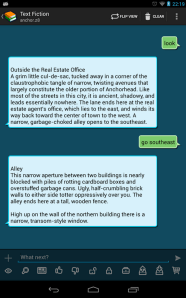 Patrick Albrecht has announced Text Fiction, a new Z-machine interpreter for Android, which uses a texting-like UI for the back and forth between the player and the game. It’s already gotten quite a few positive reviews, and offers features like text-to-speech and play of zblorb-wrapped files. It’s free at the Google Play store.
IF authors on Patreon. Colin Sandel, co-author of One Eye Open, has a Patreon page now, as do sometime Twine authors Porpentine, Mattie Brice, Anna Anthropy, and Merritt Kopas. The neat thing about Patreon is that it’s a crowd-funding model that allows for smaller pieces and less overhead for creators than Kickstarter: a good Kickstarter campaign takes a month or more of hard work to run and usually requires the creator to offer a lot of rewards that themselves add to the duration of the project. (And then there’s the challenge of meeting one’s Kickstarter deadlines, which can turn out to be difficult for unforeseen reasons, even for experienced developers.)
Patreon works on the idea that you’re supporting the author rather than a specific work, and is suitable for smaller pieces, so you pledge to give a small amount of money for each new release, regardless of what that is — the author doesn’t need to put together a pitch video and reward tiers for each project, and also has an idea of expected earnings and therefore how much work it’s reasonable to put into each release. It’s also possible to cap one’s contributions per month to prevent yourself from going over budget. Credit card fees and Patreon fees take around 8% of contributions, leaving the rest for the creator. Many Patreon-supported works are then released entirely free with no further associated costs.
If you can’t tell, I’m enthusiastic about this model and I hope it proves workable, because I think it’s a great way to build up a living income for people who create outside the mainstream, but still have an interested audience. From the viewpoint of the surrounding community, it often also means new work, released on a regular schedule, typically free for newcomers — which means that people who aren’t sure whether they’re interested enough to splash out money on new work can try it out free. Win!
(There’s probably some kind of midpoint still unaddressed, between Patreon and Kickstarter: depending on patronage levels Patreon makes sense for things that might take the creator less than a month to make, and Kickstarter for things that might take a year; I’m not so sure about projects that need to be supported in the 3-to-6 month range. But still. Having more models for this is good.)


 Emily Short's Interactive Storytelling
