Spring Thing 2016: Ms. Lojka, Tangaroa Deep, Sisters of Claro Largo

I’ve been playing more of the games from this year’s Spring Thing. (You too can play! And vote! And review, if you wish!)

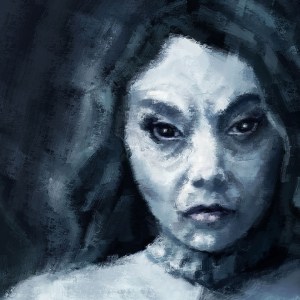
lojkacoverMs. Lojka is a horror Twine about a beastly supernatural killer in New York City, with some references to Babel and Rasputin, backed by some (I thought) rather effective illustrations, as well as whispery sound effects and music. Meanwhile, the text appears on the screen as though typed. I typically find that effect annoying and slow, and Ms. Lojka was not quite an exception, but it does use the interesting conceit that the narrator’s typing becomes more error-prone as the story goes on and they become less stable. At the end, it wound up in a loop of repeating text that I couldn’t seem to stop, which was narratively appropriate, so I assume that is the intended ending; but it’s just possible there’s an alternative outcome.

I didn’t respond as much to the content as to the presentational effort. Ms. Lojka mingles hints of mental illness and supernatural or mystical powers, and it finds some creepy images to express those ideas, but ultimately felt like a combination of fairly standard tropes to me.

Continue reading “Spring Thing 2016: Ms. Lojka, Tangaroa Deep, Sisters of Claro Largo”

EGX Rezzed

So I was at EGX Rezzed this afternoon — I didn’t have enough time in the schedule to see the whole conference, but I did get to check out a few things and to be on a panel myself.

Our panel: Chris Gardiner of Failbetter Games, Jon Ingold of inkle, and I talked with John Walker from Rock Paper Shotgun about narrative in games. It tended to focus (given our background) about what can be learned from interactive fiction, though we also talked about some other questions. Jon talked a bit about the highly experimental new school IF period I just recently wrote about in my history coverage, and we all talked about the challenge of surfacing ideas from indie/IF gaming into commercial games. As with any casual panel, I immediately afterward thought of loads of other things I would have liked to say, or wished I’d said better, but so it goes. The video from that is online.

Lottie Bevan and Liam McDonald from Failbetter also gave a talk on Sunless Sea, including a detailed preview of Zubmariner, which is even darker and scarier than the original Sunless. Several of the Q&A questions are basically “uh… you’re making it even darker???” I’ve mentioned this once or twice before, but what I love about writing for the Fallen-London-verse is that it provides an outrageous fantasy-horror shell within which I can safely encase real-life things I find deeply upsetting. So, perversely, I find this land of tentacles and heartmetal comforting rather than the reverse. Mostly. Most of the time.

And then yesterday there was a talk on the art of Firewatch, with artist Olly Moss and animator James Benson. Around 29:30, they start talking about how Twine played into prototyping for the project.

(Each of these videos is ca. 35 minutes of content, with some wait time at the beginning while they were waiting for the stream to kick off.)

I also got a chance to play the demo of Shadowhand, a casual solitaire game with a backing story that builds on the concept of Regency Solitaire (though it concerns other characters, including a highwaywoman). I liked Regency Solitaire for its inventive riffing on the familiar mechanics: it made me actually enjoy playing solitaire again, which was unexpected. Shadowhand takes that even further, introducing a duel mechanic in which you are recharging your weapon through card combos. Your AI opponent charges their weapon by taking cards and building combos off the same spread, so that introduces some new tactical considerations about which cards you want to leave available for them when your turn ends.

Chatbots as Narrative Platform

Recently I’ve been running into a fair amount of news/discussion about “conversation as a platform” and “bots as the new apps” — specifically, that people spend so much time texting that chatbots are a viable way to do advertising and storytelling and personal assistant functions all at once.

This means taking in natural language input (as opposed to the Lifeline-style experience, where the user is still pressing buttons to navigate a choice-based conversation). Historically,  I’ve tended to be skeptical about this because the error rate on chatbot output is high enough to make for a frustrating game experience.

All the same, there have recently been some developments on this front, partly because there’s now stronger AI for classifying natural language input, and partly because app discoverability problems make it appealing to embed content within chat platforms. Meanwhile, streaming means that there’s a greater audience for games that produce amusing results and accept idiosyncratic player input: here’s PewDiePie making Facade produce weird results.

What follows is a summary of some existing work I know about in this area. I wouldn’t be surprised to see quite a lot more come along.

Continue reading “Chatbots as Narrative Platform”

Spring Thing 2016: Evita Sempai, Harmonic Time-Bind Ritual Symphony, and Standoff

Screen Shot 2016-04-07 at 10.28.52 AM

The 17 IF games of Spring Thing 2016 are now available! This is a huge crop: historically Spring Thing has tended to have entry numbers in the single digits. I’m delighted to see it, because I think it’s useful having other events that at least somewhat rival IF Comp in size and attention. The trend towards diversity continues as well: there are a mix of Twine and Inform games, but also Ren’Py, a homebrew HTML/javascript game, and a pen-and-paper RPG submission.

So far I’ve had time to look at Evita Sempai, Harmonic Time-Bind Ritual Symphony, and Standoff.

Continue reading “Spring Thing 2016: Evita Sempai, Harmonic Time-Bind Ritual Symphony, and Standoff”

Draculaland (Robin Johnson)

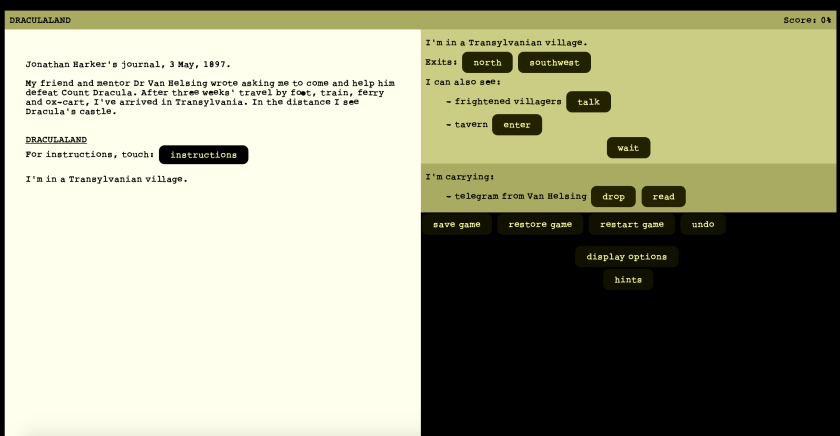
Screen Shot 2016-04-02 at 10.23.58 PM

Draculaland is a goofy, tropey piece of medium-length IF: you solve puzzles, you gather weapons, you fight monsters suitable to Transylvania. There are items to collect, and NPCs who send you on quests, and other NPCs who get in your way; there is even one NPC who follows you around. The whole piece feels animated by the spirit of Scott Adams, especially The Count — short, tight descriptions and puzzles that can be solved in a single flash of inventiveness — but it is infinitely fairer. I estimate it took me about 90 minutes, though I think I wasn’t consistently focused on it for that full time. Draculaland was written for The Ryan Veeder Exposition for Good Interactive Fiction, an unusual competition with the sole purpose of entertaining Ryan Veeder, but happily the author has made it available for the rest of us to enjoy as well.

It’s sort of a parser game without the parser: you play by clicking on verbs associated with the various objects in scope.There’s a full parser world model going on under the surface, and the links are being generated procedurally by that model. Occasionally this provided puzzle hints I wouldn’t otherwise have thought of, but mostly this eliminated guess-the-verb experiences without taking away the fun of coming up with my own solutions. Most of the puzzles require you to think of combining objects that appear in different locations, so the experience isn’t over-obvious.

It’s not exactly the first game to experiment with building clickable links out of a parser model world — see also Jon Ingold’s Colder Light, for instance — but there aren’t a lot of examples out there that I think work really well, so I was glad to play this one, and I thought that it did essentially work. Certainly it felt a lot more successful to me than a lot of historic UIs that use drop-down verb menus and other doodads to augment a standard parser game. Things like this Spellcasting UI have, to my tastes, aged much worse than even bare-text parser presentations.Spellcasting_101_interface


Towards the end of the Draculaland, the inventory list gets maybe a little unwieldy. I also found myself wishing for a clickable map, though I’m not sure whether that would actually have been an improvement or whether I was merely wishing for it because I manage to mix up east and west even in a clickable parser game. But for the most part, it worked very well for me.

The writing is compact, as it has to be in this format, and funny; the characters are sketched with as much personality as one could reasonably fit in the available space; and I found myself rather pleased with how the ending turned out, more for the sake of the NPCs than for myself.

There is one thing that the story made me do that I wanted to avoid. (ROT13: Ol gur gvzr V fubg gur jrerjbys, V xarj ur jnf ernyyl gur gnirea xrrcre, naq V jnf ubcvat sbe fbzr jnl gb xabpx uvz bhg be qr-jrerjbys uvz engure guna npghnyyl zheqre uvz. Nsgre nyy, nfvqr sebz uvf jbys unovgf, gur gnirea xrrcre frrzrq yvxr n qrprag fbeg, naq jr nyernql unq bar rknzcyr (va Zvan) bs n zbafgre jub pbhyq npghnyyl or tbbq naq zbfgyl xrrc vgf vzchyfrf haqre pbageby.) But perhaps that is in-genre inevitable.

If you like Draculaland as a tribute to Scott Adams, you might also enjoy J. Robinson Wheeler’s Adams-styled Greek myth game ASCII and the Argonauts; if you’re keen on puzzly vampire tropes, you might want Marco Vallarino’s Darkiss. If vampires sound good but you want to stick with a choice-based interface and go more Rice than Stoker, there’s always Choice of the Vampire.
Brief Bibliography about IF History

Recently someone contacted me asking to link an article explaining the difference between “old” and “new” IF. I don’t know of any such article that’s remotely up to date. Besides, this is not as easy to answer as they might have hoped, even if you agree on what we’re counting as “old” for these purposes.

But here is a sort of periodization. I’m intentionally vague about dates because people disagree about the milestones. I’m leaving a lot out because this is meant to be a digestible overview. And it’s also worth pointing out that this is a perspective taken from within a particular community, so there were other communities (adult IF, non-English-speaking IF, gamebook/CYOA enthusiasts, visual novel readers, literary hypertext folks) whose histories could usefully be drawn alongside this.

First, a couple of general histories:

The old Inform Designer’s Manual has a brief history of IF through 2000Let’s Tell a Story Together covers IF from the beginning through around 2005. Twisty Little Passages was also released in 2005 and covers about the same period. The history section of the IF Theory Reader contains accounts of French and Italian IF, as well as Duncan Stevens on the period 1994-2004, and Stephen Granade on the trend towards shorter works of interactive fiction over the course of the late 90s.

The Brief History of Interactive Fiction was an awesome (paper! full-sized for your wall!) timeline that ran through the year 2000; I don’t think there’s a great graphical version of it online, but the list of events included can be found here.

Ca. 2011 Nick Montfort and I wrote an account of IF communities that is arguably already way out of date: at the time, Twine was only barely on our radar. Meanwhile, ifwiki has a glossary that defines a number of terms that might be relevant to reading some of the linked reference work.

Continue reading “Brief Bibliography about IF History”