Casual Games and Storylets: Or, How to Make Game Mechanics Express Choice

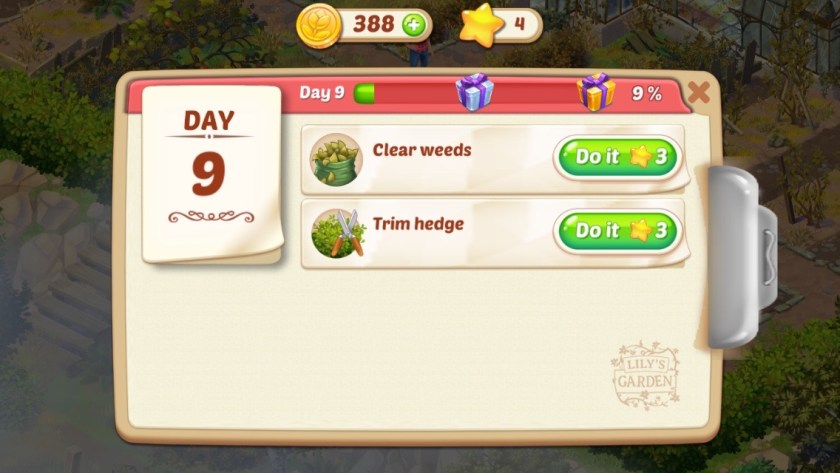
Lily’s Garden is here offering us two storylets: the story about clearing weeds and the story about trimming the hedge. Despite how it might appear, there’s actually some character and narrative advancement associated with each of these options.

In a recent post about storylet-based narrative design, I briefly suggested that even games like Lily’s Garden could be understood as a case of storylet-based design: there’s just a level of casual gameplay between elements of story.

A very simple implementation looks like this, interspersing every level with a little bit of story wrapper. This has been a standard method from the days of Diner Dash on:

Gating story with casual game levels

Lily’s Garden does something actually a little different, which is to let you gather “stars” by playing levels and then spend them to open more storylets. The “source” in the image below is the casual gameplay. Often, there are two or three storylets available at a time, which means you can choose which of them to play next, but you do have to finish all of the storylets assigned to a given day before moving on.

This is an effective design choice for mobile free-to-play, for several reasons.

Continue reading “Casual Games and Storylets: Or, How to Make Game Mechanics Express Choice”
Hamlet’s Hit Points (Robin D. Laws)

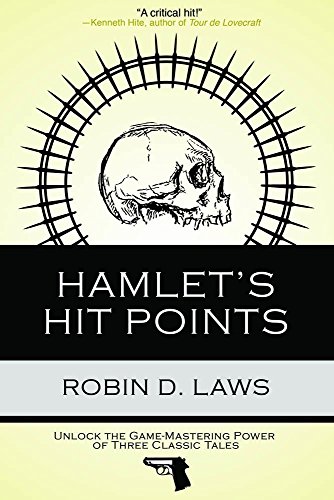
Hamlet’s Hit Points breaks down classic storylines into structures that can be deployed in tabletop (and sometimes digital) RPGs.

Hamlet’s Hit Points has been recommended to me a number of times by people with experience in RPGs, narrative, or systems design. Since I’ve recently been thinking and writing more about the stats-and-point-assignment aspects of narrative design, I came back to the recommendation this month. (It’s available as a physical book from various places including Amazon, but for various reasons I’m linking to Amazon less. You can get the book as downloadable content for $8 from DriveThruRPG, so that’s what I’ve linked.)

Hamlet’s Hit Points starts by acknowledging the influence of Hollywood writing guides of the kind I’ve sometimes covered here, and then offers its own kind of structural analysis of story beats, intended to cover both conventional narratives and RPGs. (The book is focused on tabletop RPGs with a human game master.)

Continue reading “Hamlet’s Hit Points (Robin D. Laws)”

Joining Failbetter

As of today, I’ve joined Failbetter Games as Creative Director.

Failbetter is a company very close to my heart: I’ve written for them many times as a freelancer over the past decade, and they provided key assistance when I was starting the Oxford/London IF Meetup. I have great respect for their focus on quality prose and storytelling, as well as their pioneering work exploring what storylet-driven narrative design can do.

I have a certain amount of freelance work ongoing from the past couple of months, with FBG’s blessing; and will have some pre-defined bandwidth to keep my hand in consulting. So if you see me out and around doing a few other things, that’s why.

I’m very excited to be on this team, and looking forward to what we build together!