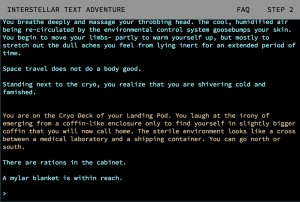
The movie Interstellar now has an official text adventure tie-in. It looks like this was hand-rolled in javascript. I haven’t had a chance to play it through (and I didn’t see the movie, which may be important), but here’s Wade Clarke’s take.
*
The Shadow in the Cathedral is a parser-based, puzzly, adventure-rich game in a steampunk setting, developed commercially by Textfyre. For a long time it was available only for sale, but you can now get it from itch.io for free. (Back in the day, I put up an IFDB review, if you’re curious what I thought then.)
*
The McFarlane Job is a new game by Jason McIntosh (Barbetween, The Warbler’s Nest).
*
Bus Station Unbound is perhaps the biggest inklewriter story to date.
*
The Oxford/London Meetup group is meeting Sunday April 12 in Oxford (leisurely lunch or drinks or whatever you feel like ordering) and Wednesday May 13 in London (conversation in a meeting space and then drinks at the pub). Please join us if you are in town and are so inclined.
If you’re elsewhere, here are some other upcoming meetups:
April 4 – San Francisco.
April 4 – Seattle.
April 10 – New York. ITP at the NYU Tisch school, off the 8th St. N/R stop.
April 13 – Boston. 6:30pm in the Trope Tank (MIT room 14N-233).
*
Those who want to use IF educationally may like to know about Brendan Desilets’ book on the topic, now available in PDF form, based on years of using parser interactive fiction with middle-school students; and also Creative Writing in the Digital Age: Theory, Practice, and Pedagogy , which includes a chapter by Aaron Reed on using Inform 7 in a creative writing workshop.
*
IF Answers is a new Stack-Exchange-like site for collecting answers to IF-related questions, especially technical ones. The aim of the project is to provide a more searchable and consistent collection of help than is currently available from the intfiction forum, where the same basic issues often get raised repeatedly. IF Answers is currently in a kind of seeding phase in which people are asking and answering some expected FAQ, but it is only likely to get off the ground with the help of contributors; so if you feel like asking or answering some IF tech-related questions, have a look.
Alex Warren goes into more detail about the project.
*
Javy Gwaltney, who has written several Twine games and now organizes the Interactive Fiction Fund for commissioned interactive fiction, wrote for Paste Magazine about representation of disabled people in video games: why we need it and what it means to him. He also covered Antholojam, which includes several IF pieces.
*
Liz England provides a blog overview of what Twine is, how it fits into the interactive fiction tradition, why people might want to use it and which Twine pieces she recommends. It’s intended for a game developer who is not already familiar with Twine; so if you read this blog, it might not be something you need, but possibly you know someone else who would find it a useful entry point. The categorization of Twine games and recommendations within categories may be particularly helpful as a counterargument to the assumption that all Twine authors are writing the same kind of thing.
*
GDC was excellent. Not all of the content is publicly available, but here’s a blog-format version of Mitu Khandaker-Kokoris’ GDC talk on social simulation games. Well worth checking out, and I’m not just saying this because of the discussion of Blood & Laurels.
Brandon Dillon did a talk on the design of Hack ‘N’ Slash, which is free on GDC Vault. Though it’s not IF per se, there’s lots of fun stuff here about systematic challenge design and coming up with a series of levels that will challenge and instruct the player.
*
Here’s Tronmaximum talking about alt games — games beyond the typical indie sphere — and the role of friendships and ideological similarities in creating communities that can then become productive spaces.
*
Squinky writes about community and family and loneliness, which is kind of an interesting pairing with Tronmaximum’s piece above.
*
Max Gladstone writes about narratives of friendship, and how they often get lost because romance and sex are so often treated as primary, the things of greatest importance. It goes into a lot of detail about Agent Carter, a show I don’t watch, but I found it accessible and moving anyway.
I also filed it among my arguments (though I don’t think Gladstone intended it this way exactly) for more moments of intimacy in games, including those that are not romantically coded. I’ve argued for a while that we need better game romance, but I think what I’m really looking for is better character connection.
One of my favorite moments in movies is the scene in the middle of Heat where a cop and the hardened criminal he’s been chasing sit down for a cup of coffee. And although they are in one sense enemies and recognize that one may end by killing the other, in another sense they understand one another better than anyone else. Another is the moment at the end of The Fugitive where the federal marshall who has just recognized Harrison Ford’s innocence takes the cuffs off him.
Neither of these are moments within the kind of friendship that Gladstone is arguing for, but they are about connection, mutual understanding and affection even under adverse circumstances.
These are rare in games — perhaps because real intimacy is challenging to portray in a game context. One of the reasons I liked 80 Days so much is that it offered several of these types of connection with characters you meet only in passing. (I have a special fondness for the man dressed as Death, in New Orleans.)
*
Katherine Cross has a detailed review of the world-building tabletop RPG Microscope up at Offworld. I’m fond of this game and have written it up before; it’s great to see more attention for it. I’ve recently been playing the related game Microscope Union, which explores a specific family tree; I’ll probably write that up here soon.
*
Folks interested in indie sales numbers for narrative-driven games may like the deep dive into Sunless Sea’s numbers, provided in multiple parts on the Failbetter blog. [1: Kickstarter], [2: Steam Greenlight], [3: Early Access and Release].
*
Tim Fowers (creator of Paperback, a wordplay card game) is Kickstarting a new heist-themed board game, Burgle Bros. It’s already successful, but there are a few more days to get in on the action if it looks like something you’d like.
*
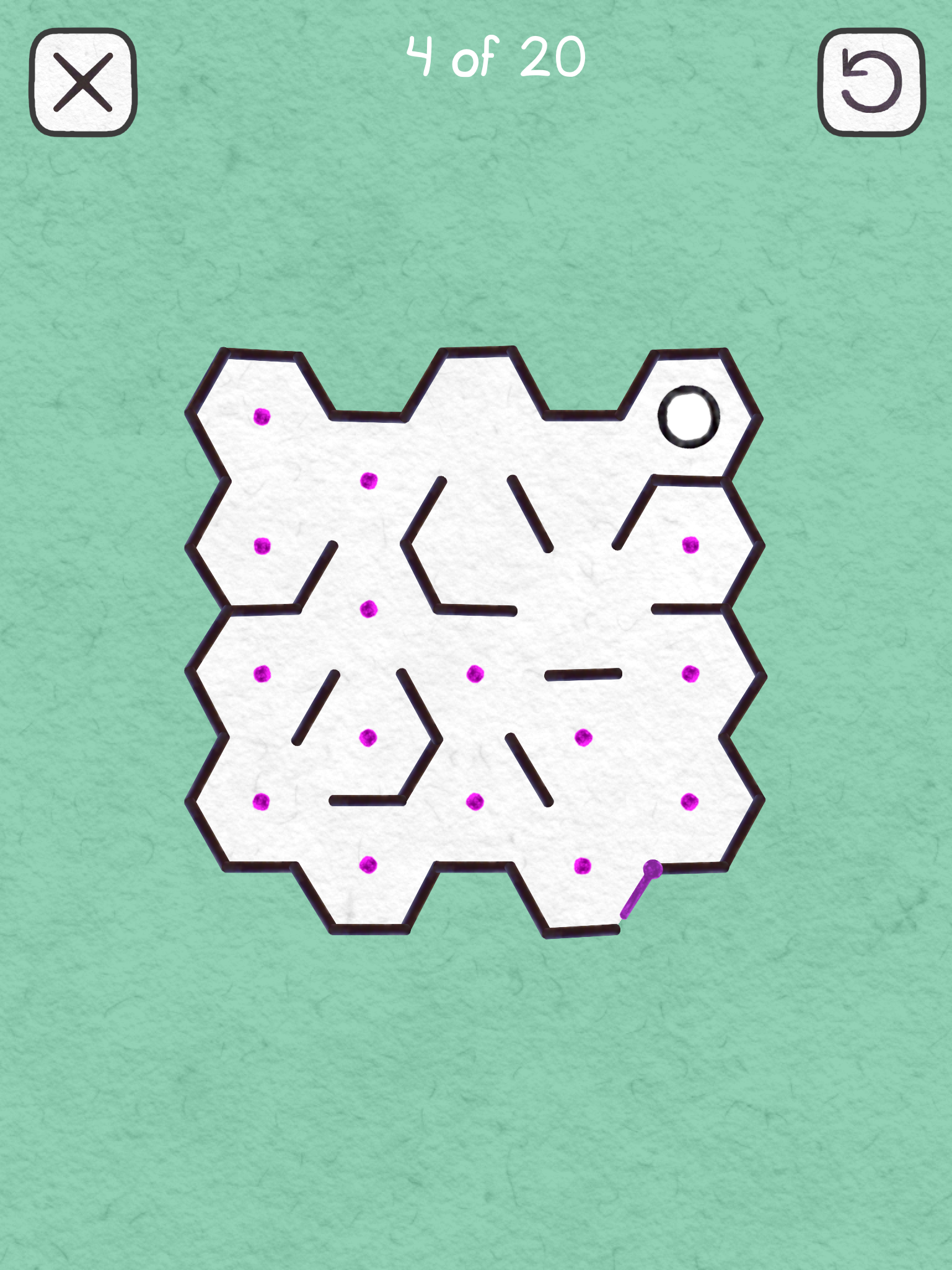
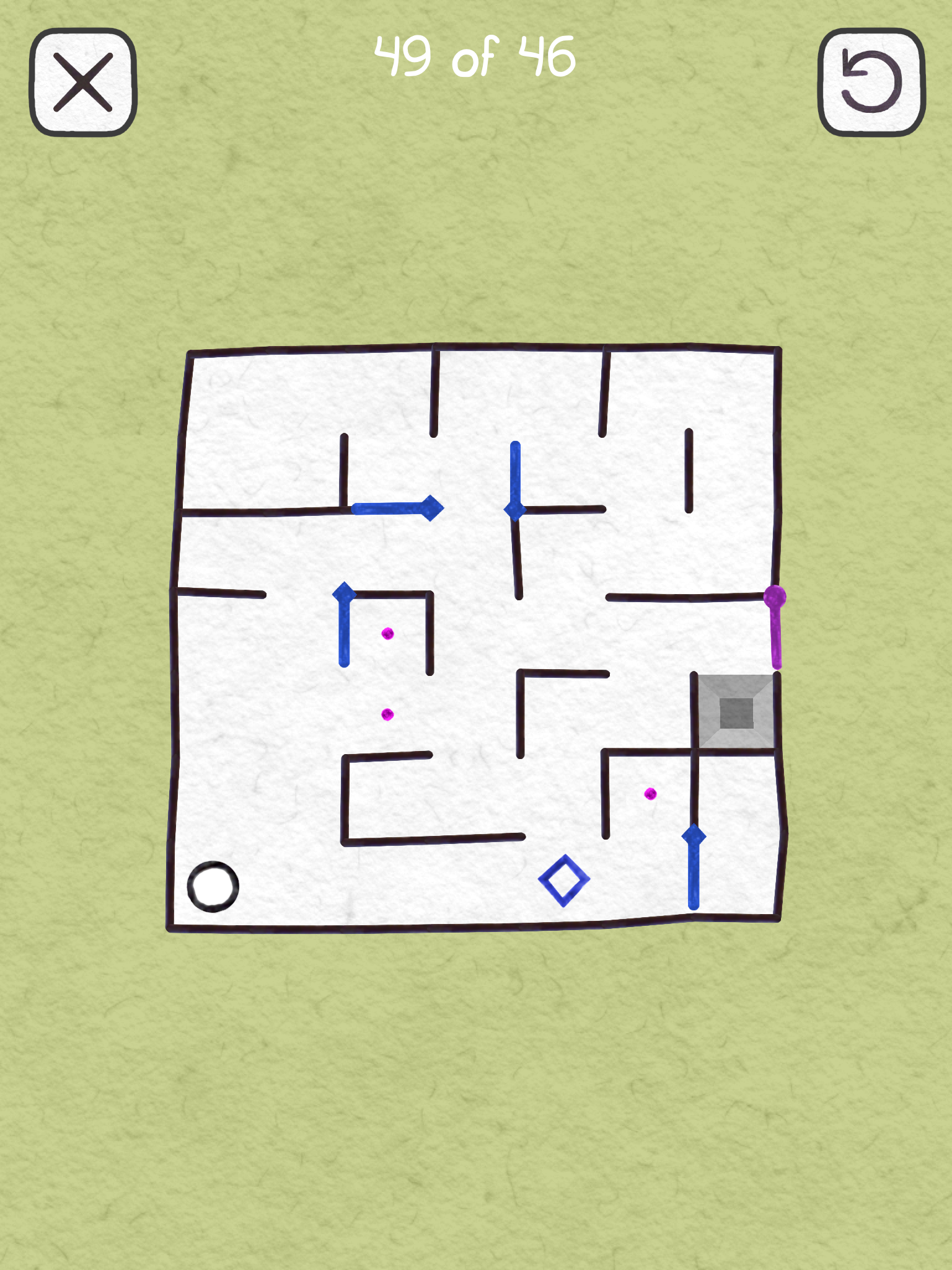
From earlier: Shift Escape is an iOS puzzle game by Toby Nelson, who is the Mac IDE maintainer for Inform (and my brother-in-law, not entirely coincidentally).



 Emily Short's Interactive Storytelling