 IF Comp 2011 is now up and running, and it appears to be a flourishing year, with 38 games in a range of systems, including Inform, TADS 2 and 3, ADRIFT, Undum, ALAN, Quest, Windows-standalone and unconventional web engines, including one engine that appeared earlier this year in the IF Demo Fair, if I’m not mistaken.
And now a side note about blurbs. The IF Comp about page gives authors a chance to include short blurbs about their work, and some of these do a notably better job than others of making me want to play.
Your blurb, like your cover art if you have any, is an important first contact point between your player and your game. If you can make the player eager to play, she’ll likely have a better time during the opening moves and be more inclined to give your game the benefit of the doubt. And a player who knows what genre and style she’s facing is also more likely to play in tune with the game’s intentions, and save the game until a time when she’s in the mood for what it has to offer — which again is likely to mean a happier experience for the player and a better score for the author.
Here’s a good one:
The Play
A dress rehearsal gone horribly wrong
By Deirdra Kiai
…
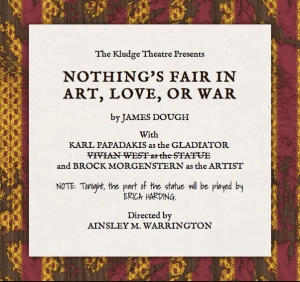
Pull yourself together, Ainsley. Just one more rehearsal until the big day, assuming nothing catastrophic happens. But really, all you have to do is get your motley crew of actors to run their parts once through from beginning to end. How hard can it be?
It’s not long, but it communicates character (you’re Ainsley), relationship (you’re directing), major conflict (keeping the actors on task until the rehearsal is complete), setting (a theater), and tone (humor centered on just how bad things can get). As it happens, I often enjoy slice of life humor IF, and this blurb suggests to me a cross between Four in One and Broken Legs. My expectations are now established and I’m keen to play.
Here’s one that doesn’t work as well for me:
The Life (and Deaths) of Doctor M
By Edmund Wells
…
Blurb: Your vision clears as you gently land in an endless landscape. There is the wind, a bleak and chill thing. And there is your sense of uncertainty: You don’t know which way to go. Or, maybe, which way you went.
Where am I? Who am I? What am I doing? Why do I care? The blurb refuses to say, and hints that the game isn’t even going to be specific about which tense it’s set in. Amnesiac wandering in a void it is, then.
But amnesiac wandering doesn’t seem to go with the title, unless this endless landscape I’m stuck in is the afterlife and I’m the repeatedly-dying Doctor M. Speaking of M, s/he doesn’t even get a full surname, so I can’t even sketch in a nationality for him or her. Meh.
This game might conceivably turn out to be interesting after all, but the blurb suggests it’s going to be a wash of artistic choices diligently avoided.
Or take the uberterse
The Hours
By Robert Patten
Blurb: Your new job may be harder than you thought.
This could be almost anything. The word “job” does sort of suggest a modern or future setting rather than a distant historical one, but anachronistic attitudes towards work are hardly unknown in IF, so we can’t rule out the possibility that this is about a freedman in ancient Rome, say, or an alchemist staring down a year’s supply of unmutated lead. Otherwise, I have no information about goal, character, tone, setting, genre, gameplay style or difficulty.
Here’s a different strategy entirely:
Kerkerkruip
By Victor Gijsbers
Kerkerkruip is a dungeon crawling game that brings interactive fiction and rogue-likes together. With a randomly generated dungeon and a complex world model, every game is different and exciting. Success can only be achieved through tactics and strategy.
Here the hook is about the kind of gameplay being offered rather than the story the game is going to tell, but the blurb is still communicating the game’s unique selling point. Sometimes that’s appropriate, especially when the focus is on systemic challenge. I admit I wouldn’t have minded getting a little more flavor here along with the description, but I do at least feel like I know what’s going to be in this package and whether I’m likely to enjoy it.
By contrast, this gives a little information about gameplay, but not enough to qualify as an actual hook:
The Guardian
By Lutein Hawthorne
Blurb: A beginner level fantasy quest, made to be straightforward to finish without previous IF experience. Small feelies, an instruction book and MIDI music, are included. A walkthrough is available.
The genre and difficulty rating are useful information, and the presence of feelies and instructions suggests that some care has gone into the production. But it’s not telling me how this game might be different from (and possibly more interesting than) any other piece of beginner-level fantasy IF, and there’s quite a lot out there.
 It’s comp time, so I’m going to short summaries in my RSS feed in order to avoid dumping spoilers into the aggregators. And, as usual, I will be skipping games that have no evidence of beta-testing.
 now, after having played
 Emily Short's Interactive Storytelling