Narrative Design for Indies (Edwin McRae)

narrativedesig.jpgNarrative Design for Indies: Getting Started. This is a brief Kindle book published in October of last year.

Edwin McRae is a writer and narrative designer who specializes in indie projects, and has written some blog tutorials and guidance for ink, as well. His book is designed to help aspiring indies figure out what they might need in the area of story, whether they need to hire a writer, and what expectations they should have going into that process.

McRae’s approach is very much conscious of resource constraints. Voiceover is expensive: what can you do without it? What methods of delivering story are affordable and easy to sneak into your story? How can you manifest important story information through gameplay and flavor text that you needed to create anyway?

Continue reading “Narrative Design for Indies (Edwin McRae)”

End of May Link Assortment

June 2 is the next meeting of the SF Bay IF Meetup.

June 9, the Oxford/London IF Meetup hears from Graham Nelson about Inform 7’s latest progress, and we look at the parser game space.

June 16, the Baltimore/Washington DC group meets to talk about Grayscale (ideally, play in advance).

*

New Releases

I reviewed it earlier, but I recommend Katherine Morayati’s Human Errors; you can also read her interview about its themes.

Continue reading “End of May Link Assortment”

Generominos (Kate Compton)

Geronimos.png

Generominos is a deck of cards designed to help the user think of possible generative art and visualization projects. Some of the cards describe input types (words, images, geographical locations, etc); others describe output formats (3D printed shapes, light changing glass, and so on); and then there are a number of cards that describe ways of transforming one type of data into another. The ideas generated would be suitable for lots of applications, from alternative game controllers to computational-creativity crafts to data visualizations to museum installations.

There are additional project modifiers that suggest purposes for the project (making a creative activity for a senior center, for instance, or put it someplace where no humans can see it).

The cards make a cool teaching (or self-teaching) tool, both around process — how might you change one kind of data into another? — and about specific techniques. Kate has a wide experience with generative art forms in both physical and digital space, which means she includes ideas like “express your output in colored fire” or “attach a webcam to a microscope to observe microbes moving” or “get ocean condition data from NOAA’s API”. Even with a fair amount of experience in related spaces, I found a shuffle through the cards suggested a lot of possibilities I hadn’t considered. So it’s an interesting place for beginning-to-intermediate users to start thinking about generative art design. It also provides a bit of framework for more advanced users: you can add your own cards as you think of new methods and inputs, and then play with how those might generate interesting new combinations.

The flip side of this: the cards may suggest a cool project that would be prohibitively difficult or expensive to build at home, or that would require a dive into new code or algorithms to realize. And in some cases, a little more context might be useful. For instance, the card on word2vec accurately explains that you put a word in and get a vector out, but there’s not enough room on the card to talk about the ways word2vec is often used to get from one input word to another, or to calculate analogies.

So actually building a project based on these ideations is possibly not a beginner-level task; or, to be more precise, the cards may not give enough information for a beginner-level user to tell which concepts would be accessible enough for them to implement from scratch. One might need to do some additional research into particular techniques, or be encountering the cards in a classroom or workshop context.

Bonus recommendation: Rich Vreeland gave some great talks at the AI Summit this year about the procedural music for Mini Metro and about sonification in general as a way of understanding data (instead of or alongside visualization). If you happen to have GDC Vault access for 2018, that material is definitely worth checking out.

Human Errors (Katherine Morayati)

Screen Shot 2018-05-15 at 6.44.13 PM.png

Human Errors is a new piece on Sub-Q, by the author of (among other things) TAKE and laid off from the synesthesia Factory.

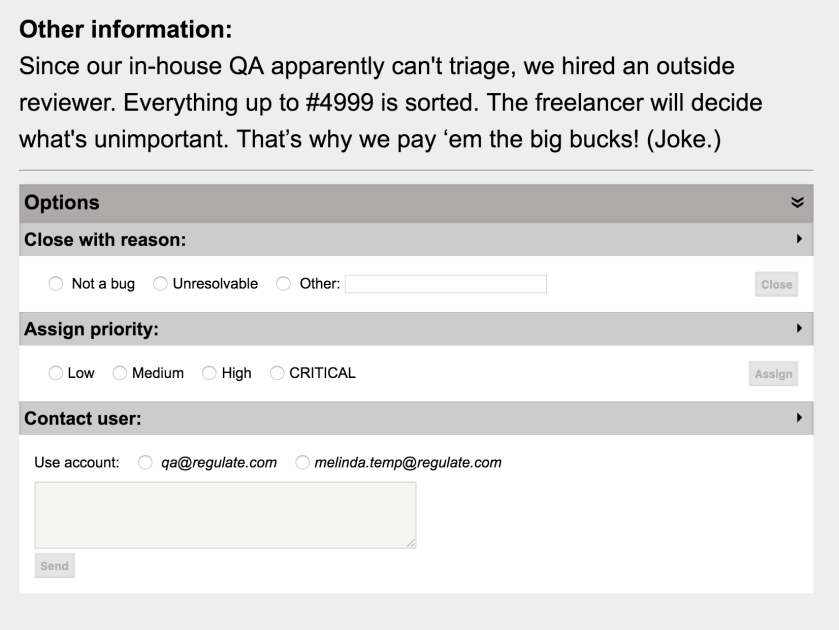
Human Errors describes a world in which human attention (and empathy, care, and understanding) are a severely limited resource. The player plays the role of a contractor brought in to triage support tickets on a product that (we quickly realize) has a rather alarming range of functionality. What you’re supposed to do is close as many tickets as possible, while prioritizing only the undeniably critical ones.

You also have the option — not preferred by the company — to follow up with particular users and try to get more of their stories. Here, you can engage either as a nameless QA figure or via personal email.

But engage too much, with too many people, and the company will start to view you as inefficient, or as going outside the proper parameters for engagement, and your access to the system will be cut off entirely. So you’ll have to budget your sympathy, dole it out cautiously, try not to get in trouble too quickly.

A single interaction node looks like this:

Screen Shot 2018-05-15 at 6.52.54 PM.png

There are, of course, other games out there working through the interface of simulated email or other computer-mediated messaging — I recently covered Grayscale, which puts you in the role of an HR employee resolving complaints, for instance. Several of Christine Love’s pieces act similarly.

But what I particularly like about the system in Human Errors is the way it combines the guided and the open-ended, the effective and the reflective choices. If you choose to close an issue, it goes away, is no longer your problem. If you write an email to a user, you get a brief time — enough to type a short sentence or two — to type whatever you want before the text box fades to “Sent.” It’s not expressive in the sense of a parser input, because you’re not constructing a complex command all of whose aspects will be understood by the game; but it does allow and indeed encourage the player to express something. Continue reading “Human Errors (Katherine Morayati)”

Mid-May Link Assortment

May 16 is the next meeting of the People’s Republic of IF (Cambridge, MA). The agenda is to play something from Spring Thing.

May 19, the Oxford/London IF meetup does a workshop on Tracery and building your own Twitter bots. This is a great introduction to basics of text generation, if you’re interested in that.

Feral Vector is May 31-June 2 this year. This is a joyous, playful indie conference in Yorkshire and has always been delightful when I’ve been able to attend. (I can’t make it this year, alas.)

June 1 is the deadline to vote in the final round of 2017 XYZZY awards.

June 2 is the next meeting of the SF Bay IF Meetup.

June 9, the Oxford/London IF Meetup hears from Graham Nelson about Inform 7’s latest progress, and we look at the parser game space.

June 16, the Baltimore/Washington DC group meets to talk about Grayscale (ideally, play in advance).

*

Competitions

illuminismocoverCongratulations to Michael Coyne for winning Spring Thing 2018 with his parser puzzle game Illuminismo Iniziato (my review here, and he has also written a postmortem).

Robin Johnson has a postmortem for Zeppelin Adventure, and Karona for House, also from Spring Thing.

Congratulations also to all of the finalists for 2017 XYZZY Awards, including Best Game finalists

  • American Angst (m3g1dd0)
  • Eat Me (Chandler Groover)
  • Known Unknowns (Brendan Patrick Hennessy)
  • The Owl Consults (Thomas Mack)
  • The Wizard Sniffer (Buster Hudson)

Articles

Katherine Neil has written up a medium post comparing a lot of basic features between Twine 2 and ink, for those who are curious about what it’s like to write in each of those systems.

Crowdfunding

Aaron Reed is Kickstarting a new tabletop storygame called Archives of the Sky. He also talks more about the game on DelveCast.

http://kck.st/2rd0N5h

Mailbag: Applying Filters to Character Dialogue

The following letter fits right into this month’s topic on procedural generation. I’ve edited (just a little) for length:

Hi Emily! I read your chapter in the Procedural Generation in Game Design book, and was really impressed. I tried to follow up on some of the sources you mentioned (e.g. the Spy Feet game) but I wasn’t able to get a lot of details, and we have a pretty specific use case, so I’d love to beg a moment of your time to get me pointed in the right direction. Or, if answering my question properly takes more than a moment, I’d be happy to talk about a consulting fee…

We’re doing a bunch of what I’d call dynamic writing, which you can read more about here or on our wiki if you’re interested in the specifics. We have procedurally generated characters (heroes in a fantasy setting) with personality stats tied to their histories, and our system allows writers to take those personalities (and other details) into account in 2 main ways. The first is by picking who takes what role in any given story, (e.g. the highest goofball stat in the party might be picked to be telling the joke in a particular story) and the second way is by inserting markup in the text to add variations for specific personality traits (or relationship status, class, age, etc..) For example we can say things like, if the leader is more bookish, they’ll say something academic, but if they are more hothead, they’ll say something aggressive. This markup is also how we handle gendered words and attraction.

One of the things our game supports (due to the 2D art style and just the stories we want to tell) is really dramatic character transformations, like, to take a simple example, you might find a wolf shrine, and make a deal with the wolf god, and get your head replaced with a wolf head. Now you have a bite attack, cool. But it would be great if we could alter the character’s speech to reflect their condition. Likewise for other conditions or origin stories, or frankly (eventually, maybe) personality quirks.

Continue reading “Mailbag: Applying Filters to Character Dialogue”