First, a massive disclaimer: Voyageur’s author Bruno Dias is a friend. Also, I often do work for Failbetter, which provided support for Voyageur via Fundbetter. In addition, Voyageur uses procedural text generation features that draw on things I did for Annals of the Parrigues, and I had a number of conversations with Bruno about the game while it was in development. That said, I will try to be as useful as I can, since I’ve been asked for more of an assessment than the simple announcements I’ve been posting.
What is Voyageur? This is a systematic quality-based narrative with procedurally generated textual descriptions, trading, and perma-death — though in the right circumstances you can leave a substantial legacy to a future captain.
To unpack that a bit: you start out on a planet with a little money and a few supplies and something called a Descent Drive. A Descent Drive is alien technology that moves faster than anything made by humans — but only in one direction, towards the center of the galaxy. If you want to take a trip on one, you are never coming home.
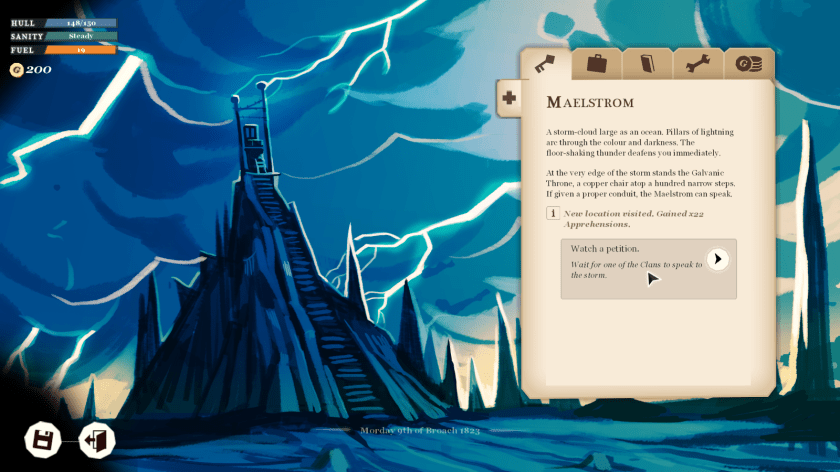
So you set out, and each time you do, you have the ability to steer a little. You can typically pick which of 2-5 available planets you want to see next. You know one or two facts about them. Sometimes those facts are enough to tell you which planet is going to be the best place to sell off your current cargo or drop a passenger; sometimes you’re pretty much taking your chances. The descriptions of the planets, as well as the crew you pick up and the trade goods you acquire, are all procedurally generated. Planets have governments, cultures, climates. Trade goods have different levels of quality and other features that make them appealing on different worlds. I particularly enjoyed some of the trade good descriptions that hinted at the surrounding culture: Sea urchin substitute. Generic locust steaks. An artwork consisting of AR decorations overlaid on electronic components.


 Emily Short's Interactive Storytelling