 The IF Demo Fair will be held from 8:00 to 10:00 PM on Saturday, March 12, in the Alcott conference room at the Westin Boston Waterfront Hotel adjacent to PAX East 2011 (map). No PAX badge is required to attend. This is an IF community event sponsored by the People’s Republic of Interactive Fiction.
We have 23 pieces, including interactive poetry, journalism, and documentary; experiments with styles of interaction that go beyond the puzzle, and modes of input other than the standard parser form; new prototype authoring tools; and new interpreters, both serious and whimsical.
Here are some highlights:
The XYZZY-nominated Automatypewriter, Jonathan M. Guberman and Jim Munroe. Like a more literate cousin of the player piano, the automatypewriter is a manual typewriter that types by itself, and takes input. You may have seen the video online where an early version of this project plays Zork — the one being showcased here is an entirely different typewriter, playing a custom-built interactive fiction piece by Jim Munroe (Everybody Dies, Roofed).
A new way to interact with fiction from Jonathan M. Guberman on Vimeo.
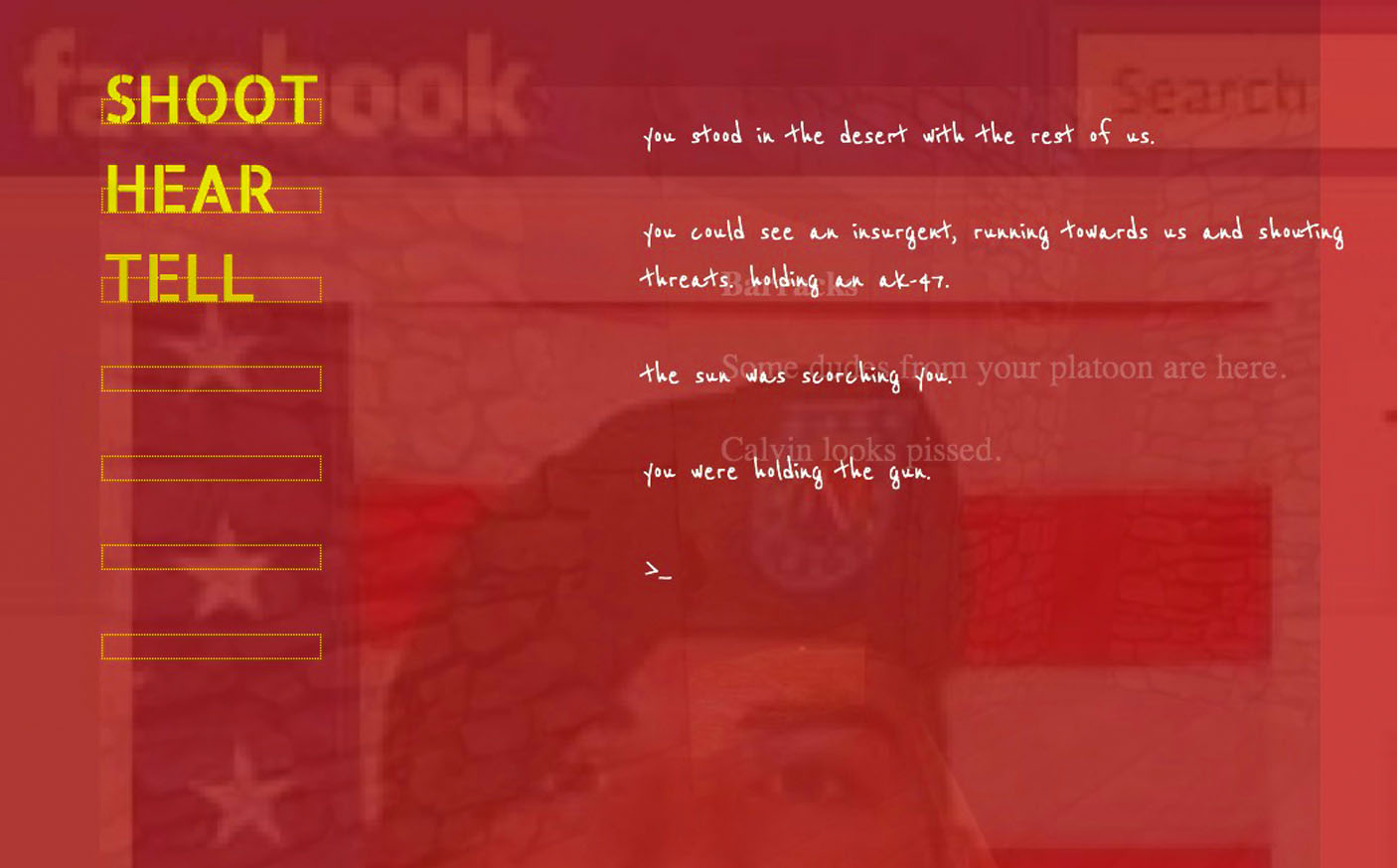
 what if im the bad guy?, Aaron Reed, UC Santa Cruz. Exploring a frozen battlefield moment from a half dozen violently conflicting perspectives, this prototype (part of the author’s work towards a digital arts MFA) merges traditional IF with video, sound, and web conventions. Inspired by the currently unfolding trials of six US Marines accused of committing war crimes in Afghanistan, the project asks what interactive stories can say about contemporary, real-world events, and wonders if there can be such a thing as an IF documentary.
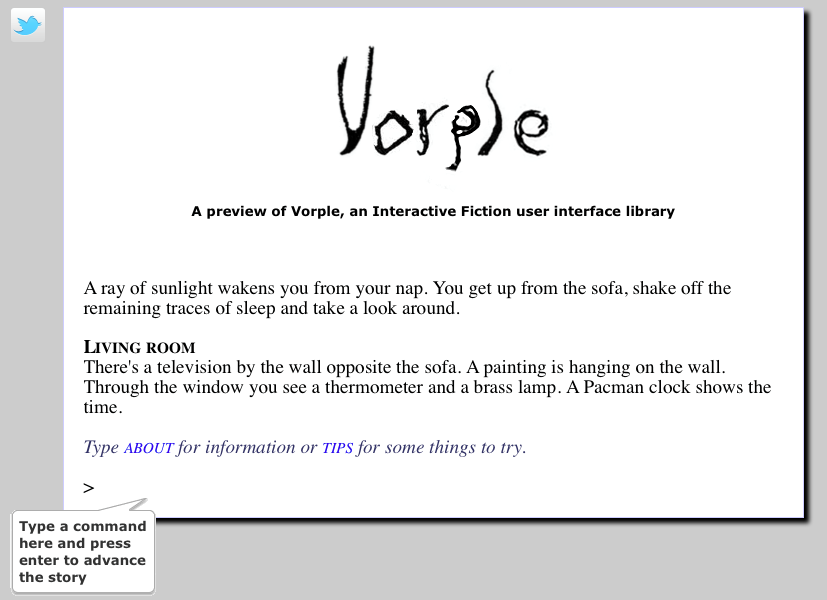
 Vorple user interface library, Juhana Leinonen. Vorple is a JavaScript user interface library designed to be used together with interactive fiction and hyperfiction systems. Vorple provides an additional user interface layer on top of existing web interpreters and systems. Story and library authors can build user interface and web elements the underlying system might not support natively. Through Vorple, stories can display YouTube videos, pull data from Wikipedia, communicate with Twitter or Facebook, integrate to blogs, or use any other services and techniques available for web applications.
 Procedurally Generated Narrative Puzzles, Clara Fernandez Vara, Michaela Lavan, Alec Thomson, Singapore-MIT GAMBIT Game Lab. This project focuses on methods to generate narrative puzzles procedurally. The point-and-click game Symon was a proof of concept of what an adventure game would be like if players had the chance to restart the game and get different puzzles, because they were being generated by the system. The project here presented are a set of tools for designers which eventually should be compatible with different development environment, including those dedicated to interactive fiction. The tools include a series of building blocks to build puzzle patterns, and a database editor, which designers can use to create the characters and items involved in the puzzles.
Also to look forward to:
- Combat and conversation demos from Bob Clark, Victor Gijsbers, and Robb Sherwin
- New browser interpreters by Dave Cornelson and Alex Warren
- Nick Montfort’s Curveship system for narrative variance
- Adam Parrish’s Frotzophone interpreter, which interprets changes to the object tree in the Z-Machine into music



 Emily Short's Interactive Storytelling