ShuffleComp, 2015 edition

ShuffleComp is an interactive fiction comp in which participants send in lists of songs; the songs are shuffled and redistributed, and each participant writes a game based on one or more of the songs they received. (Last year’s competition yielded some 34 games and is responsible for not one but two games titled Fallout Shelter.)

Here are some favorites from this year’s comp:

Continue reading “ShuffleComp, 2015 edition”

Spring Thing 2015: Doggerland (A. DeNiro)

Doggerland_small

A. DeNiro’s Doggerland belongs to the interactive poetry school of Twine: highly personal, only loosely narrative, making play with hover effects as well as links in order to evoke some connections that aren’t explicitly stated. It concerns, among other things: winter and isolation, global warming, childhood, problems with America’s health care safety net, parenthood, glaciation, the passage of time, and a personal decision which (since the work is described as autobiographical) I assume is true to DeNiro’s actual experience.

There is, as far as I could find, one branch point where you can choose which of two vignettes to read, and since links are marked with icons rather than with text, it’s hard to call this a choice: it’s more of a lottery. The work is otherwise linear-exploratory, allowing the player to decide only how much depth to experience at each point before moving on.

I might almost have preferred not to have that branch. I replayed the story to see what I had missed the first time around, but the structure is otherwise so tight and the emotional impact so much tied up in the process of revelation that playing for completeness the second time felt like a diminishing of the experience. Perhaps. But then, the theme of opportunity cost is also appropriate for the story. And then, also, I understood the shape of the piece better the second time around, so perhaps it was worthwhile to encourage this. I don’t know.

I do know that it has a quality I associate with good poetry, which is that the more I think about it, the more it pulls together, the more the different screens and different text seem thematically interrelated.

The rest of what I think about this is not about craft but about content, so I’m going to put a spoiler jump in now.

Continue reading “Spring Thing 2015: Doggerland (A. DeNiro)”

Spring Thing 2015: Ruiness (Porpentine); Missing Since ’77 (Andrew Watt)

Ruiness is a Porpentine game, and as such is typically difficult to summarize. It takes place in an evocative post-apocalyptic wasteland in which people have roles like “scavenger” and “dustrunner”, as well as apparently belonging to different species and riding various creatures.

Most of the gameplay is exploratory and concerns uncovering new places to go, or else new kinds of character to be — in this regard it reminded me of Contrition. Both Ruiness and Contrition take some concerted work to explore fully; they don’t feel like puzzle games, precisely, but they are more demanding to navigate than the average Twine. (In fact, I’m reminded a bit of Toby’s Nose, here.)

I’m not sure I could summarize what happens here at a plot level, and sometimes the descriptions become more prose-texture than denotative. One of the curious things about Porpentine’s work is her ability to make worlds and stories that are navigable even when they take place in an utterly alien environment. This effect is fully in force in Ruiness.

Through both mechanics (the replacement of one protagonist with another and another) and content (the endgame), the story suggests that the experience of individuals is relatively unimportant, that their culture and history is being shaped by supervising forces far beyond their comprehension. I found this simultaneously bleak and comforting: bleak because it was hard to enter into any one character’s life in any depth, comforting because the supervisory force seemed to at least desire positive outcomes such as a reduction in war.

*

Missing Since ’77 was entered in the Back Garden because it’s a demo of an unfinished game. The results were certainly polished enough to have made this a reasonable contender in Introcomp, and I’m glad to see the Back Garden option used for a variety of purposes.

The game identifies itself as fantasy, but most of what we see in the setup is set in the real world. This appears to be a portal story in which a character has gone missing in an alternate fantasy universe, but it’s told from the points of view of those looking for him, namely his wife and the young detective she’s hired. The game starts out in the detective’s view, then switches to the wife’s and retells the same events (some of which depend on what the player did the first time around) with an alternate perspective. Like KING OF BEES IN FANTASY LAND, it uses a change of typography to indicate when we are seeing through new eyes.

This is an ambitious approach, uncommon if not absolutely unknown in other IF: Stephen Granade’s Common Ground did multiple-perspective retelling in the form of parser IF, and a handful of time travel puzzle games record what the player has done and repeats these back to allow the player to collaborate with other selves — Fifteen Minutes being a notable recent example.

To work, this kind of design requires rigorous state tracking (though possibly this is less fiddly in Twine because there’s less state to worry about) as well as good enough writing to make a second pass through the same scene interesting to the player. Missing Since ’77 did pull this off, at least for me.

I enjoyed this and would be curious to see more.

Spring Thing 2015: Mere Anarchy (Bruno Dias)

I didn’t run reviews during Spring Thing because of having my own Back Garden entry. I’ve also changed my review policy for comps: moving away from trying to be thorough (a goal at which I didn’t always succeed anyway), and focusing on covering games about which I have a fair amount to say and/or that I really want to recommend to other players.

For Spring Thing, that starts with Mere Anarchy.

Screen Shot 2015-04-07 at 3.04.58 PM

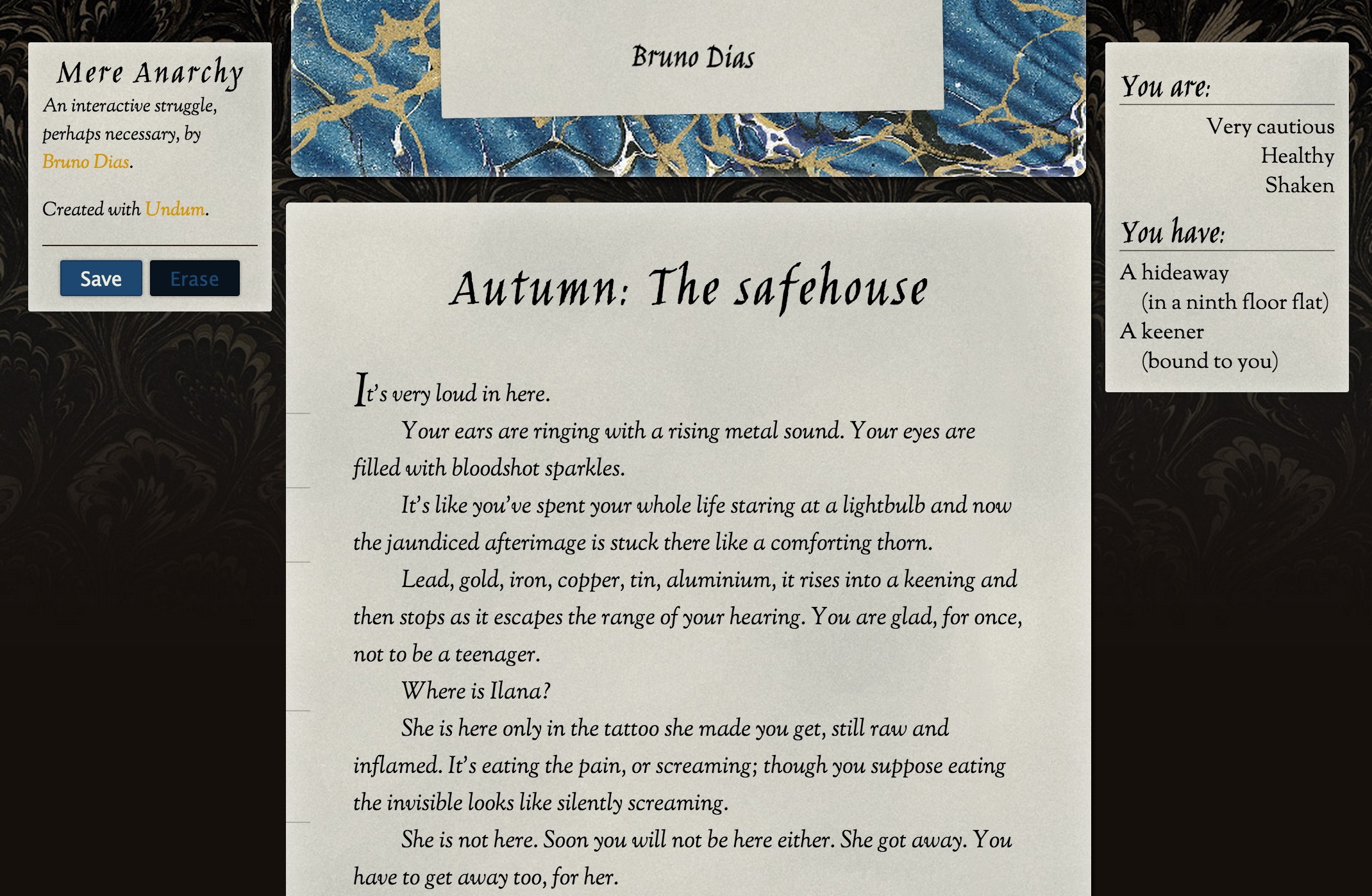
Mere Anarchy (Bruno Dias) — this is a choice-based game in Undum by the author of ParserComp’s Terminator Chaser. As usual for Undum games, Mere Anarchy looks really good — Undum is still in my view the prettiest-by-default of the available choice systems, and the only real strike against it is that it offers so little by way of authoring tools. I’m impressed that Dias submitted two such complex games in such a short window. And this is a fairly complex piece: I think the state space is smaller than in Squinky’s The Play, but there’s a fair amount going on relative to most Undum games. Many early choices quietly play into the descriptive text later, even if they don’t substantially branch the story.

Mere Anarchy describes itself as “urban fantasy”, which led me (despite the title) to imagine cops-who-are-also-werewolves literature. This is less trope-y and goofy than that, but “urban fantasy” still fits. The protagonist is a magic user in a modern city environment, in which a wealthy cabal controls most of the high magic and which has been having lesser magic-users killed. The story details the preparation and execution of a strike that might be considered a terrorist attack, a coup, or a revolution, depending on your point of view. There’s not much leeway about what you will do or how it will come out, but you can choose details of how the protagonist will act and what their motivations will be. Many of the choices here are about the protagonist’s inner life rather than anything else.

Continue reading “Spring Thing 2015: Mere Anarchy (Bruno Dias)”

Beneath Floes (Bravemule, Pinnguaq)

bmportal

Beneath Floes is a folk tale of Inuit culture, created in collaboration with Inuit contributors. (There’s a browser-based play option as well, but at the time of writing, that version wasn’t serving audio well, so you may prefer the download.) Recently a Kickstarter raised the funds to have Beneath Floes translated into Inuktitut (an indigenous language of the eastern Arctic) and Anishinaabemowin.

It is both a story and a meditation on story-telling, one which starts by explaining to the reader how much is going to be under the reader’s control. Not a lot, as it turns out: you mostly get to change small details, details that explicitly don’t branch the plot, while the horrible core story is beyond the player’s capacity to change. But the effect is very different from, say, the also very linear interaction in My Father’s Long, Long Legs, or the fact-mingled-with-fiction of Coming Out Simulator 2014.

Nonetheless the small details that you’re allowed to affect are not selected arbitrarily. Does evil, in your mind, have a hooked nose or a button nose? Do you associate yourself with an indigenous hero or with Superman? Perhaps we’re allowed to make these choices because we inevitably see reflections of ourselves in the stories we’re told, no matter who the teller is. Elsewhere — a dark sort of joke — you can pick which of two strings of gibberish numbers and letters the qallunaat, the white people, have assigned you as your identifying marker; or, in another place, you can change (by one year) the date associated with an anthropological recording. History is slippery, but the fundamentals hold.

I appreciated, too, the passages where material that relies on cultural context is presented just clearly enough for someone not native to the Arctic to understand, but yet not overly explained. A favorite passage:

It’s said that your father shot a caribou and failed to kill it, but that’s one person’s belief—not a well-liked individual, either.

From context, it’s clearly a scandalous thing to fail to kill a caribou. A whole ethos is implied but not explained.

Beneath Floes is not completely linear, however. There are at least two endings that I found, and as far as I can tell, what makes the difference is what you decide about the protagonist’s willingness to do violence.

Spring Thing 2015, and Aspel

Spring Thing is now open, with nine new games: six in the main category, three in the “Back Garden” area for games that aren’t in competition for prizes and have somewhat looser entry requirements. There’s a mix of systems, too — Twine, Undum, Seltani, Glulx and z-machine, and Ren’Py.

My contribution is a Back Garden game called Aspel, which is a realm in the choice-based multiplayer Seltani platform. As my entry blurb says:

Aspel is an experimental interactive experience designed for multiple players, featuring asymmetric information and collective decision-making. The text you see on the screen won’t necessarily be the same as what everyone else sees, so you’ll need to communicate with your fellow players in order to experience it most fully. To make that easier, I’ll be around to participate/host at the following times:

Tuesday April 7 at 8 PM British/3 Eastern/noon Pacific
Sunday April 19 at 8 PM British/3 Eastern/noon Pacific
Friday May 1 at 8 PM British/3 Eastern/noon Pacific

…but of course people are more than welcome to arrange their own visiting hours.

At some point I’ll likely write something about the experience of writing for Seltani.