“I’m a vampire. It’s very boring.”
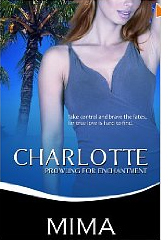
 Thus Ryder, one of the love interests in the CYOA Charlotte, Prowling for Enchantment (Take Control)
 (also available for iOs). Personally I think it a little risky lamp-shading the tedium of your own characters, but Charlotte doesn’t have much fear on that front. Or how about this:
The bubbling sexuality eating at her flashed into steam.
This is one of those metaphors that’s not so much mixed as fatally mangled at the blender factory. How can a liquid both bubble and eat? Are we talking about a flash-boiled acid here? Or, speaking of hot things you don’t want to be dipped into:
Lava tickled the tender skin between her thighs.
Such a tease, lava. Or
She needed a drink. Of skin.
You just don’t really want to think about that too hard.
The prose is not good — not keenly observed, not stylish or lyrical, not surprising — but it has a glossy professional assurance. And, indeed, the author, who works under the name Mima, has apparently published a whole series of non-interactive paranormal erotic romances.
The premise is that the protagonist has gone on a cruise, not realizing that (a) the cruise is a singles cruise for fantastical beings and (b) she has paranormal powers herself. At once she is being fought over by a vampire and a werewolf (where have I heard this before?). The first choice, therefore, is about which of the two she’s going to spend the night with. From there, many of the additional choices are about whether she is going to use her power, as it turns out she can command people to do her bidding. You would think she would have noticed this before the age of 29, but apparently the power is activated by proximity to bodies of water, and she was raised to avoid them all her life.
Some of the paths have a fair amount of plot; others are almost entirely porn, the kind of porn consisting largely of boggling euphemisms. (“The pleasure roared past like the blue line metro had missed its stop.”)
As CYOA, it’s structurally unusual. The passages between choices are long — the app calls these chapters, and it’s not wrong to do so — and there can be only three or four choices in a complete play-through. This makes the choices seem more surprising when they appear, because there’s so much that Charlotte decides to do of her own accord that getting agency back is a little startling. It is also a bit of a drag on replay (at least, I thought so), because there’s necessarily such a lot of previously-seen text to reread before one gets to any new branches.
It does offer a fairly polished interface, though, and the credit text on the iOs version is interesting: it invites published authors or professional writers to contact Branching Path Books to get their adventures out there.
The tactic of approaching static-fiction authors with an established fan base and getting them to write various types of interactive fiction has been discussed before, but I don’t know of a lot of cases (post-80s, anyway) where it’s happened. Mima isn’t exactly Stephen King, but there are those 19 published erotic romances; and the result is a CYOA that feels fairly different from the average example of the genre, both because of its subject matter (mostly the “silken bar” the vampire has in his pants) and its structure (choice points are rare and feel arbitrarily placed, with the emphasis of the experience still mostly being on the author’s story vision).
 A Penny For My Thoughts is a short storytelling game about trauma and lost memory. The premise is that the three players are all victims of some disastrous experience that caused them to lose their memories. Thanks to a special mind-enhancing drug, they are able to access fragments of those past events — both their own and one another’s.
 has been around in book form for a while now. There’s even a copy in my household, but I haven’t ever gotten to the point of reading it properly (and there is a “properly”, as one soon discovers). Now, thanks to Andrew Plotkin,
 Emily Short's Interactive Storytelling