It is now here.
Category: interactive fiction
ifMUD IF discussion
Our scheduled IF discussion on ifMUD happened this evening. (“Scheduled discussion” sounds confusingly vague. This thing needs a name.) I’ll link from here once our transcript is posted; it was recorded but needs a bit of cleanup. It ran roughly two hours, in a slightly shambolic fashion.
We are going to do this again: 8 PM GMT / 3 PM Eastern / Noon Pacific, Saturday, April the 5th, on ifMUD’s theoryclub channel.
Some conclusions from our first try: Next time it would be good to be prepared with a list of relevant games, so that people will have more shared ground from which to build the discussion. It’s challenging to keep a flow going that both discusses and compares work and takes the time to explain what is happening in each piece.
Also, narrower topics may be better. We spent a lot of time brainstorming around examples, but also a lot of time discussing what even fell into the category of interiority. And there were a lot of different examples that pointed in different directions.
But first, we need to pick a next topic. What shall we discuss? I opened this question at the end of the session, but the consensus was that we should do the topic selection here, where people who didn’t attend the first meeting could also make suggestions. So. Thoughts?
(ETA: There is now a permanent page for this club here.)
Post-Linden
As recently announced, Linden Lab is no longer supporting Versu.
What this means for me: I am no longer an employee of the Lab. At the moment I’m taking on some contract work.
What this means for the project: I am currently trying to see whether I can get back the IP for Versu and the apps that we built that Linden did not release, including Blood and Laurels. If that succeeds, I’ll post more information here. Aside from wanting to see our hard work out there, I’m concerned that people who had started working with the Versu toolset in academic environments continue to be able to use that toolset and, ideally, have a way to publish their work for others to play with. I may not be able to make that happen, but it would mean a lot to me to be able to do so.
A (Mostly Recentish) IF List, For Breadth
At the London IF Meetup this week, several people mentioned that they’d like to get a better sense of the range of what IF can do. This is a list I’ve put together to suggest the variety of what is out there — different types of play, different ideas about how interactive storytelling could possibly work. Notice that this list includes fiction and nonfiction, many different genres, and many different target audiences.
I’ve also leaned especially toward work that is by people who are part of the meetup group — starred pieces are by people you might run into at one of our meetings.
18 Cadence, by Aaron Reed. Play with snippets of story, construct your own, share with other people. A physically beautiful work that touches on themes of oppression and civil rights, grief and change, love and growth, without being particularly heavy-handed about any of it. Instead, it leaves a space for you to discover your own strands of meaning — and it also happens to include some cool procedural text reworking.
howling dogs, by Porpentine. A sometimes disorienting but powerful sequence of vignettes; it is difficult to explain this one in advance, but this is one of the pieces that really got people paying attention to Twine.
* Aisle, by Sam Barlow. A one-move parser-based game that allows you to type any of many, many different commands in order to discover what to do next. This is one of the older pieces on the list here, but Aisle functions so well as an introduction to what’s fun about parser IF that I’m including it anyway.
* Fallen London, Failbetter Games. A massive sprawling browser-based exploration of a world in which Victorian London has been stolen and taken underground by space bats. (Sort of.) Free to play; lots of lovely prose; many small plot arcs within a very long ongoing world exploration.
Solarium, Alan deNiro. A gripping Twine piece about the madness of the Cold War.
maybe make some change, Aaron Reed. IF augmented with video and audio effects, about a true war-time event. It uses the mechanic of player-typed commands to express fundamental points about the actions that we’ve learned and the terminology with which we think about people and situation.
My Father’s Long Long Legs, by Michael Lutz. A very linear, tightly focused piece of Twine horror that explores how effective it can be to make the player responsible for moving forward through the story, even when there are very few choices.
* Black Crown, Rob Sherman. Uses similar underlying mechanics to Fallen London, but to tell a more focused and darker story. Body horror and strange smells abound.
Choice of the Deathless, from the long-running Choice of Games line. This one is about a magic-using, demon-contract-making law firm. In general, games in this series do a lot with player character customization, providing lots of ways to experience similar issues and problems. Choice of the Deathless has an especially strong premise and setting. Choice of the Deathless is for pay; Choice of Games also offers some freebie experiences, though in my opinion they are a bit less good.
Conversations with My Mother, Merritt Kopas. A reflection on interpersonal relationships in the context of a trans experience, with links outward to actual tweets and real-world documents.
Analogue: A Hate Story, Christine Love. An illustrated science fiction puzzle-story about piecing together what happened aboard a damaged generation ship.
* First Draft of the Revolution, Emily Short, Liza Daly, and inkle. An interactive epistolary story where you play in the juncture between what people want to say to one another, and what they actually dare to say. The player’s role is to revise the letters being sent between characters.
* Moquette, Alex Warren. A somewhat melancholy slice of life story about a dissatisfied man riding the Underground. Features some neat procedural effects for creating the stops on the journey and the characters who get on and off the train.
Lost Pig, by Admiral Jota. A light-hearted, deeply implemented parser game about a lost orc called Grunk.
* Sorcery!, Steve Jackson and inkle. An old-style gamebook updated as a modern app, and one that has gotten very widespread appreciation.
* Bee, Emily Short. A real-life story about a homeschooled girl training for a national spelling bee. It’s built on the Varytale system, which means that the player gets to select which snippets of the story to read next, then make choices within each subchapter.
* Frankenstein, Dave Morris and inkle. A modern retelling of the Frankenstein story that explores what was going through the minds of all the major characters.
Kerkerkruip, Victor Gijsbers et al. A highly randomized dungeon-crawl story with rogue-like mechanics, but textual descriptions of events. Illustrated with a map and other colorful features.
Edited to add: in case it’s of interest, here is an old post, with screenshots, listing text-based games of various kinds. Some are interactive stories; some are interactive poems or other types of games that happen to use text.
Kerkerkruip Revisited

I last played Kerkerkruip when it was an entrant in IF Comp 2011. At the time, I was sort of luke-warm on it: it’s a roguelike game done as IF, which is very different from most of the competition it was up against, and I found it distracting to have success and failure messages (with die roll information) mingled in with more descriptive handling of character behavior.
The game has been the subject of considerable work and improvement since then, however. It now boasts one of the most complex UIs implemented in Glulx, including several cute startup animations, an illustrated screen, a handsome graphical map that can be brought up on demand, and (in the main gameplay window) several side panels providing constant status report information.
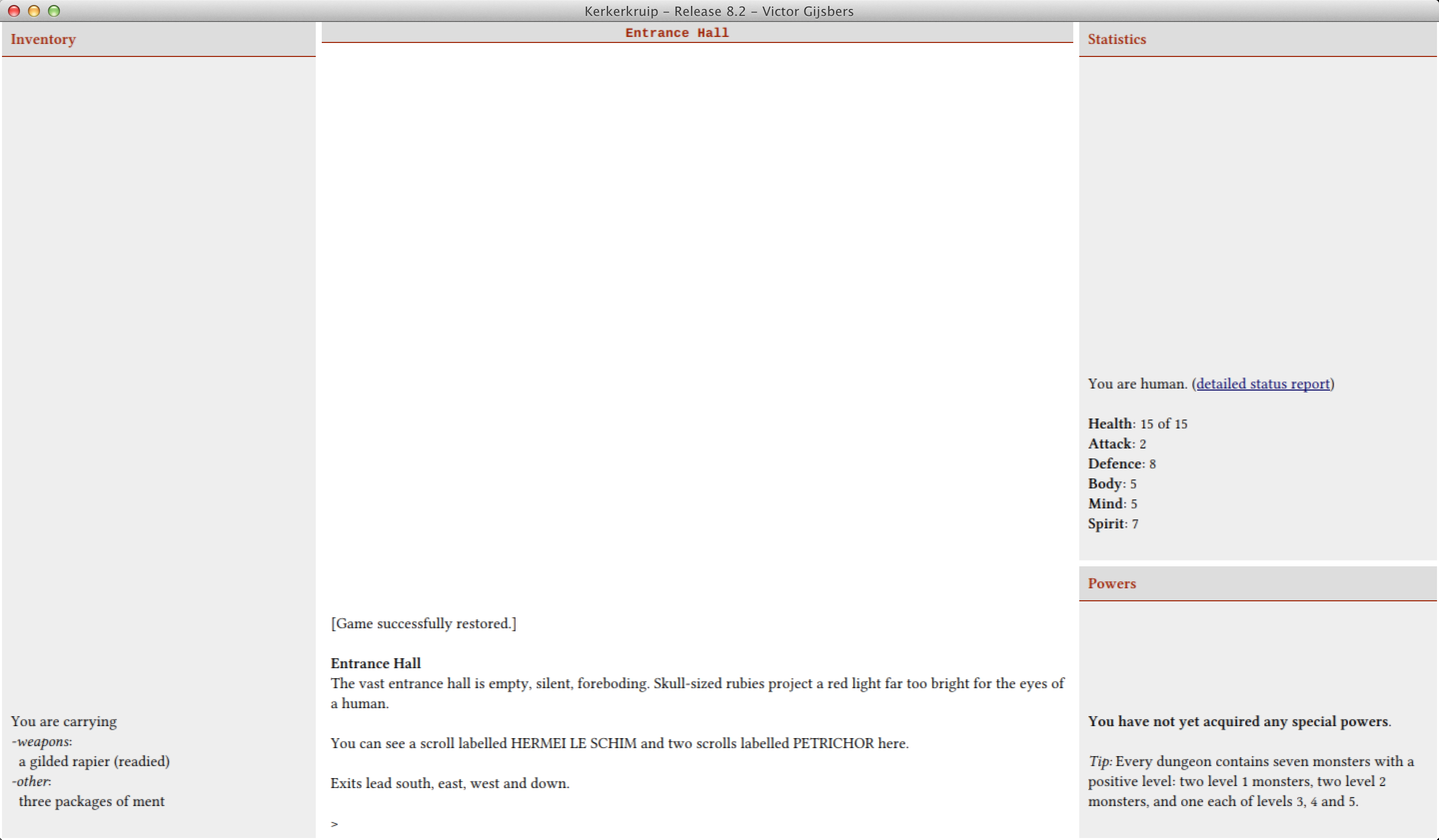
The result is still quite spare, admittedly, but having all this information laid out made it much easier this time around for me to understand the world state and play effectively.
In addition, the gameplay has been refined, with more monsters and weapons, a reduction in the randomness of the experience, and more tactical elements.
There’s still a great deal to learn. Playing Kerkerkruip effectively means balancing a lot of possibilities and outcomes in one’s mind: if I use this ment now, will I be without it at a more crucial time later? In which order should I try to kill my enemies? Is it worth trying to kill this high-level creature even though that will strip away the powers I’ve absorbed from other creatures? Coming to any conclusion about the best course of action requires the player to get familiar with the gamespace, to have a rough idea of the potential size of the dungeon and the number of creatures likely to be in it.
To make that startup experience easier, Kerkerkruip puts your first playthrough in “apprentice” “novice” mode: I was able to win on my first try, which boosted my confidence and gave me a clearer sense of what was going on when it came to subsequent, more challenging runthroughs. (All of which I immediately failed at. But hey.)
All of which is to say: I really recommend trying this thing if you haven’t. It pushes in interesting ways on the boundaries of what IF normally does, by having large elements of randomness and systematic play. It is one of the few IF games to make a serious shot at interesting combat that is not puzzle-based, and it shows off UI effects that most Glulx games never attempt.
It also yields some surprisingly entertaining moments that capitalize on the juxtaposition of procedurally generated situations with narrative text — for instance, I was being attacked by four enemies and thought my goose was probably cooked, but then I sprouted four tentacles from my torso, my enemies went mad and started licking their own weapons, and I was able to clean up.
Version 9 is now available in beta form and feels pretty solid to me: it adds a menu soundtrack, new enemies, and other goodies to the experience. And in the meantime if you want to follow development, Kerkerkruip has just gotten a new blog.
Intelligent Narrative Technologies (INT) Call for Papers
If you’re working on new systems in interactive narrative, or new projects, you may be interested in presenting your work at the workshop on intelligent narrative technologies, to be held June 17-18, 2014, in Milwaukee, WI. They’re currently calling for papers (full details after the jump); submission deadline is March 3.
Continue reading “Intelligent Narrative Technologies (INT) Call for Papers”
 Emily Short's Interactive Storytelling