Here are some things I want to say from my own perspective about the IF community. I acknowledge starting out that my perspective is one of considerable privilege and good fortune, and that I know my experience is not the same one everyone has. But I think also that what I’ve said may give the wrong impression about what I think is going on, and I would like to balance it a little. Necessarily this is more personal than my usual output, and I do it in a separate thread because I don’t want to frame this as an excuse for things that are wrong. If that’s not input you’re interested in and you mostly hang out here for the reviews, that’s totally cool too.
Category: interactive fiction
A word about who we are
Porpentine wrote this about her experience of entering howling dogs in the IF Comp:
It was natural for me to approach the circle of interactive fiction. I made games with words in them. But there was nothing for me. I was poor, not middle class. I was queer, not straight. I wrote experimental hypertext, not traditional parser. I was a woman, not a man, and there were many of them, and one of me.
It was intimidating.
Once I did participate, by submitting my Twine game howling dogs, I got harassing emails saying making howling dogs was a “crime”.
It shames and angers me that that was her experience with the IF community. I am sorry for it, but cannot repair it; I’d like to think we’re better than that, but I can see that we aren’t, because the reality is right there.
Assorted Releases and Events
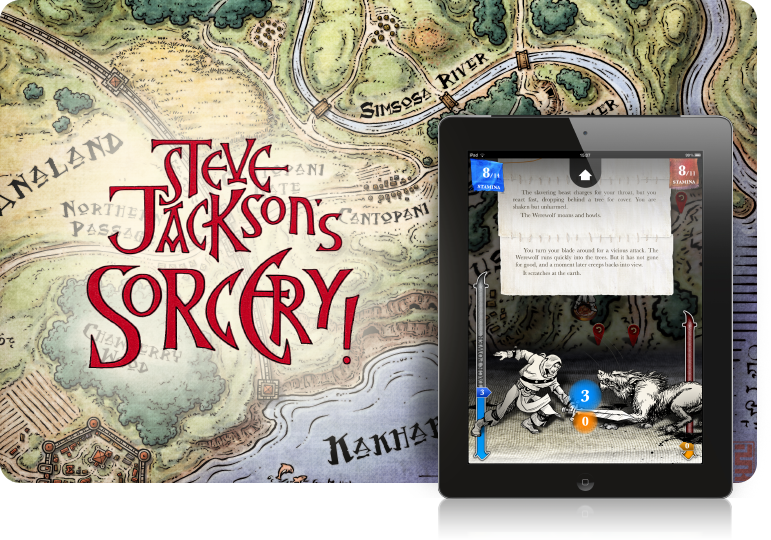
inkle has been posting for some time about their Sorcery! project with Steve Jackson, and it’s now available for iOS. I haven’t had a chance to try it out yet, but it looks gorgeous, with fun gamebooky play, a revamped combat concept, and a really attractive map. Here’s more about the making of, including discussions of the combat system and the creation of the user interface. It looks gorgeous, however, and is getting rave reviews at the app store, as well as positive coverage at Pocket Gamer. One unfortunate note: it’s not (yet?) really playable with VoiceOver.
The People’s Republic of IF in Boston is organizing another IF meetup this year, September 14-15, coordinated with the NoShowConf and the Boston Festival of Indie Games. This is an opportunity to hang out with other IF authors, share in-progress concepts, demo to the public (at Boston FIG), and attend game design talks (at NoShowConf). There may be some IF-specific programming there, though this isn’t finalized.
I’ve mentioned this before here briefly, but I’m speaking next week at the Inventing the Future of Games conference put on by UC Santa Cruz. That’s in Mountain View May 10. I’ll be talking about tools for interactive narrative creation, drawing on experience with Inform, Versu, and (to a lesser degree) various other IF tools.
XYZZY Award voting is ongoing through May 7. If you want to participate, check out the nominees and voting page.
The Walking Dead (Telltale)

I’m late to the party on this, I know, but I’ve finally finished Telltale’s The Walking Dead series.
Though I generally dislike the gun porn and grotesquery typical of zombie fiction, I got so many recommendations of this series that I had to play it. I thought very highly of it, and I thought the later episodes were significantly better than the first couple.
There has already been a ton written about the series, so this isn’t really a review or an attempt to summarize its content, as both of those purposes have been amply served already; what follows is more of an essay about the mechanics, choice mechanisms, and writing. It is fairly full of spoilers, because it’s pretty much impossible to talk significantly about this game without getting into the details. Consider yourself warned.
XYZZY Awards 2013 Eligibility
I’m reposting this, with permission, from the intfiction forum. I did not write this announcement; it is by Sam Kabo Ashwell. But it is about how the XYZZY Awards are changing to attempt to incorporate works that weren’t promoted to or didn’t originate inside the traditional IF community, and to avoid imposing unnecessary formal barriers to people who might be interested in having their work considered.
If that’s something you’re interested in, read on.
GDC 2013: Mordechai Buckman on Interactive Fiction Interfaces
 At GDC this year, I unfortunately wasn’t able to go to Mordechai Buckman’s poster session on interactive fiction because of schedule conflicts. (At any given time at GDC there are usually at least three things I urgently want to be doing…). The good news is that he was good enough to put up a video of that talk, which can be viewed here. I’m going to talk about what he says, but the talk itself is well worth viewing.
His first point is that CYOA and text adventures, and the point-and-click graphical adventures that came after them, are strongly hampered in the types of story they can tell and the variety of pacing they can provide because the interface elements remain fairly uniform throughout and because there are strong conventions about what they can be used for. He describes parser-based games as primarily evoking disorientation in the player; he argues that CYOA games always have to be high-stakes in order to make choices matter.
Throughout this portion of the presentation I found myself raising mental objections. The possibility space with existing tools is not nearly so narrow as he argues. There are a lot of IF games that incorporate some element of menu choice at key moments, or massively constrict the verb or object space in order to focus the player, or keep things moving so that actions keep playing out. There are a lot of CYOA games that present an IF-like world model under the surface, or that allow the player to explore multiple ideas in a leisurely fashion, or that reach for a lyrical experience. Mark Marino has just recently written about how the promise of hypertext, which had seemed long dead, has revised in new forms and formats of interactive literature. In the realm of visual novels and graphical adventures, too, there is a surprising diversity these days.
Nonetheless, though I thought his generalizations were way too general, Buckman’s not all wrong about CYOA and traditional parser IF. There’s a ton of fascinating work at the cutting edge, but a lot of that is coming about precisely because people are thinking about presenting options differently, dressing stories in different skins, and so on. I’d position Buckman’s pitch here not in contrast to what the IF and related communities are already doing, but as another natural contribution to this exploration of what all we can do.
Buckman’s second point is that it would be possible to explore a wide number of other emotional and play experiences by changing up how we display player choice, not just from one story to the next, but from one scene to another in the same story. He offers examples, and laudably they’re not just Photoshop mockups, but short playable sequences you can access on his site. Dialogue buttons change size and shape to communicate how the protagonist feels about saying those things. Boring options appear on just a to-do list to be checked off. In a time-pressured context, options pop up rapidly, obscuring old text. If some of this sounds familiar, you may have run into Buckman’s Gamer Mom at some point in the past. That work moves, expands, contracts buttons to reflect mood. Most of the concepts here have to do with implicitly and intuitively communicating the protagonist’s interior experience to the player without having to spell out how the protagonist feels about things, though there’s a curious minigame example about playing a difficult decision-making problem like a game of solitaire.
Some of Buckman’s mockups work better than others.
Continue reading “GDC 2013: Mordechai Buckman on Interactive Fiction Interfaces”
 Emily Short's Interactive Storytelling