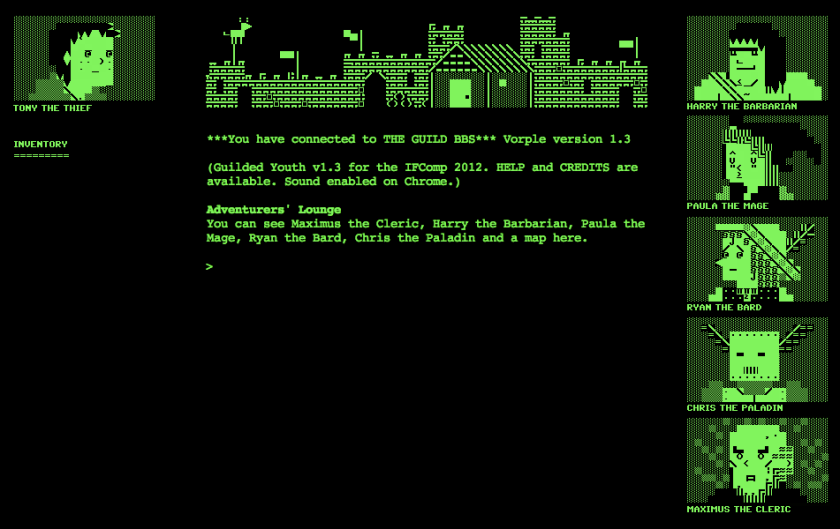
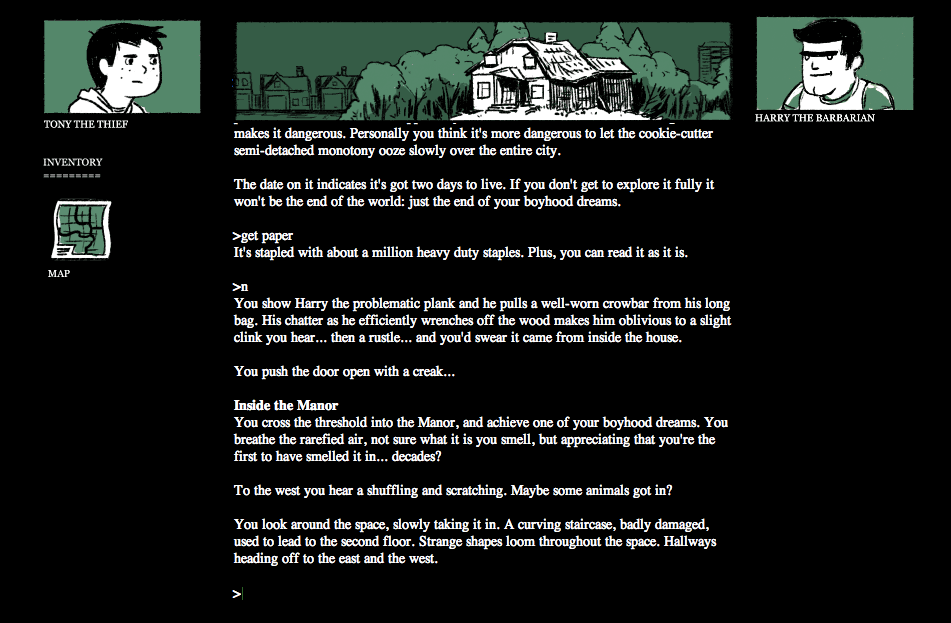
Guilded Youth is an Inform 7 game with a Vorple front end, concerning a teenager interacting with his MUD guild-mates both online and off. Per tradition, I will have some non-spoilery content after the jump; then if there’s anything spoilery I wish to discuss, it will be separated from the rest of the review with spoiler space. The fact that I am covering Guilded Youth at all means that it does feature listed beta-testers.
Category: interactive fiction
IF Comp 2012 is now open
It is That Time of Year again: IF Comp games for 2012 are now available: 28 games this year, which any non-author may judge, assuming they submit their votes before November 15. Many of these can be played online directly through the IF Comp site.
Assorted reviews are already beginning to appear on various IF blogs as well. Links to many review sites may be found here, for the interested. I have also posted my own overview.
The Holographic Story
…this illusory experience of living the story in time is not the only thing that is going on dynamically as we read. All the while, we are simultaneously building up a mental model of the story as a whole. And unlike the first model, this image of the story is timeless: it includes everything that ‘has happened’ and a great deal that ‘is going to happen’. At the point we have reached in our journey through the text, there are still large areas of the map that are blurred or blank. We know some, but not all, of the events already ‘past’ — who found the body, perhaps, but not yet who committed the murder…
This narrative model does not develop in the timelike way that the text does — as if a curtain were rolling back and exposing everything to view an inch at a time. Rather, its linear development is holographic: from an initial blur to increasing focus and clarity. From the start of our reading, it is a total picture of the story, with successive details filled in as we go along. It is finally complete only when the story is ‘over’ — that is, when we read the last word of the text.
Thus N. J. Lowe, in The Classical Plot and the Invention of Western Narrative, p. 23.
Lowe is a classicist, and a good deal of his book is concerned with the way that story works in specific ancient works and genres, but he is interested also in how stories work in general. One of his points is that, while reading a story, the player is constantly building up an understanding — a gamelike understanding — of the rules that pertain to this story world, what to expect next, and what sum total of information or event would make the story feel complete.
I find Lowe’s concept of the holographic story model constructive because it presents a way to think about plotting without reference to a taxonomy of temporal structure: stories told in linear order, mysteries that are about discovering what happened at an earlier time, stories with foreshadowings and flashbacks, braided narratives looking at multiple points on the timeline simultaneously, and so on. Such taxonomies describe a range of craft techniques all serving a common goal: to bring the story into focus for its reader or player in an order that will be maximally satisfying.
The holographic concept makes it easier to understand a variety of interactive story models that don’t map well to static fiction: works that are given meaning by their losing endings, works that need to be replayed several times to be understood fully, works whose authors expect their players to compare notes to arrive at a communal understanding of the story. Indeed, a number of interactive story techniques are about letting the reader/player control the focus knob in some way. What do you want to look at? What is the final point that will bring the story into focus for you? How slowly or quickly do you want to reach that understanding?
(And an aside: the whole discussion made me think about an interactive story concept where the whole plot is presented in a sentence or two and then elaborated by the player choice, rather than unfolding in time. I made a small sketch of what that might look like in inklewriter, which I’ve mentioned elsewhere: Holography.)
Phrontisterion, and some more thoughts about tools and the art
A couple of weekends ago I went to Phrontisterion 7, a living-room-sized conference on interactive storytelling run by Chris Crawford at his home in Oregon. Participant comments from that are now available.
For context for people who weren’t there: it was a really wide-ranging discussion about what projects currently exist in interactive storytelling and how/how well they work (Saturday) followed by forward-looking stuff about what to do next (Sunday). On Saturday, we talked about (among other things) Prom Week and Storybricks, Storyteller, LA Noire, Chris’ plans for Storytron 2.0, StoryNexus, ChoiceScript, and the project that I’m working on for Linden Lab. Though there weren’t formal presentations on these items, people also talked a bit about conventional interactive fiction, and about Varytale and StoryDeck.
Sunday was directed more at the question of “well, what next?” — and that was a more challenging discussion, one that I think frequently frustrated Chris. We generally agreed that we’re not trying to reproduce the Holodeck as such, at least not in its full technicolor, surround-sound, smell-o-vision glory, and quite possibly not in most of its other aspects either. I may possibly have gone on a short rant on the value of text, darn it, you know, with words, and how text is not inherently a second-class citizen and a cheap substitute for the greater expressivity of visuals. (Visuals are cool, and if there were to be a Holodeck that could conjure up a 3D immersive sensory experience, you bet I would want to try that thing out for sure. But. The art I personally want to create is made of language.)
Continue reading “Phrontisterion, and some more thoughts about tools and the art”
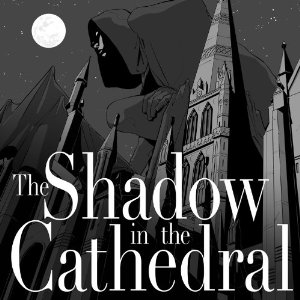
Shadow in the Cathedral hits Kindle
Cover Stories minicomp
Cover Stories was a minicomp in which artists contributed cover art in the first half, and then in the second half authors chose covers they liked and wrote games to fit them. A lot of cool covers were submitted, not all of which got used (alas).
The comp followed the lead of the Apollo 18 Tribute Album project in that it explicitly incorporated a time period for beta-testing and encouraged authors to beta one another’s work. I really like this model, and it seems to result in more consistently polished output than some of the other models. The term “minicomp” isn’t entirely applicable, since it’s really more like a mutually edited anthology, but I’m not going to quibble too much.
I’ve posted reviews of a number of the Cover Stories games I played on IFDB. I especially recommend Olivia’s Orphanorium, a dark comedy about managing a Dickensian orphanage, and Home Sweetie-Bot Home, which rather surprisingly includes a voice-recognition feature allowing you to play the game via speech.