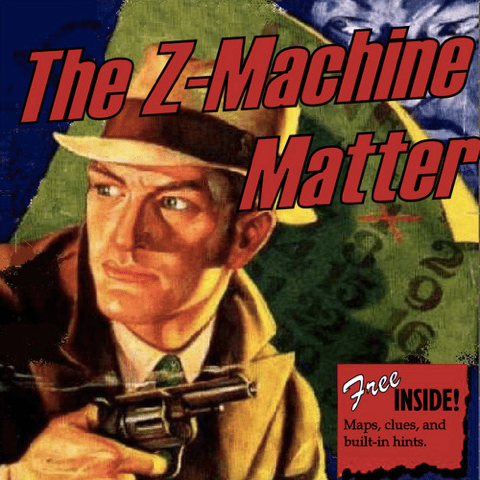
 The Z-Machine Matter is classic mystery IF with a locked house and a set number of suspects. Moderately spoilery comments follow the break.
Category: interactive fiction
Introcomp 2011: Stalling for Time

 Stalling for Time is an Introcomp 2011 game about a cross-country trip with your uncle Ted and his Japanese friend Kenji. Brief, not especially spoilery thoughts follow the break.
More Introcomp Reviews
To the best of my knowledge the blog Forty Two Hooks is not currently syndicated to Planet-IF, but it’s currently running Introcomp reviews as well.
Introcomp 2011: Chunky Blues

 From Introcomp 2011, “Chunky Blues” is a noir mystery set in the town of Bleakton, MA, with some pleasingly innovative puzzle mechanics.
The first part of my feedback is not spoilery, and talks about the puzzle mechanics in general. Then there’s a spoiler space, followed by some more specific discussion of what I think does and doesn’t work.
Mini-Ludum Dare 27
Last weekend there was a mini Ludum Dare — an online game jam — focusing on conversational games and encouraging people to try Inform, Undum, Ren’Py, and other text-heavy engines. There were thirty entries and I haven’t tried all of them, but some thoughts on the ones I sampled:

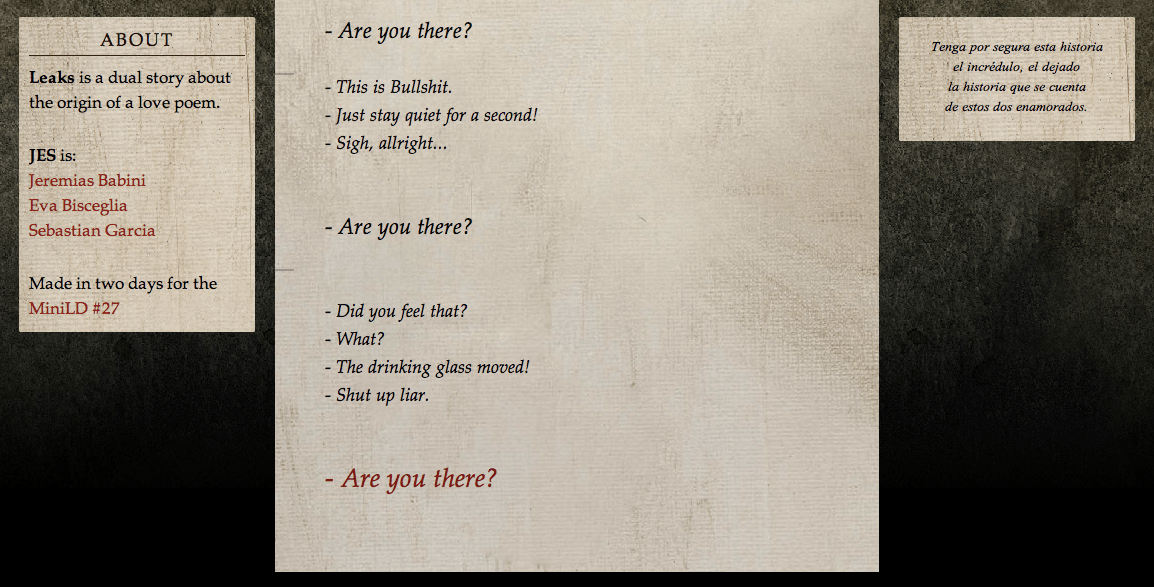
Leaks is an Undum piece that presents the backstory to a poem. Technically it’s doing something rather cool: new stanzas of the poem appear in the sidebar as the reader makes progress through the story. The story itself could use quite a bit of polish, as there are a bunch of non-native English errors, and it is initially somewhat confusing what is going on and how the different passages of text relate to one another. It’s also extremely linear. All the same, it’s an interesting example of what Undum can do with juxtaposing and reordering text. (See also The Matter of the Monster.)
Wunderkammer: The Fiction of Physical Things

Typically a shryng, or altar, was set up in the home with commemorative articles from lost family members. Typical articles were a scrap of clothing, a lock of hair, an amulet, or a favorite razor. Pictures of loved ones were rare and treasured, brought out only on these occasions… For ancestors about whom little was known, Tre-manners used a custom they called “Ricing the Soup.” The unknown relation was given attributes common to all of humanity but in such a way as to make him or her sound individual. In this way the thin back-story of the ancestor’s memory was thickened. — Eli Brown, Excerpt from the forthcoming The Feasts of Tre-Mang
The Feasts of Tre-Mang is a cookbook with real recipes from a fake cuisine and a fake history. “Pamatala Jad-zum”, or “Storm Chowder Pie”, is a seaweed-laden dish served traditionally in memory of those lost at sea, appropriate to the memorial services of the Tre-manners described above.

This interview with the author reveals an enthusiastic love of world-building for its own sake. In addition to the context-rich recipes, he has also created currency, propaganda posters, and a flag for Tre-Mang. Even though the book isn’t finished yet, the concept has already poked through into the real world in the form of a Tre-Mang evening at a local restaurant.
A History of the Future in 100 Objects is a project by Adrian Hon of SixToStart, imagining the world to come by highlighting specific items that might be invented or imagined in the future. His project is mostly to take the form of images and essays, but he has promised his Kickstarter funders a few physical rewards, including a newspaper of the future (which tells us, I suppose, that he envisions a future that includes paper-based news) and several 3D modeled objects.
Retropolis is a world envisioned by Bradley W. Schenck, built up around art and images, though the website does also feature some branching CYOA-style fiction. Even in the stories, there’s a feelies-rich delight in physicality, however: inventory items are pictured and have their own descriptions, encouraging the reader to take some time off from the narrative progression to check out the tokens that come with it. Retropolis takes the “do art for free, make your money on t-shirts” concept to the maximum, allowing you to buy everything from clocks to blank journals with Retropolis designs on the cover — it’s the most obviously merchandising approach of these three — but they include tourist postcards and similar objects that are meant to “belong” to their world of origin rather than to our world.
Continue reading “Wunderkammer: The Fiction of Physical Things”
 Emily Short's Interactive Storytelling