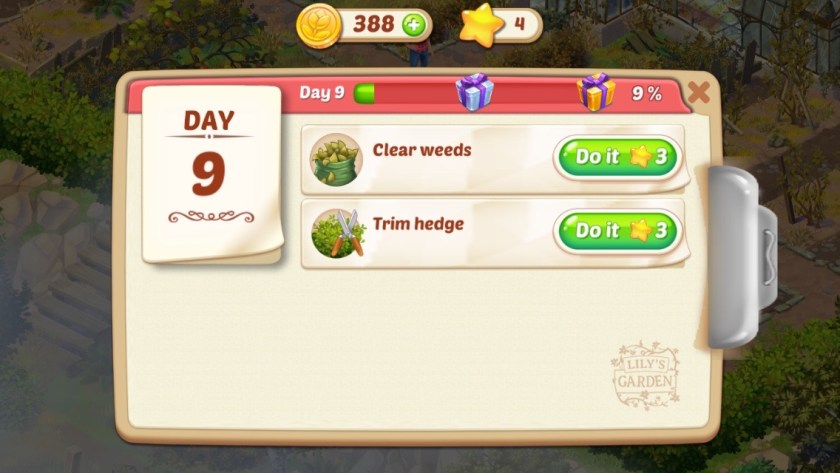
Lily’s Garden is here offering us two storylets: the story about clearing weeds and the story about trimming the hedge. Despite how it might appear, there’s actually some character and narrative advancement associated with each of these options.
A very simple implementation looks like this, interspersing every level with a little bit of story wrapper. This has been a standard method from the days of Diner Dash on:
Gating story with casual game levels
Lily’s Garden does something actually a little different, which is to let you gather “stars” by playing levels and then spend them to open more storylets. The “source” in the image below is the casual gameplay. Often, there are two or three storylets available at a time, which means you can choose which of them to play next, but you do have to finish all of the storylets assigned to a given day before moving on.
This is an effective design choice for mobile free-to-play, for several reasons.
There will be a London IF Meetup in late January, where I will be talking about narrative design with storylets; time and venue are TBD, but I will announce them via the London IF Meetup page when these are settled.
January 31–Feb 3, Ryan Veeder is running the first of three events in his Exposition for Good Interactive Fiction. This one is a short jam for Inform 7 games. There are a number of rules about how to participate, so please do check out the fine print.
February 15-16, Rob Sherman is running an interactive fiction masterclass at the British library. This is a paying event; tickets here.
The NarraScope organizers have announced that there will be a NarraScope 2020: specifically, May 29-31, in Urbana-Champaign, Illinois. Call for talks is here and the deadline for proposals is January 17.
Last year was the inaugural year for this conference, focused on narrative games from classic IF and text adventures through point-and-click adventures to VR games, interactive audio, and mobile story games, TTRPGs and LARP, and quite a bit more. Meanwhile, if you missed this year’s event, or would just like to revisit its glories, there is a new podcast, Through the NarraScope, that discusses some of the talks and content.
Competitions
If you plan to enter Spring Thing 2020, you have until March 1, 2020 to declare your intent to enter. Spring Thing is a long-running competition for interactive fiction that welcomes longer games than IF Comp can accommodate, and features a “back garden” section for games that are unfinished, commercial, experimental, or where the author just wants to opt out of the competitive aspect of the competition.
Meanwhile, Ryan Veeder’s Exposition for Good Interactive Fiction will be taking place in early 2020, in the form of three different events for different formats and lengths of game. The rules for this are fairly complex, so rather than trying to summarize, I will just point you in the direction of Ryan’s pages.
This is an overview of the IF games that worked best or meant most to me in 2019, plus a couple of bonus games that weren’t released this year but that it took me this long to play. There’s a range here — some of these are short, some are long, some choice-based, some not, some commercial and some otherwise.
I didn’t have nearly time to play everything that I might have wished to: it was a very busy year with a few especially wild months. So I didn’t play very many of the IF Comp games, or any of the EctoComp pieces, or many recent releases from Choice of Games.
I played two striking pieces by Porpentine Charity Heartscape this year.
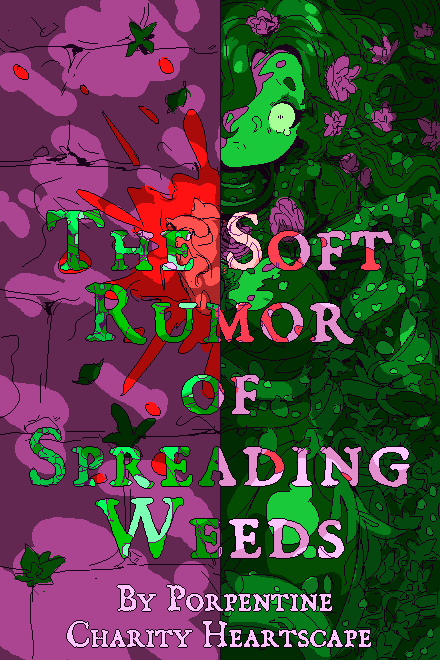
One is available to the general public: The Soft Rumor of Spreading Weeds, a companion piece to With Those We Love Alive, published by Sub-Q. This one explores what it means to be the Empress in this universe; what sort of life she has; what her cruelty tastes like.
The other was a multi-player piece, created specifically to be the keynote of an event: organized by Karlien van den Beukel, and presented to the public at the Victoria & Albert Museum in February. I was in the unique position of presenting the work — a role for which Porpentine had written specific instructions and extra text — and I talked a bit on Twitter about what it was like and how it worked. It would be impossible to capture the experience entirely in another medium or context, but this was one of the more interesting IF experiences in my life, and certainly one of the most interesting multiplayer works.
Storyscape is an app for free-to-play IF on mobile. There are a lot of these out in the world: Choices and Episode have been around for a long time, and have been followed by lots of other apps of varying degrees of quality and imagination, including Fictions, Story, Chapters (Choose Your Romance), Moments, and My High School Summer Party, among others.
In this landscape, substantially the best piece I tried was Titanic in the Storyscape app. I have not yet played all the way to the end of the storyline, but the premise and the first several episodes are by Meghna Jayanth, and they are top-quality work. Expect very non-standard characters; a setting that feels well-researched but never pedantic or onerous; and many many fun choices. Highly recommended.
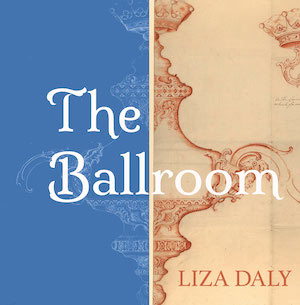
The Ballroom by Liza Daly tells its story through text that morphs as you change elements of the scenario — becoming by turns a Regency romance, a high school dance scenario, a spy thriller or a police story. It’s an elegant use of textual variation that draws on the legacy of works like Space under the Window. One of the most formally inventive pieces I played this year.
Pray to Your God(s) is a short Twine piece by Vian Nguyen. It describes an act of prayer in the author’s tradition and culture, with autobiographical details that bind it to Vian’s lived experience; but it also provides opportunities for the player to decide how they would engage with this type of ritual themselves, and asks what they might say to the departed.
Dull Grey, by Provodnik Games. Dull Grey presents the story of a young man who is deciding between two possible careers, in a state dominated by Soviet-style centralized planning.
The story presents vignettes, and then, from time to time, offers a choice — the same choice each time — about which career he would like to pursue. It is essentially an entire game that consists of one big Track Switching Choice structure. There is also a little more possibility than the game initially makes obvious.
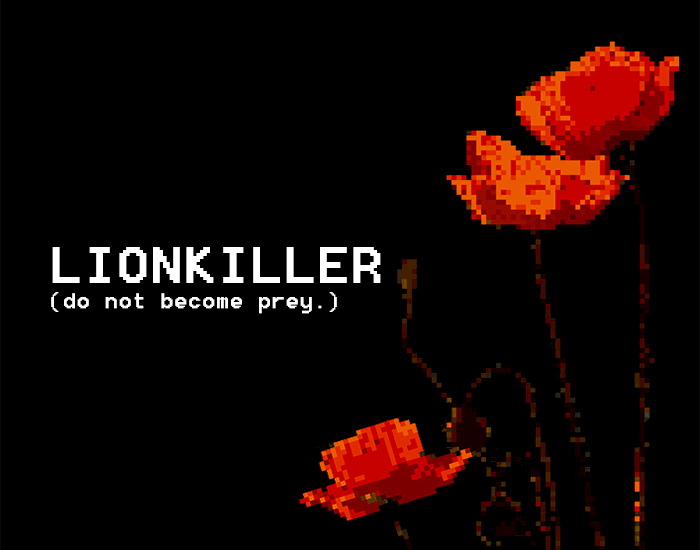
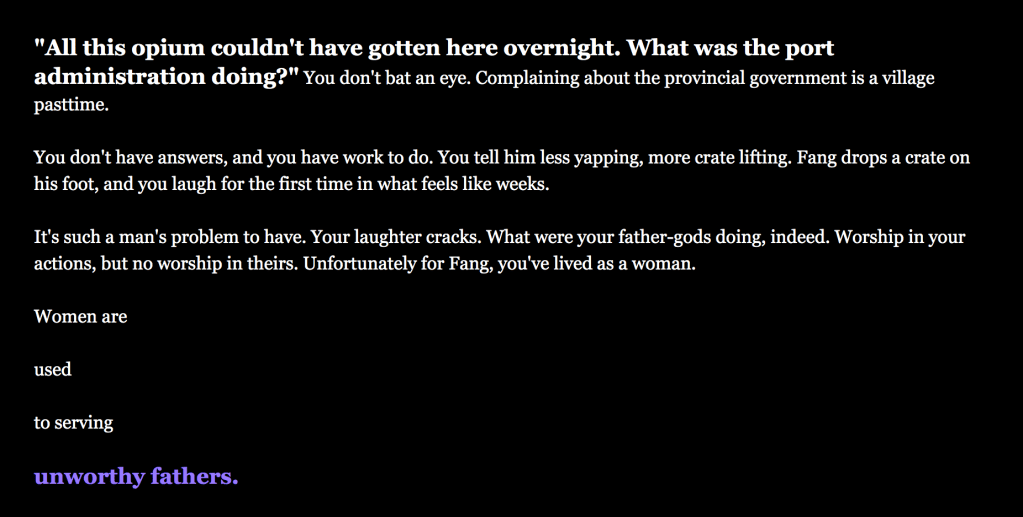
Sisi Jiang’s Lionkiller is set in China during the First Opium War. It tells the story of a woman who disguises herself as a man and becomes a soldier, riffing on the legend of Mulan. The characters are nuanced, the setting rich in detail. There is also a lesbian romance arc, at least in some versions of play.
One of the stronger pieces of IF writing I’ve encountered this year, and very much recommended.
Turandot, Victor Gijsbers. This is a ChoiceScript game but very different from anything that would appear under a Choice of Games branding: largely linear with minimal branches and no visible use of stats, it draws its inspiration loosely from Puccini’s opera of the same name, but entirely revises the plot, so that the titular princess requires Prince Calaf to traverse a death-trap-filled dungeon in the spirit of classic games (a bit as spoofed in Inhumane).
Turandot drops in quite a few references to classic IF and sometimes wanders into gratuitous in-joke territory, but the actual concerns of the piece — about agency and consent, about our responsibility for the situations into which we place other people, about the value of truth and the possibility of atonement from a position of monstrosity — are anything but frivolous, and can be read even by players not familiar with the source materials.
That said, I need to put a warning on this. There are also times when the game’s characters make mean-spirited sexist, racist, and homophobic jokes; and some descriptions of torture and incidents of dubiously consensual sex. Personally I found that the philosophical and moral argument in play made a good case for why I should encounter these objectionable elements. I know other people for whom that wasn’t the case. And I can also understand why one might not want to be exposed to those elements regardless of their reason for existing.
So handle with care.
Bonus game:
I finally got around to playing SPY INTRIGUE (furkle) properly this year. It was an amazing experience and I recommend you check it out if you haven’t gotten to it yet. My review will give you some idea of what to expect from it.
February 15-16 next year, Rob Sherman is running an interactive fiction masterclass at the British library. This is a paying event; tickets here.
The NarraScope organizers have announced that there will be a NarraScope 2020: specifically, May 29-31, in Urbana-Champaign, Illinois. Call for talks is available as well if you’d like to present.
Last year was the inaugural year for this conference, focused on narrative games from classic IF and text adventures through point-and-click adventures to VR games, interactive audio, and mobile story games, TTRPGs and LARP, and quite a bit more. Meanwhile, if you missed this year’s event, or would just like to revisit its glories, there is a new podcast, Through the NarraScope, that discusses some of the talks and content.
December 2 is the deadline if you’d like to submit a talk proposal or an exhibition piece (interactive fiction might very well be suitable) for the Electronic Literature Organization’s next conference, July 16-19 2020 in Orlando. Details of the call here.
The Oxford/London IF Meetup does not get together during the festive season, so we’ll not be together again until 2020.
The NarraScope organizers have announced that there will be a NarraScope 2020: specifically, May 29-31, in Urbana-Champaign, Illinois. If you’re interested in speaking there, the call for proposals is now open.
Last year was the inaugural year for this conference, focused on narrative games from classic IF and text adventures through point-and-click adventures to VR games, interactive audio, and mobile story games, TTRPGs and LARP, and quite a bit more. Meanwhile, if you missed this year’s event, or would just like to revisit its glories, there is a new podcast, Through the NarraScope, that discusses some of the talks and content.
New Narrative Games
Tender Claws is the company behind the amazing PRY. They have a new piece out now for Oculus Quest, The Under Presents.
Meanwhile, Choice of Games has a new line of romance IF coming out, under the imprint Heart’s Choice. The first three titles will be available on Steam shortly, and consist of A Pirate’s Pleasure, Dawnfall (science fiction), and Jazz Age.
And this one isn’t a new release, but new accessibility for old releases: David Welbourn continues to release a steady stream of verbose, friendly walkthroughs for parser IF games from the 1990s and 2000s. His walkthroughed games can be found on IFDB via the lists that he publishes each month. Recent walkthroughs include Dr Dumont’s Wild P.A.R.T.I., a formerly commercial game.
Crowdfunding
Aaron Reed’s every-version-is-different novel Subcutanean is funding for a couple more days.
Competitions and Exhibitions
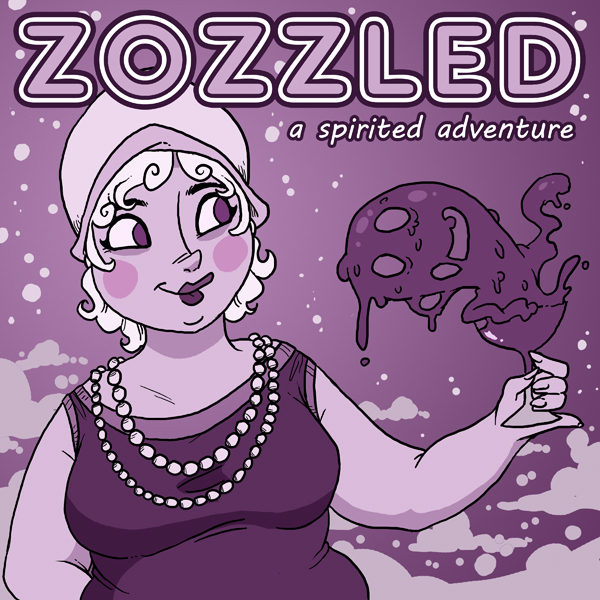
IF Comp 2019 has closed, with Steph Cherrywell winning first place for Zozzled. The full set of rankings and results is available on the competition website.
SubQJam is open now through December 16 for submissions of short interactive fiction, and winners will be featured in SubQ Magazine next year.
Ryan Veeder has announced his Second Quadrennial Exposition for Good Interactive Fiction, an event whose purpose is to create games that are pleasing to Ryan Veeder. Fortunately, Ryan’s IF tastes tend to elicit games that appeal to a lot of other folks as well. Last time around, the winner was the highly entertaining Foo Foo. As a taster of the sort of thing to expect, here is how Ryan describes his preferences:
Entrants should be advised that I like games that are funny, cute, elegant, spooky, friendly, dumb, and/or sincere. Entrants should be advised that I dislike games that are cynical, depressing, gory, horrifying, serious, and/or important.
Entries to the Second Quadrennial Exposition are due… well, at potentially several different times in early 2020. Rather than confuse matters by trying to summarize here, I refer interested parties to Ryan’s own site.
If you’re hankering to write a long game, or a game you don’t think is going to appeal to Ryan Veeder, or a game that is just going to take a bit longer to complete, Spring Thing 2020 is accepting intents from authors now, and through March of next year.
Finally, Green Stories is a competition for stories about building a sustainable future. The competition includes an interactive fiction division.
Articles and Videos
Jon Ingold talks to Meghna Jayanth about her work, the upcoming project Sable, and her presence in the game industry at AdventureX 2019.
Ed Fear talks about challenges around representation in games, and about writing gay characters in particular. Also from AdventureX. (Several other videos from AdventureX are now available as well.)
Those interested in the problems of teaching an ML agent to play interactive fiction may like these articles courtesy of Prithviraj Ammanabrolu:
https://arxiv.org/abs/1909.05398 Interactive Fiction Games: A Colossal Adventure – formalizing the task of playing text games with reinforcement learning agents, a software platform (https://github.com/microsoft/jericho) and series of baseline agents designed to play a wide variety of text based games.
https://arxiv.org/abs/1908.06556 Transfer in Deep Reinforcement Learning using Knowledge Graphs – answering the question of how well an agent can play a text adventure by learning to play other text adventures within a genre.
https://arxiv.org/abs/1909.06283 Toward Automated Quest Generation in Text-Adventure Games – looking at the other side of the problem, instead of playing a game, how can we use AI to help generate content for a game (here in the form of a quest within a given world).
Understanding how player stats map to story outcomes can be a challenge. This article looks at some strategies for simplifying and visualizing complex state spaces, including the use of ternary plots.
Last week I tweeted about the concept of narrative states and how to plot and think about them. This post is a bit of an expansion on that tweet thread. Thanks to everyone who responded there. I’ve answered some of the questions I received, and added some extra resources and images.
Suppose we have a dating sim where outcome is decided by the player’s relationship stats to three characters, and the player has loads of chances to increase relationship with any/all of them. It can be tricky to reason about the design of this.
However, we might choose to make the outcome of our story depend on which suitor we currently like best. Now we can collect a score every time we do something that indicates liking a particular character, and then calculate percentage of interest in each character, thus:
Needless to say, this value is undefined until the player has expressed an interest in at least one character. Do not divide by zero.
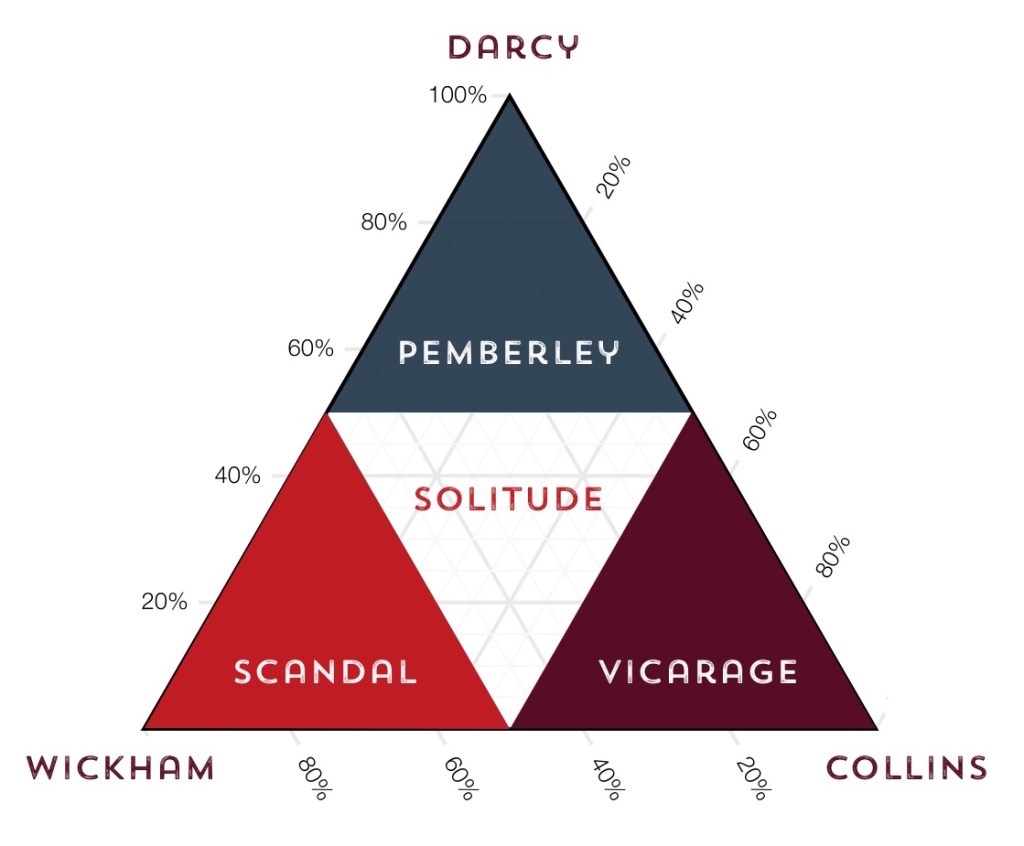
Darcy’s percentage, Wickham’s percentage, and Collins’ percentage have to add up to 100%, which means that we can plot these three variables in two dimensions, with a ternary plot. Three suitors, four story outcomes.
We have four outcomes — one for if the player is more than 50% invested in each suitor, and a fourth outcome if they’ve not given a majority preference to anyone.
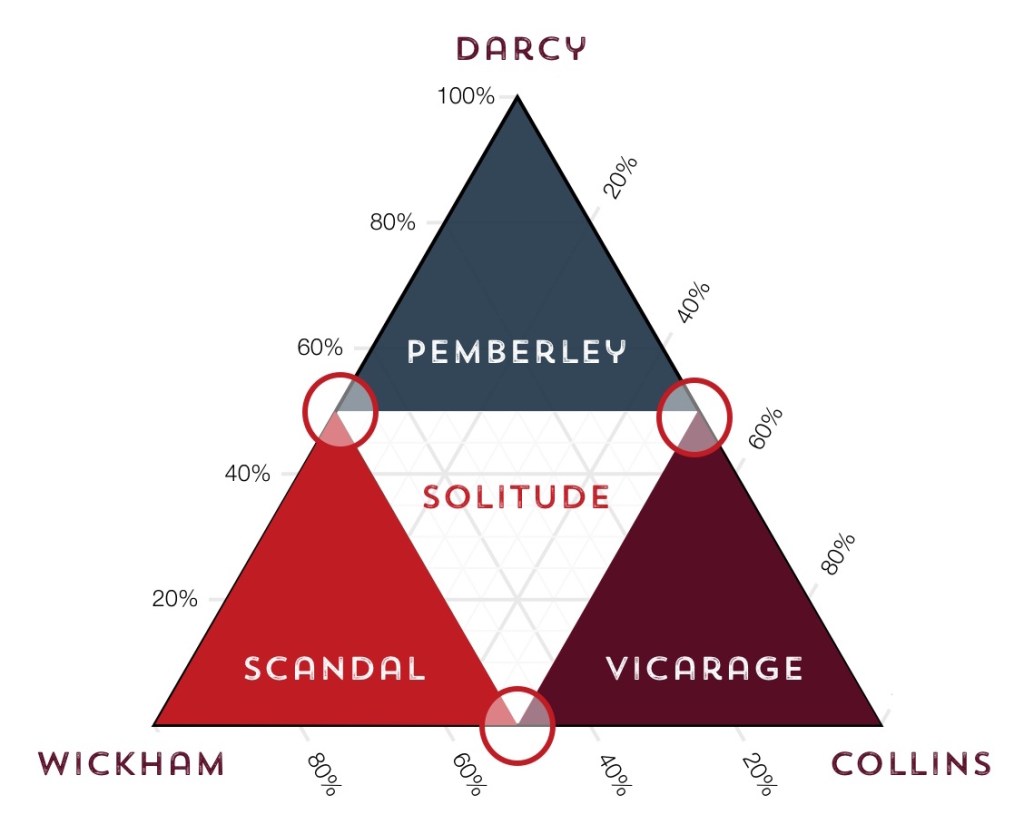
Immediately this chart shows us where the player might get confused or frustrated about why they got the outcome they did — because there are some points of really abrupt state transition.
At the corners between states, a single player action could flip the outcome to another suitor or to the solitude action. This can feel abrupt and confusing.





 Emily Short's Interactive Storytelling