On my previous post, Ron commented speculating about what has changed about IF in the last few years, and that spurred me to check a couple of other hypotheses.
(1) Slice of life games have gotten more popular in the post-2000 period.
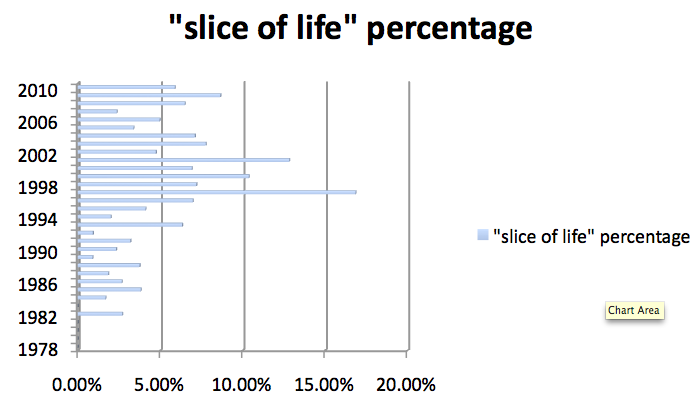
Not so much, it turns out.
I’d really love to do a full breakdown on genre percentages and see how horror, SF, fantasy, and other elements have fluctuated over the years, but that would require a Lot of Counting.
(2) Games have gotten more novice-friendly since about 2004, with more tutorials, help menus, built-in hints, maps, improved parser messages, smarter can’t-go replies, navigation by GO TO ROOM, and so on. Certainly it feels like we’ve talked a lot more in the past five years or so about how to make games accessible and reduce stuckness, and there have been a host of libraries, extensions, and goodies designed to make this easier.
But is it making a significant difference?
This one is harder to address, because there aren’t tags for most of these features. (I did go in and tag games that I know of that have included feelie maps, built-in maps inside the game, room-name navigation like GO TO THE KITCHEN, or tutorial modes, but my memory is faulty and incomplete. If other people want to go in and add their own tags, that would be very welcome.)
The one tag that is readily searchable is “built-in hints”, and it doesn’t give the results I might have expected:
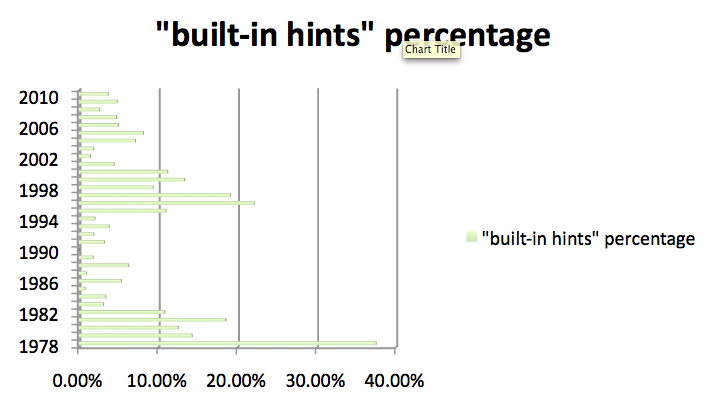
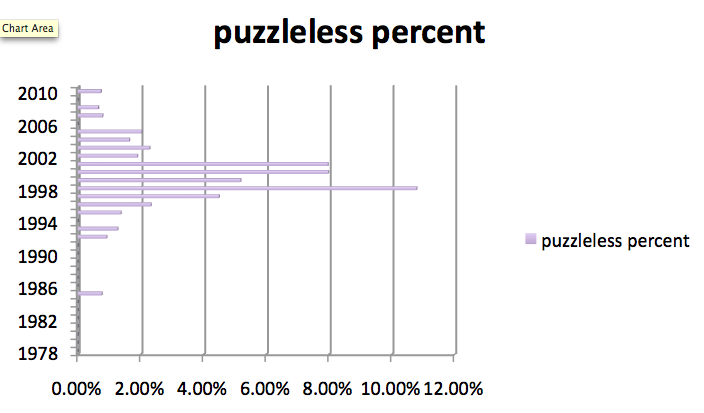
In fact, it’s a bit dippy around 1998. But wait! As we saw last time, 1998 was the year of the puzzleless-game spike. Do we expect built-in hints in puzzleless games? Probably not so much. A “Puzzleless *or* built-in hints” chart looks like this, a kind of anti-stuckness graph:

Still, even with the adjustment, it looks as though game “friendliness” or accessibility has developed in just the opposite way to what I would have expected.
This could be another sign that my expectations are just wrong, all wrong, but I think there might be some other issues.
These graphs don’t account for game length: games used to be longer on average, and therefore there was more need for built-in hints in order to get through the morass. And there are a lot of options that IFDB tags don’t currently cover, as mentioned, or don’t cover enough to be significant. For instance, several of my games don’t have built-in hints but did feature invisiclues-style accompaniments outside the game, and there are other people who have done feelie hints as well in preference to something inside the game. So I feel like we’d need a lot more tagging of various kinds to give a clear idea of accessibility features as they’ve evolved over the past few years.
Another thing this graph doesn’t deal with is the difference between major releases and trifles or toys. Speed IF isn’t likely to come with any player niceties — because there’s no time, and no one is expecting any polish. But a year with a lot of Speed IF competitions in it tends to bulk out (in a numerical sense) with dozens of tiny games that are never intended for presentation to a wider audience. Likewise, IntroComp games might reasonably be lacking the features of a full and complete release. But it’s difficult to factor out those sorts of things without a different and more sophisticated counting method.
Or, you know, I could still just be totally wrong. That’s possible too.


 Emily Short's Interactive Storytelling