Mid-September Link Assortment

IF Comp goes live in a couple of weeks.

If you’d like to submit a game for presentation at WordPlay, the Toronto word-based-game festival, you still have until September 30 to do so. Accepted pieces will be displayed to the public as part of the festival, and the creators will receive an artist fee of 80 CAD.

Community Feedback

IFTF is running a survey about how people use IFDB and how the experience could be improved. You can let them know your views at the link attached.

New and forthcoming releases

Jam City has started a new line of interactive fiction in the mold of Choices and Episode, using a model that includes pay-to-unlock premium choices, but also a subscription option. (At $2.99/week, this is a bit more expensive than Fallen London’s Exceptional Friendship, and I wonder whether people will find a weekly sub more appealing than monthly. My instinct says no, but my instinct is often wrong.)

IF author and sometimes-conference-organizer Jim Munroe has been working on a new VR project called Manimal Sanctuary. It’s pitched thus:

Manimal Sanctuary is a lurking simulator. It leverages low-end VR technology to enable every player’s ultimate fantasy: to play a creature part coral reef, part Cthulhu, who consumes human emotions. Set on the Toronto Islands after the rest of the city is consumed by gibbering monstrosities, you eavesdrop on the survivors and their dramas involving things like bad potato crops and graffiti tags. And if those everyday emotions aren’t filling enough, you can always uncover some devastating secrets…

Naomi Clark’s Consentacle is now on Kickstarter. It is a card game about consent and mutual agreement, and I would be hard-pressed to describe it more than that. If you want your own print of the game (perhaps from seeing it played at GDC, as I did), this may be your one and only opportunity.

Misha Verollet has released a trailer for American Angst, a forthcoming choice-based game:

*

A total tangent: possibly I’m one of the few people who remembers this, but did you know that well before YouTube or the current trend for trailer-making for games, there was a TrailerComp for parser-based IF. The main thing I remember is that Fallacy of Dawn had a trailer set in part to “Smooth Criminal.”

Interactive Storytelling for Video Games (Josiah Lebowitz/Chris Klug)

Screen Shot 2017-06-14 at 9.36.06 AM.pngLast seen on this blog because Chris Crawford panned itInteractive Storytelling for Video Games: A Player-Centered Approach for Creating Memorable Character and Stories.The main body text is written by Josiah Lebowitz, but with interleaved commentary and examples written by Chris Klug.

This book is aimed at relative beginners, starting with a chapter on video game history and then three more chapters on basics of story in general (a point it has in common with a few other how-to-write-games books I’ve surveyed in the past). Each chapter ends, in textbook fashion, with a short list of questions for the student to ponder for later.

And, inevitably, there is a detailed breakdown of the hero’s journey, the references to Joseph Campbell and Christopher Vogler, the examples from Star Wars. However, despite Crawford’s shade, they’re pretty up front about recognizing when they’re talking about standard tropes and clichés, and discussing them as such with the reader, as well as recognizing how those elements are most commonly applied in games. Klug makes a pitch for why the Refusal of the Call phase of the monomyth is important — something I would agree with (though grudgingly, since I wish people were in general less hung up on mapping every game to this formula). (See also Skolnick’s remarks on the Refusal of the Call.)

In some places, though, Interactive Storytelling for Video Games does get pretty dogmatic about things that I would like to hope are flexible. For instance:

…video games tend to focus on fighting and strategy, exploration, puzzle solving, or some combination of the three. These types of external conflicts are far easier to portray in a game-like fashion than the more internal emotional conflicts that are often the focus of things like romance and sitcoms. Therefore, a “proper” game story needs to support a large amount of external conflict. (44)

Continue reading “Interactive Storytelling for Video Games (Josiah Lebowitz/Chris Klug)”

End of August Link Assortment

Events

September 2 is the next meeting of the SF Bay area Meetup.

September 14, Hello Words meets in Nottingham to write IF together.

Also September 14 is the next meeting of the People’s Republic of IF in Cambridge, MA.

September 15-17 is Progression Mechanics, a Chicago-area conference on the changing medium of games and the business of the games industry. I will be speaking there.

October 14 in Dublin is a one-day course in writing for video games and interactive narrative, offered by Charlene Putney.

WordPlay, the annual festival of word-based games that came to London in 2016, is this year returning to its native Toronto on November 18. If you’d like to submit a game for inclusion, you have until September 30. Accepted games will be presented to the public, and submitting artists will receive an artist fee of $80 CAD.

If you’re going to be on this side of the water in November, you might be more inclined to attend AdventureX in London, November 11-12.

There’s one more month before IF Comp goes live: this is your opportunity to finish a game, if you’re working on one, or to contribute testing if you’re so inclined.

If you enjoyed my post about ASMR but felt that there wasn’t enough in there about, like, games, Bruno Dias pointed out this game that is about making ASMR videos.

New Releases

The Secret of the Chatter Blocks is a children’s IF piece originally prototyped in Twine but with an iOS-friendly front end.

Matthew Ritter of the Boon Hill cemetery simulator has a new game out called Dead Horizon, a short fantasy-western story paced by lightgun-style shooting matches with various villains. It’s now available on Steam and itch.io. (If you play and are curious about the backstory of this world, there’s also some extra story material available from the menu.)

Vitaly Lischenko has made an Alexa skill to play classic IF. There is a demo video and a home page/source code.

Talks and Podcasts

Jeremiah McCall sends along a podcast where he talks about history teaching and interactive fiction — “and a host of other games and history ed topics, though mostly Twine.”

The talk I gave at Gamelab in Barcelona, about AI as Uncanny Mirror, is now available online. It’s covering a range of topics: a bit about what I’m doing now at Spirit, a bit about past projects including Versu, and the ever-vexed question of trying to make AI both sentient and obedient.

Talks from the GameDevsOfColorExpo are available online now.

Also available for viewing is this YouTube capture of the Procedural Generation Workshop 2017.

Especially recommended: here’s Nicky Case with a talk on Seeing Whole Systems. Nicky is the creator of Coming Out Simulator 2014, as well as some really fascinating work on understanding complexity by creating and testing simulations. If you too are interested in the juxtaposition of procedural rhetoric and narrative (interactive or otherwise), I recommend keeping an eye on Nicky’s work — perhaps, if you’re so inclined, via this Patreon account. Further, the talk mentions a sweet visualization tool Nicky created called Loopy:

Screen Shot 2017-08-25 at 7.25.14 PM.png

Articles

Renga in Blue has covered dozens of adventure games from the 1970s — all of them, the blog claims, though it seems possible that some obscure personal experiments might have escaped this accounting — and has thoughts about them, as well as a catalog of firsts.

Cat Manning writes about constrained, limited-parser games, with special attention to Lime Ergot and Take.

cwodtke writes about some core “big ideas” in game design. If you’ve been around industry game design for a while, a number of these will be familiar, 101-level concepts, but there may be a few that aren’t; and it links on to useful further background on several.

Strange Horizons has a long-form review of the storytelling choices in the tabletop narrative game T.I.M.E Stories. And speaking of that, SH is also in the middle of fundraising to pay for its next year of operation.

Jon Ingold writes about procedurally generated artifacts in inkle’s upcoming Heaven’s Vault.

Here is an article for Topic about female mentorship pairs; one of the mentors profiled here is Liza Daly (Stone Harbor, co-creator and commissioner of First Draft of the Revolution, et al).

And here is Tuukka Ojala on what it’s like to be a programmer who can’t see.

Tooling

Adliberum is a multi-player IF engine that is also available on Steam. This is the kind of thing that I would normally want to have more of a look at; the last few weeks have been comically over-busy, though. So I didn’t. Perhaps some of you will do so!

And along the same lines, Jeff Schomay writes about the ELM Narrative engine that he’s working on:

Here are the main points I’d like to share:

  • This tool is unique in that it uses a context-aware, rules-based system, similar to what I believe you have called a salience system.
  • A great strength of this tool is that it totally separates story logic, content, and presentation, making it possible to fully customize what a story looks like, or add interactive narrative to many different types of games.  I speak of this on my dev blog, and have some nice polished playable demos showing the variety of games the same narrative system can power.
  • I have a story starter to help people get started, and I am working on a visual editor with an exportable story data file as well.
  • I recently created an interactive story structure visualization tool for the unique graph-style nature of stories made with this tool.

You can read more about the tool at my dev blog. http://blog.elmnarrativeengine.com/, including a post on why I made this tool and what makes it unique, per your suggestion.

Other

A longtime friend writes about viewing the totality of the eclipse (which, being in England, I did not get to do); and in recollection of his father, one of the first science teachers in my life.

Mid-August Link Assortment

IF Comp intents to enter are still open through the beginning of September, so if you’d like to write for the comp this year, you can sign up.

August 14-17, Cape Cod, MA is the Foundation of Digital Games conference, including a workshop in procedural content generation.

August 17 is the next meeting of the People’s Republic of IF in Cambridge.

WordPlay, the annual festival of word-based games that came to London in 2016, is this year returning to its native Toronto on November 18. If you’d like to submit something, you have until August 25 to propose a talk or workshop, and until September 30 to submit a game.

New Releases

Mid-September, Anya Johanna DeNiro is releasing A Bathroom Myth, a story whose proceeds will go to the Transgender Law Center.

Elizabeth Sampat has written 8 Vignettes from the Tech Industry, a Twine piece about her reactions to the recent leaked Google menu about the role of women in tech.

Nanobots is a Twine anthology based on the They Might Be Giants album of the same name. It is still seeking entrants to cover some songs, but others have been filled in; for instance, zarf has contributed Nouns.

Joey Jones’ Choice of Games piece Trials of the Thief-taker is now out. Joey is a participant in the Oxford/London IF meetup and the author of a wide array of parser IF; this time he turns to a choice-based historical about being a sort of bounty hunter in London before there was such a thing as an organized police force. I’m completely a sucker for historical IF, especially when it’s supported by some loving research, and we had a good time playing an in-progress version of the game many months ago. I’m looking forward to seeing how the finished version came out.

Xalavier Nelson, Jr. (of SCREW YOU, BEAR DAD among others) has released Replacement, a Twine anthology about body modification. The portion I’ve read so far is quite linear, using links for pacing and to dramatize the text in dynfic fashion.

Introcomp games became available this month; there are eleven unfinished entries of various kinds of IF, and the aim is to vote on which pieces you’d most like to see made into a finished project. Introcomp is also an opportunity for authors to get feedback on works in progress, so responses from reviewers are especially valuable here.

Paying Work

Choice of Games has started a new, romance-specific line of interactive novels, called Heart’s Choice. This is the first time CoG has branched out genre-wise beyond their Choice of / Hosted Games distinction, which is more about quality and brand-adherence guarantee than anything else. The Choice of series contains a number of different genre titles, including romance but also superhero stories, fantasy, science fiction, thrillers and adventure of various types. I’ll be particularly curious to see how their structural requirements change (if at all) to support narratives that are more about relationships rather than the development and expression of an individual protagonist’s powers.

See their description of the line for more information about what it is and how to pitch for it.

Worth Reading Elsewhere

Sam Kabo Ashwell has a detailed writeup of the story-focused board game T. I. M. E. Stories, which I’ve been wanting to play for a while and just haven’t had time for yet.

Also on Sam’s blog, this writeup of Inheritance, a Viking-themed LARP that sounds pretty engaging.

Timothy Samoff has written a masters’ thesis about the use of real-time mechanics in IF, taking examples from 80 Days, Breakers, Border Zone, The Martian, and others.

Digital Antiquarian has been doing a fascinating sequence on game development in the USSR, including the saga of how Tetris came into being, and what happened afterward.

And here’s a history of the writing of Tales from the Borderlands. From those who were around at the time. TftB is one of my favorite Telltale experiences.

Procedural Generation and AI Topics

Using Electricity is a collection of computer-generated works, mostly poetry, edited by Nick Montfort.

Been Kim gave a talk on interpretable machine learning: how do you make the system’s decisions comprehensible to human onlookers? I didn’t see the talk itself, but the slides are easy to follow.

IntroComp 2017

IntroComp is a yearly IF competition for just the beginnings (or, in this case, just an excerpt) from a longer work, allowing authors to test the waters and get feedback about how well their concept is playing. You too can participate, if you wish, by trying out the games and then voting before August 31.

Of the intros I’ve had time to sample, these are the ones that most intrigued me:

Onna Kabuki by Victor Ojuel had the best story hook of the intros I tried: a protagonist with a clear identity, in a dire situation, with lots of reasons to have strong feelings about what happens. As the name suggests, this piece is set in Japan, among warring nobility and traveling monks. In parser IF, feudal Japan is a rarely used setting with just a handful of examples.

The implementation was a bit rockier, unfortunately: I several times got the game into a state that didn’t seem to be anticipated, and in one case that prevented me from making progress at all and I had to restart.

So the introcomp version is not in a very high-polish state. But fans of Ojuel’s historical settings and large-scale plot concepts will probably share my interest in seeing this finished and more deeply tested.

Meanwhile, for mechanical inventiveness, two contenders:

The Adam and Eve Project by Brian Kwak (How to Win at Rock Paper Scissors, among others) is a dual-protagonist game with the option to switch between viewpoints and command either PC. This is an intriguing approach for parser IF, allowing for characters who describe the same environments in different ways (Suspended, ExhibitionCommon Ground) or who have to collaborate somehow using different powers or tools (Max Blaster…, the Earth and Sky series). In this variant, the protagonists are in constant communication after the very beginning of the game, so you always have the other character commenting on what you run into.

Continue reading “IntroComp 2017”

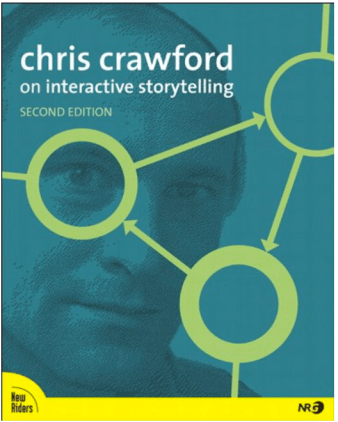
Chris Crawford on Interactive Storytelling, second edition (Chris Crawford)

Screen Shot 2017-06-04 at 10.07.49 PMChris Crawford on Interactive Storytelling (Chris Crawford). Long ago, I wrote about the first edition of this book. Since then, I got to know Crawford a bit, and attended one of his Phrontisterion sessions; he solicited IF community input on a second edition; he kindly sent me a review copy of the second edition, but I was too busy to get to it (this feels like my permanent condition of existence); I then failed to write anything about the second edition. I also wrote recently about Chris’ Encounter Editor project. But now, as I’m going back and looking at the variety of writing available on this topic, I’ve taken that review copy down so I can finally do what I should have done a couple years ago. Apologies, Chris.

In the interests of getting a fresh perspective on the book, I have read it without referring back to the first edition or even rereading my review of the first edition.

This lead to some thoughts like: was this in the first edition? I don’t remember it from the first edition. I feel like I would remember if I’d read this before:

“Your designs should aspire to the ideal of metaphorically having sex with your users.” (37)

especially as it is followed a few pages later by

“The overall quality of an interaction depends on its depth as well as its speed.” (40)

But these moments aside, the second edition is — as I remember from the first — opinionated, sometimes correct and insightful, but also at times reductive, patronizing, or willfully indifferent to work done outside his own sphere. Crawford is passionately committed to the procedural power of computers, and so pays even less attention than usual to related art forms like immersive theatre, tabletop RPGs, LARPs, or other rules-based interactive story structures. Indeed, he thinks that if you don’t share his emphasis on procedurality, you don’t belong doing computer-based interactive storytelling, or you are, in his words, “prostituting your Muse.”

He also doesn’t have much time for standard video games and largely ignores their contributions. Unlike many of the other contributors to the advice-for-interactive-writing genre, Crawford is no longer actively engaged with the game industry and has no interest in perpetuating industry norms, outfitting readers to become professional games writers, or staying on good terms with potential employers. He sees himself rather as a prophet unappreciated in his own era, a quixotic seeker who may not have time to find what he’s looking for before he dies, and his aim is rather to inspire and instruct the next generation on a quest for the holy grail of storytelling. He tends to assume that the reader of his book is technically very ignorant, and talks down on a regular basis, including little admonitions to get over one’s fear of elementary algebra, even if one does not in fact experience such a fear. And his view on women, expressed at several points in the book, is that they are socially gifted but nervous of math and possibly logic in general; and will need to be bucked up a bit in the numbers department in order to make the contribution to interactive storytelling for which they are otherwise destined.

At the same time, there is much that I recognize. Chris shares my own desire for a future of interactive storytelling full of dynamic, persuasive characters who react to the player in rich ways. In that pursuit, he’s brought passionate commitment and dedication over the course of decades, and made many attempts, both paid and unpaid, to build what he wants to build. We are very different in temperament, style, and our approach to projects. But the purpose that underlies this book speaks to me much more than the purpose underlying a lot of game writing manuals about how to keep your game cheap and appeal to the broadest audience. The latter considerations are valid, to be sure, but I wouldn’t be in this business in the first place if it weren’t for the thing I want to achieve.

So I read through a haze of mingled familiarity, sympathy, and exasperation. I don’t think any of that reaction will surprise Crawford himself: the review copy is inscribed to me with a wry note acknowledging both my help and the fact that the finished product isn’t likely to be universally pleasing to me. Here is what I found.

Continue reading “Chris Crawford on Interactive Storytelling, second edition (Chris Crawford)”