Necklace of Skulls, The Sinister Fairground (Cubus Games)

cubusCubus Games is a maker of gamebook apps, and they have released a version of Necklace of Skulls by Dave Morris as well as a game called The Sinister Fairground.

In both cases, I felt that the UI was a bit clumsy and a bit unpolished, compared with the sleekness of 80 Days and inkle’s other work, or the splashy dynamism of Tin Man Games’ Appointment with FEAR. When you encounter new objects in the text — things that you might write down as keywords in a paper gamebook — you have to tick off a checkbox to acknowledge them as part of your inventory. I didn’t realize this in my first playthrough of Necklace of Skulls and got really confused about why I seemed to be missing objects that the text said I possessed; and indeed it’s not quite clear to me why it’s useful to make the player do this.

Along the same lines, the navigation through the helper pages for Necklace of Skulls (map, items, journal, checkpoint, table of contents) had me thoroughly confused and tapping in circles: there isn’t a clear hierarchy of how these pages relate to one another, and the icons and back buttons don’t all do quite what I would have expected.

Continue reading “Necklace of Skulls, The Sinister Fairground (Cubus Games)”
Loose Strands (Darned Sock Productions) and Mapped CYOA

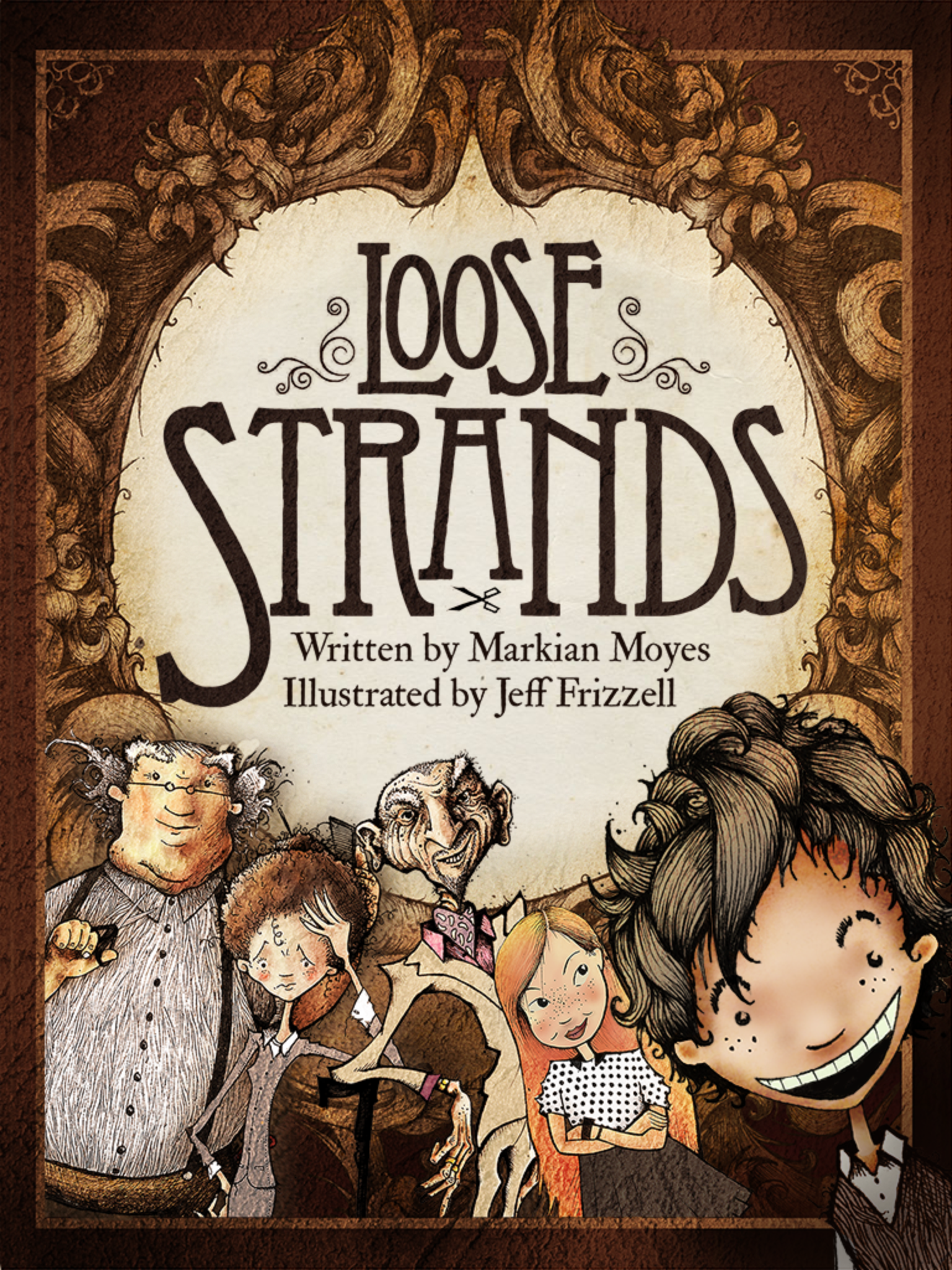
coverphotoLoose Strands is a choice-based interactive story app for kids ages 9+. It tells the story of Roland Bartholomew Dexter the Third, a boy who lives in an impoverished barbershop and is never allowed to go outside. His parents fashion clothes and even food out of hair leavings. Since he can’t go outside to school, he reads books about history and dinosaurs and airplanes, but these books have been so rigorously censored that they aren’t much fun. It never seems to be his birthday.

The only bright spot, if you want to call it that, is that Roland has unusually vivid dreams about the might-have-beens, the things that would have occurred if only he’d made a different decision from the one he did take.

Loose Strands is a story about regret: about being debilitated by the desire to erase the past, or, conversely, plagued by the inability to learn from our mistakes. It handles this with a kind of Lemony Snicket gloss. The villain is cartoonishly evil, the world a fantastic rendition of a totalitarian dystopia. The characters are charming, but not enormously nuanced. Now and then the narrator addresses the reader in a condescending Let Me Tell You About The World fashion, and the pacing around the end of part 1 felt a bit slow to me. Nonetheless, it’s a story about the nature of choices that makes a strong use of the choose-your-path structure.

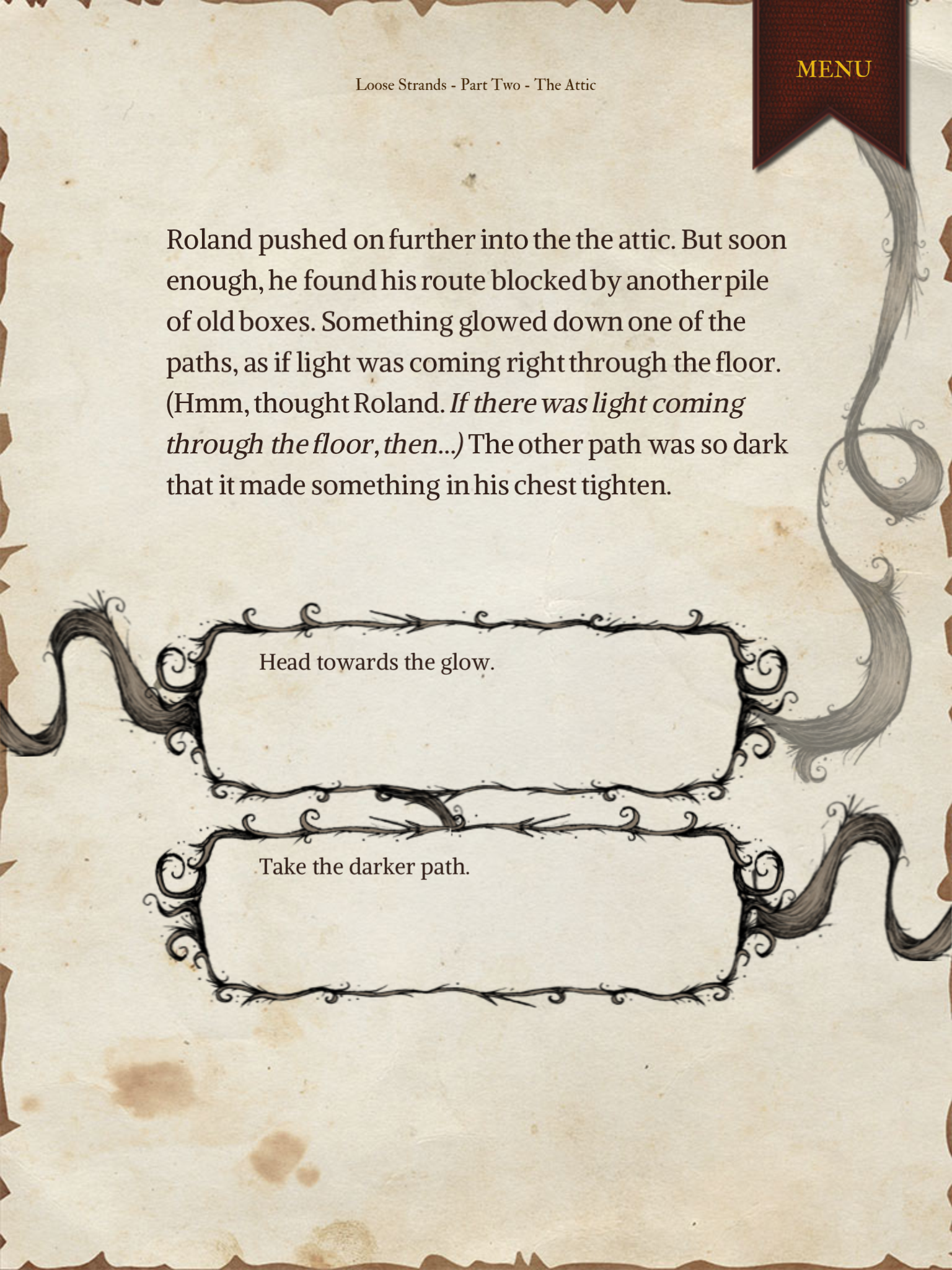
Whenever you get to a choice point, you can swipe the page in one of two (or occasionally three) directions in order to proceed to the next portion:

choicephoto

And when you’ve made a choice, the book immediately zooms to the overall story map and blacks out a bunch of spots — showing you how your decision has prevented you from ever seeing certain possible futures. It’s partly a reminder that what you do matters, a “Clementine will remember that” tag — but it’s expressed in an explicitly negative way.

Loose_strands_photo

Likewise, you can sometimes use the map to go to an earlier page, but if you’re trying to rewind too much, you’ll get a message saying you’re not allowed to go back.

Continue reading “Loose Strands (Darned Sock Productions) and Mapped CYOA”

80 Days (Meg Jayanth / inkle )

4_travelling-ferry

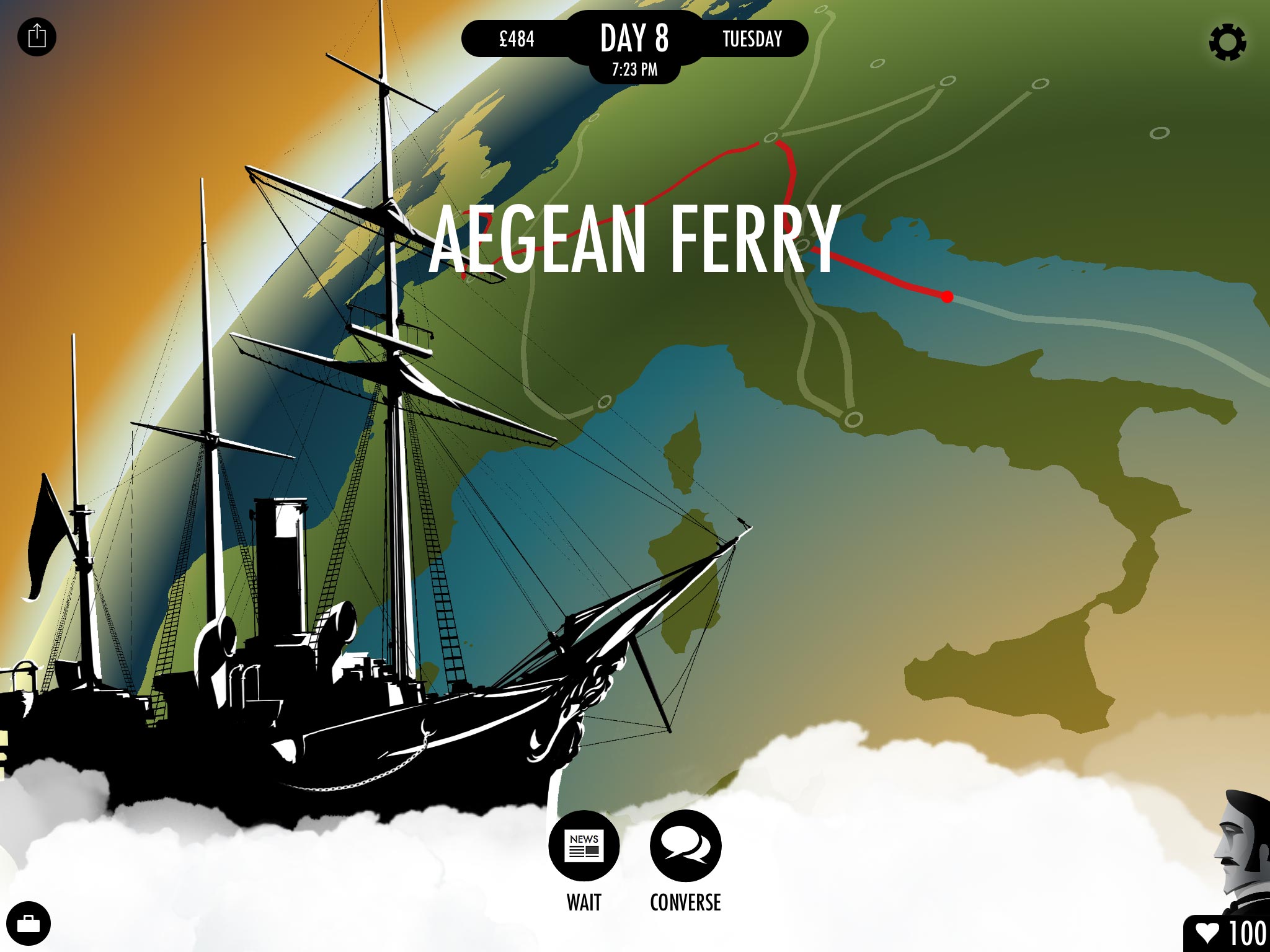
80 Days is a gorgeous iOS game from inkle studios and a script by Meg Jayanth, who (among other things) did the StoryNexus Samsara project. 80 Days takes off from the Jules Verne novel about Phileas Fogg’s round-the-world race; but it adds steampunk elements to the setting (I realize that some people feel about steampunk the way I feel about zombies) and allows the player to set the route, casting him in the role of Fogg’s valet Passepartout. Different routes take different amounts of time and have different costs associated with them; money and health are both resources that must be replenished periodically. The player can also buy (or more rarely acquire through narrative events) various inventory items that make the trip more comfortable, reveal new routes, or sell for fantastic profits in distant cities. It’s also slightly more constrained than the big open map might initially make it seem: you can’t really backtrack in some cases, even if there’s a nominally valid route in a particular direction and even if you the player think it would be a good idea.

Continue reading “80 Days (Meg Jayanth / inkle )”

Hide&Seek: Tiny Games Kickstarter

Screen Shot 2013-04-09 at 3.35.17 PM

Tiny Games is a Kickstarter-funded app offering rulesets for dozens and dozens of short, simple games, designed for a variety of social situations: games to play at the the pub, on the train, in your living room. Hide&Seek has years of experience doing installation-style games at museums and festivals, including the very cool Searchlight game demonstrated at the GDC Experimental Games Workshop this year. The Tiny Games collection includes work by a long list of well-known experimental game designers.

I’ve enjoyed all the Hide&Seek work I’ve encountered, and I especially like the playfulness of this concept, as a source of social lubrication and fun when no one happens to have a pack of cards or wants to commit to a playthrough of Arkham Horror. Or you just want to do something new.

There are only a couple of days left on this project and it’s still shy of its funding goal, so if it sounds like something you might be interested in, check it out.

Future Voices (inkle)

Future Voices logoFuture Voices is an iOS-based anthology of eleven CYOA stories from inkle, culled from an open competition. As one might expect from inkle’s work, it’s an aesthetically pleasing object: it uses Frankenstein’s imagery of pieces of paper being attached to the end of an ongoing, developing story. Proofreading is not flawless — I ran into a handful of typos here and there — but this is a fairly rare problem, and overall the app is an elegant-looking piece of work, tactile and classy.

I’m also delighted to see someone running with the concept of anthologized interactive narrative: curating and promoting the best material from the wide variety of freeware is still a really useful role for publishers or publisher-equivalents. And I gather that the competition leading to this anthology drew work from a wide range of authors, some of whom had no previous experience with interactive writing.

Continue reading “Future Voices (inkle)”

CIA: Operation Ajax

CIA: Operation Ajax is an enhanced graphic novel about the 1953 coup d’état in Iran, engineered by the CIA and British intervention.

The story is compellingly told, with the clear intent of both teaching the reader something and establishing a particular attitude towards what happened. CIA: Operation Ajax works to establish its credibility. It is thorough — it runs about a dozen chapters and took me multiple hours to read; this is not a brief pamphlet, and to lay out a story about 1953 it starts with originating events in 1908 and works its way forward. There are also a number of supporting documents that are embedded in the story or accessible through supporting menus. In some panels, a star appears — a kind of visual footnote marker, which will bring up citations or background articles for claims that the story is making. And yet this is also not a documentary. The choice of dialogue, the manner of drawing, the narrator’s plainly expressed horror and regret about what happened, all convey an unmistakable attitude towards events, and the final chapter drives home the point that the effect of American intervention was to destroy a democratic government and create significant future problems in the region.

The production values are extremely impressive, and it makes the most of the idea of a computer-aided comic format: panels slide in and out of frame, speech bubbles pop up and disappear, characters shift positions; but the comic book metaphor never drops away entirely, and the screens never cross the line into the territory of animated movie. The only exception is that old newsreels are embedded at intervals, documenting events such as the arrival of Mossadegh in New York to speak to the UN. There are no voiceovers, but background sound effects and music do a great job of establishing mood. I would suggest being sure to read with headphones or somewhere where you can afford to leave the sound up.

By the standard of most things I review on this blog, CIA: Operation Ajax is only very barely interactive at all. You can tap to advance the story; you can tap stars or look through the character roster to bring up supporting evidence. The affordances are roughly equivalent to turning pages or flipping to a set of end-notes in a conventional book — and if accessing notes is less annoying in this format than it would be on paper, conversely you’ll be tapping to advance many more times than you would turn pages under ordinary circumstances, just because of how many different frames there are. There’s too little connection between reader actions and story events to establish a sense of complicity in what’s happening, much less to leverage some of the more difficult and complex player/story relationships we see in interactive narrative. So I’m not convinced by some of the more breathless blurb-writing about how it represents a revolution in interactive storytelling. What it does do is present a fairly uninteractive story in a very memorable and compelling form.