Fast-Paced Parser Games

Most parser games tend to keep a pretty stately pace, allowing the player to move around and explore, and only ratcheting the plot forward in response to player actions. There are exceptions, though: a handful of pieces describe a world already and continuously in motion, or cut rapidly from one scene to another with just a few moves in each — presenting an experience paced more like a film than like Adventure.

Quite a few of these are by J. Robinson Wheeler, which is unsurprising given that that style is a bit of a specialty of his (perhaps reflecting the fact that he’s also a filmmaker and takes a cinematic approach to his IF stories).

moonbaseMoonbase Indigo, J. Robinson Wheeler. Inspired by Moore-era Bond, with a lot of the tropes you might expect in that context.

Centipede, J. Robinson Wheeler. A Starship-Troopers-esque reinterpretation of the classic arcade game.

The Tale of the Kissing Bandit, J. Robinson Wheeler. Playful, lightly romantic.

Being Andrew Plotkin, J. Robinson Wheeler. If Being John Malkovich where about zarf, instead. There are a fair number of community and classic IF in-jokes in this one, but also some entertaining riffs on different narrative styles.

Everybody Dies, Jim Munroe. Touches of both realism and mysticism, together with some excellent illustration.

Guilded Youth, Jim Munroe. Told through a series of vignettes that take place both on and off-line.

Dial C for Cupcakes, Ryan Veeder. There are some puzzles in this one, but also a fair amount of scene progression. As is typical for Veeder’s games, the puzzles are not tremendously hard.

Attack of the Yeti Robot Zombies, Øyvind Thorsby. The conceit of this game is that you’re meant to play once and never undo. If you commit to an action, you’re stuck with it.

Andromeda Dreaming, Joey Jones. Most of the games set in Marco Innocenti’s shared Andromeda world are fairly puzzle-based, but this one focuses more on an unfolding story.

If this sort of thing interests you, see also: IFDB poll for Autonomic Narration (where you can also add your own suggestions).

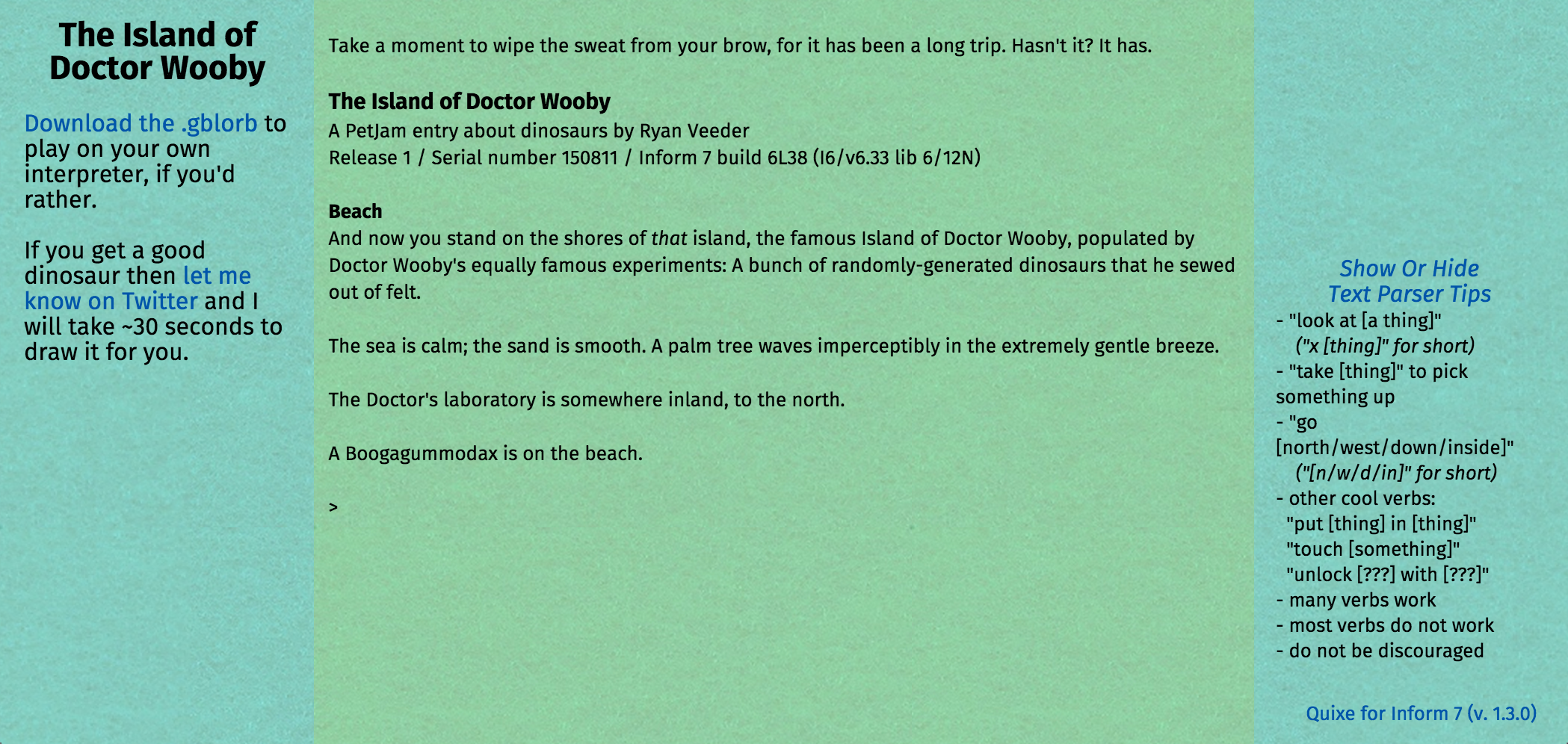
The Island of Doctor Wooby (Ryan Veeder)

Screen Shot 2015-08-17 at 1.44.37 PM

All around you, huge white ribs slice out of the ground like angry grabbing chthonic fingers, and from the center of this ossified ampitheatre a colossal pointed skull looks up at you with toothy indifference. This is a macabre location.

The Island of Doctor Wooby is a short, friendly piece of parser IF, with the chatty narrator, solid parsing, and lightweight puzzles familiar from a lot of Ryan Veeder’s work. It’s somewhat shorter than Dial C for Cupcakes and probably a bit easier than Nautilisia. The premise is that you’re exploring a toy-like island covered with felt dinosaurs sewn by Doctor Wooby.

As for the dinosaurs, their names and characteristics are procedurally generated, giving them different colors of felt and different physical attributes, as well as a range of cute behaviors. You can pet them, feed them, and interact with them in a few other ways — which makes sense considering that Island of Doctor Wooby was an entry in PetJam.

Several of the puzzles turn on recognizing that you’re dealing with artificial things rather than real ones, and therefore you can deal with them differently than you might initially have expected. The game acknowledges its own status as an artificial construct, too:

The sand isn’t diggable in this game. This may be because its components are too securely joined. Maybe it is intended to be a sympathetic character, and digging it would violate the contract of nonviolence implicit in this game’s player-parser relationship. Or perhaps “digging a sand” is just bizarre concept.

In one spot, a river scene is described as “Edenic”; elsewhere, a description of a garden is supplied by a substantial quote from Paradise Lost, though the things described in the quotation are of course not really present, and an attempt to interact with them provokes a disambiguation asking if you’re referring to “the literary flowers”. The setting is thus both childlike and prelapsarian, and yet neither the felt nor the poetry is quite real. In this respect it’s a little reminiscent of Delphina’s House, though DH allows the player to swap between realities rather than making them simultaneously present as Veeder does.

Ultimately the effect of all this remains primarily playful. Gentle, charming, took me about 10-15 minutes to play.

Riddles and Madlibs UI: Blackbar; Interactive Sexy Story

blackbar-large-1

Blackbar is an interactive puzzle story, for various mobile platforms, about censorship: you see one side of a correspondence, and must guess the missing words in order to move forward, as the participants try to communicate through the filter of an oppressive regime. It got a reasonable amount of enthusiasm at the time, and appeared on some top-ten lists for 2013.

screenshot-2-3.5-outlinedI have to confess that I went to a walkthrough for some of the later puzzles. One of the issues with riddle-style puzzle design is that it isn’t very explorable: you either have that flash of understanding or you don’t, and if you are thinking along the wrong lines, it can be very hard to get back on track. A few of the puzzles in Blackbar are divided up into components that you can try to solve individually, which moves it more towards crosswords territory — you can figure out some bits, get confirmation, and then use that to work out the parts you don’t understand — but others aren’t as friendly.

I also thought there wasn’t all that much to the story when it was all stitched together. Others described its storyline as Orwellian and said that it critiqued censorship, but that critique mostly boils down to: “Censorship. It’s bad.” Orwell made points about how controlling language ultimately means controlling thought, as sophisticated arguments become impossible to form. Blackbar is more about goofy ways to try to get around the censors, and casts the censors themselves as pretty incompetent. Surely a censor who really wanted to suppress information would black out more at a time, leaving us with puzzles that were harder to solve. Still, it was entertaining and competent and lots of people had fun with it.

I was reminded of Blackbar again recently because, while I was looking for a completely different thing, the iOS app store recommended Interactive Sexy Story, a free to play app with in-app purchases. I downloaded it as a piece of potential kusoge, and I was not wrong.

Continue reading “Riddles and Madlibs UI: Blackbar; Interactive Sexy Story”

Scroll Thief (Daniel Stelzer)

scrollthief

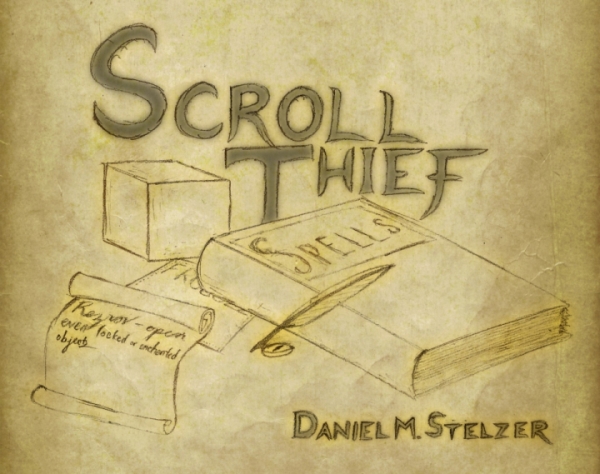
Scroll Thief is a game by Daniel Stelzer, set in the Zork/Enchanter universe, though with significant nods to Colossal Cave as well. It’s a puzzlefest built around the same magical spells that appear in the Enchanter series — gnusto to copy things into your spellbook, frotz to make them glow with magical light, blorb to enclose them safely in a strong box, rezrov to open and untie things — to which Stelzer has added a couple of “metamagic” spells, including the lleps reversal-spell from Balances and another spell that strengthens the effect of a given casting. Stelzer released Act One of the game in IntroComp 2014. (My review at the time.)

Meanwhile, though the spells may be ones we’ve mostly seen before, they’re generally being used on situations that we haven’t. The resulting puzzles do well (or at least, did for me) on the originality and explorability axes. Some take longer than others to work out, and for one or two I needed the hints; on the other hand, others are made easier because they have multiple solutions involving different spell combinations.

To make the exploration more fun, Stelzer provides a number of good easter egg responses for using the spells in unusual places or unexpected ways. There are also a lot of nods to IF community figures and institutions, including what I take to be a reference to ClubFloyd and NightFloyd. In keeping with the Infocom originals, the author has provided invisiclues-style hints which you can highlight to view solutions; these are of course themselves full of misdirections and red herrings.

At the same time, Scroll Thief sets itself apart from its predecessors and inspirations with an expanded role for NPCs, especially the Adventurer from Colossal Cave whom you can summon into your world. Your initial interactions with him are quite manipulative (and you really have no opportunity to make them otherwise), but later in the game it becomes possible to treat him more as an equal, someone you can talk to and do favors for. The bird and the snake from Colossal Cave get cameo appearances, and with judicious use of spells, you can get the bird’s insights into its situation. Then, too, the game’s setting gives more time and attention to the training of novices and the organization of the community of spellcasters, making it less a world of lone heroes and more a world of collaborative effort — a point that becomes particularly clear at the transition to Act II.

The result is less lonely and more focused on interpersonal (or inter-creature) connection than the original games — in a lightweight way reminding me of the transition in Endless, Nameless from a puzzle-oriented model to one where NPC conversation is possible.

The game’s story is not complete in itself. Scroll Thief contains two acts of a longer story, which promises to be a trilogy. The end of Act II introduces a mechanic from Spellbreaker which I would enjoy seeing explored further, so I look forward to the next chapter.

Scroll Thief is certainly possible to play with only moderate knowledge of the source material, but I wouldn’t give it to someone as one of their first encounters with parser IF. Technically, this piece is doing some very challenging things — viewing from one room into another via magical scrying glasses, tying ropes to objects, ordering NPCs around from a distance, and other tasks that justly give parser IF authors pause.

A huge amount of work has gone into making this complicated world model easy for the player to manipulate, and providing hints when some unusual bit of syntax is required. The world model works smoothly most of the time despite the difficulty of what it’s trying to accomplish. But the parsing involved in issuing commands and viewing things from a distance is still sometimes tricky to deal with. When scrying, for instance, LOOK IN SPHERE produces a disambiguation about what you want to look at while LOOK INTO SPHERE actually gives the desired room description of the thing on the other side. In other places, it can be necessary to run through several variant phrasings (ASK ADVENTURER ABOUT HELP vs ASK ADVENTURER FOR HELP, e.g.) in order to land on the one that will work. I ran into a few snags that meant I had to look for hints on puzzles I would otherwise have been able to solve on my own. However, Stelzer is releasing new updates rapidly, so it may be that these issues will be less of a concern in a couple of weeks.

And one more thought on the puzzles, post-spoiler space:

Continue reading “Scroll Thief (Daniel Stelzer)”

IntroComp 2015

IntroComp is a yearly IF competition which invites participants to send in the first part of a game. Judges vote on how much they would be interested in playing the rest of the submitted game, and authors who finish and release their pieces within a year are eligible for a prize based on where they placed. The games for 2015 are currently available, and judging is open through August 21.

Below, thoughts on the pieces I ranked highest.

Continue reading “IntroComp 2015”

Delphina’s House (Alice Grove)

delphinaDelphina’s House is another of several ParserComp games that I didn’t have time to get to while the competition was actually in progress. It was widely liked by the comp judges, and came in 3rd overall and 2nd in the technical category. It’s the story of an imaginative little girl who is performing a sort of treasure hunt (mostly of the imagination) before moving out of her house for the last time. I found this premise mildly charming but not all that gripping; I was more interested in the puzzle construction, which was effective.

The core mechanic centers on shifting from one universe to another: an object that appears as tiny jinglebells in one imaginary universe might appear as a collection of marbles in another, for instance. This is strongly reminiscent of Dual Transform, but whereas Dual Transform requires you to move through and understand all its spaces, Delphina’s House uses the transformation strategy to make its game more forgiving. There are three major puzzles, each of which can be solved in any of the three universes: you can pick which variation you find easiest and solve it there.

Continue reading “Delphina’s House (Alice Grove)”